

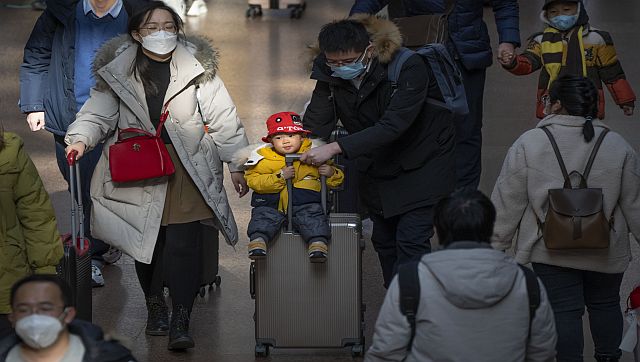
 "As China's population dips, effective policies are needed to boost fertility rates")
Xi Jinping begins his third term as the President of the People’s Republic of China. This means that China will continue to give competition to its competitors at the international level. But a bigger challenge is plaguing China internally. China’s population is dipping for the first time since 1961. The United Nations has predicted that by 2050 the Chinese population will fall to 100 or 200 million. This change in the demography will bring new legislation and reforms in Chinese policies, which have been awaited for a long time. What led to the decline in the population? After decades of trying to push its population to get a boom in birth rates, it can now be said that the Chinese government has failed. Various economists had already predicted that China’s one-child policy would bear unfruitful consequences for the country’s economy in the future. The infamous One-Child Policy was introduced in the 1980s. In 1961, China witnessed a devastating famine that killed millions of people. Still, in the next ten years, China multiplied its population to such an extent that the Chinese government had to bring stricter policies like One-Child Policy which declared that couples should not desire more than one child. By 2015, China was adamant about reversing this. According to official Chinese data, the Chinese population decreased by 8,50,000 from 2021 to last year. China’s strict policies towards family planning remain the primary reason for this decline, but other factors must also be considered. For example- the evolution of the mindset of Chinese youth, especially towards marriage, family, and gender equality, the increase in the cost of living in Chinese cities, and the cost of raising a child. For some time, Chinese youth have taken mental health issues seriously. In 2020, a National Library of Medicine survey estimated that 17·2 per cent of children aged 6–15 years in China reported depressive symptoms. Keeping such factors in mind, couples in China avoid raising any child. What will the Chinese government do? The 1980s was a turning point in Chinese history as Deng Xiaoping took power and opened up China’s economy for reform. With the boom in the Chinese economy but falling birth rates, the Chinese government started scrapping family planning policies, but it had very little effect. The government increased the limit to two children in 2015 and three in 2021, along with financial incentives. But with the increase in the limit on having children, the price of living in China also increased. Education costs and costs of living in China make couples not fit to afford children; the situation worsens if one out of the couple happens to be the only earner in the family or a single parent. The financial pressure increases when the government fails to cope with the demands of raising the retirement age and increasing pensions for the retired and the elderly. The Chinese government tends to go the extremes when implementing a policy. For example, when One-Child Policy was implemented, women caught going against the policy were often subject to forced abortions, heavy fines, and eviction. Now the pro-natalist and patriarchal regime is seeking to implement poor and repressive laws, which can pose serious threats to the life of women in China and can harm their reproductive rights. The Chinese government and its policies will have a harsher effect on its population because the country is ageing rapidly, its workforce is shrinking, and there is tremendous pressure on the younger generation. The growth rate of the Chinese economy in 2022 was only 3 per cent and is expected to reach 5.2 per cent in 2023, as per the IMF report. The younger generation will bear the pressure of expanding China’s economy and look after their grandparents and parents. In such a scenario, fewer couples will be willing to have more than one child. Way forward A big policy turn was taken by China when it announced its Three Child Policy. The policy also passed various provisions like cancelling the social maintenance fee- a fee charged from couples to have children beyond the government- set limit - and increasing women’s employment rights and childcare infrastructure. The government even encouraged parental leave. After the official decline in the population, this policy, too, looks futile. This is severely going to impact the Chinese economy. It is not hidden that the labour-intensive manufacturing sector dominates China’s economy. An endless supply of young labourers working for midpoint wages has occupied the secondary sector in China. But in a country where the average life expectancy has reached 78, and the younger population is scant, the situation has become alarming, especially considering the labour rollout from other Asian countries like India, Bangladesh, Vietnam, and Indonesia. This will make the Chinese manufacturing sector less competitive and push down the Chinese economy. The need is to have technology-driven growth in China instead of labour-driven growth. Looking at the current demands, China must increase its retirement age which currently stands at 55 for women and 60 for men, while in India, people continue to work till the age of 62. Instead of focusing only on family planning, the Chinese Communist Party must also change policies against women in the workforce. On the one hand, women are asked to rear more children, and the burden of raising children and taking care of the elderly becomes their responsibility. On the other hand, pregnant women are fired from their jobs. The government also does not recognise children born out of marriage or children from the same-sex union. Single women are frowned upon for freezing their eggs or getting in vitro fertilisation. Providing monetary benefits or parental and maternity leave are not the solutions to increase population growth in a country that produces educated men and women. Conclusion The negative population growth in China is a cause of worry for the entire world. In a globalised world, where economies are interconnected, a fall in one’s economy can bring disastrous consequences for others. And this would be an interesting experiment to witness. China is still expected to overtake the USA as the world’s largest economy, but with the demographic shift, this expectation looks less bright. Amid all this debate, people tend to forget the consequences of the COVID-19 pandemic; not only did it impact the Chinese economy, but it took away many people’s lives, accelerating the population’s decline. The Chinese government is currently under tremendous pressure as demographers have predicted that increasing this number will not be easy. It is high time for China to reform its laws. Effective policies are needed to boost fertility rates. Women and mothers need not only financial incentives but also a law guarantee that women will be offered children benefits and protection in the workplace. Moreover, the current international situation has already created economic problems for the rest of the world at such a time; the world cannot afford the economic slowdown of another country, especially not China. The author is a Ph.D. Candidate in International Relations, at The Maharaja Sayajirao University of Baroda, Gujarat. Views expressed are personal. Read all the Latest News , Trending News , Cricket News , Bollywood News , India News and Entertainment News here. Follow us on Facebook, Twitter and Instagram.
Women and mothers need not only financial incentives but also a law guarantee that women will be offered children benefits and protection in the workplace
Advertisement
End of Article


 "Russian drones over Poland: Trump’s tepid reaction a wake-up call for Nato?")
 "As Russia pushes east, Ukraine faces mounting pressure to defend its heartland")
 "Why Mossad was not on board with Israel’s strike on Hamas in Qatar")
 "Turkey: Erdogan's police arrest opposition mayor Hasan Mutlu, dozens officials in corruption probe")
 "Russian drones over Poland: Trump’s tepid reaction a wake-up call for Nato?")
 "As Russia pushes east, Ukraine faces mounting pressure to defend its heartland")
 "Why Mossad was not on board with Israel’s strike on Hamas in Qatar")
 "Turkey: Erdogan's police arrest opposition mayor Hasan Mutlu, dozens officials in corruption probe")



