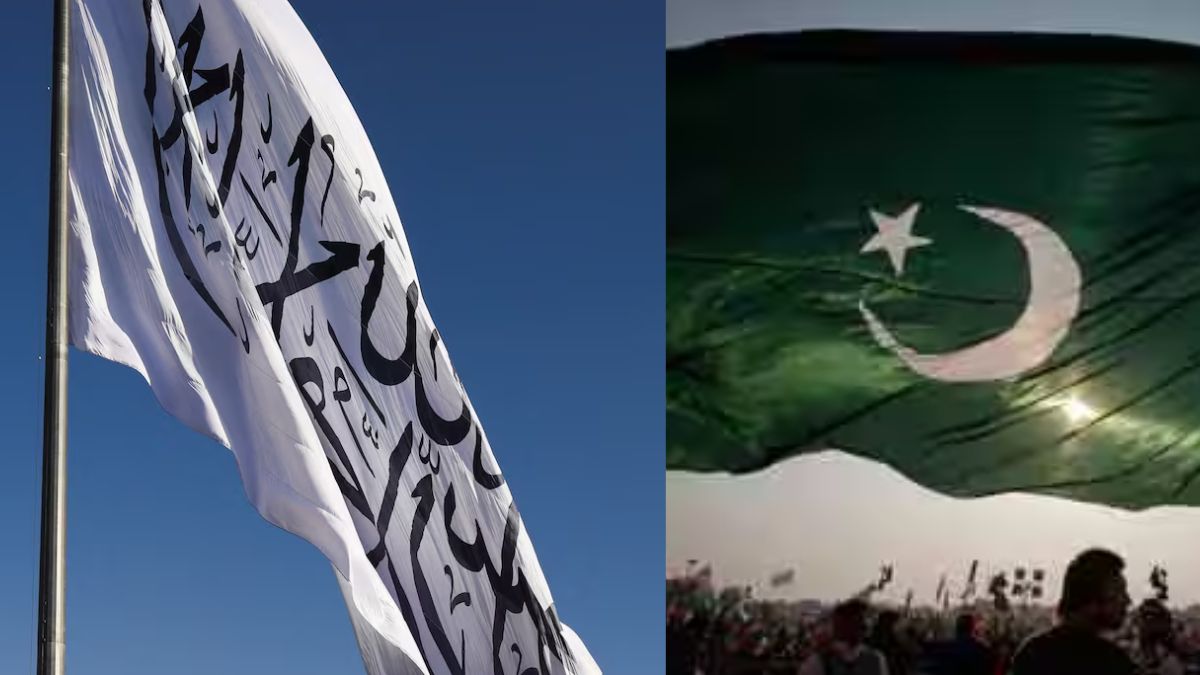
 "Representational image. (Reuters)")
Tensions between Pakistan and Afghanistan have escalated to a critical level recently, marked by direct military strikes and a breakdown in diplomatic trust. The relationship has deteriorated from the alliance that existed before the Taliban’s return to power to one of open hostility.
In the most recent major escalation on 22-23 February, the Pakistan Air Force (PAF) launched massive airstrikes in Paktika and Nangarhar provinces against seven alleged militant camps belonging to the TTP (Tehreek-e-Taliban Pakistan) and IS-KP (Islamic State – Khorasan Province). While Pakistan’s military claimed to have killed at least 70 to 80 militants, the Taliban government stated that dozens of civilians were killed, including women and children. Pakistan said the strikes were a retaliatory response to a wave of suicide attacks inside the country, including a mosque bombing in Islamabad that killed 31 people. However, the Taliban government condemned the strikes as a “blatant violation of sovereignty” and warned of a “befitting response”.
India strongly condemned Pakistan’s airstrikes on Afghan territory that resulted in civilian casualties, including women and children, during the holy month of Ramzan. Ministry of External Affairs (MEA) spokesperson Randhir Jaiswal said it was another attempt by Pakistan to externalise its internal failures. India also reiterated its support for Afghanistan’s sovereignty, territorial integrity and independence.
Earlier, on 6 February, the Indian Ministry of External Affairs formally dismissed Pakistan’s allegations of Indian involvement in a deadly suicide bombing at a Shia mosque in Islamabad as “baseless” and “pointless”. The MEA stated that Pakistan was choosing to “delude itself by blaming others for its home-grown ills” rather than addressing deep-rooted internal security failures. The response followed statements from Pakistani officials, including Defence Minister Khawaja Asif, who suggested Indian and Afghan involvement.
Recent months have seen a dramatic escalation in military hostilities between Pakistan and the Taliban-led Afghan government, marked by heavy border skirmishes and precision airstrikes deep into Afghan territory. It may be recalled that in September 2015, intense border outpost skirmishes occurred in the Kurram district when Taliban forces attempted to construct a security outpost on the border. At least eight Taliban fighters (including two commanders) were killed, and five Pakistani soldiers were injured. One Soviet-era T-62 tank operated by the Taliban was reportedly destroyed by Pakistani forces.
Quick Reads
View AllOctober 2025 witnessed the deadliest clashes in years, briefly bringing both nations to the brink of open war. Pakistan launched strikes in Kabul targeting TTP leader Noor Wali Mehsud. The Afghan Taliban retaliated by attacking multiple Pakistani military posts along the Durand Line, claiming to have killed 58 Pakistani soldiers and captured several outposts. A fragile ceasefire was eventually mediated by Qatar and Turkey on 19 October 2025.
In December, heavy exchanges of fire erupted along the Spin Boldak-Chaman border crossing, one of the primary trade routes between the two nations. Both sides used light and heavy artillery for several hours. Afghan officials reported five deaths, including a soldier and four civilians, while Pakistan accused Afghan forces of “unprovoked firing”. These clashes broke out just as peace talks in Saudi Arabia failed to produce a breakthrough.
There are several core drivers of tension. Foremost among these are issues relating to the TTP. Pakistan accuses the Afghan Taliban of harbouring the Tehreek-e-Taliban Pakistan, which has intensified attacks within Pakistan, including the 6 February bombing at an Islamabad mosque that killed over 30 people. Islamabad maintains that the TTP operates from safe havens in Afghanistan with the tacit support of the Afghan Taliban. Kabul denies these claims, asserting that the TTP is Pakistan’s internal security failure.
Second, there is the dispute relating to the Durand Line. The 2,640-km border, drawn by the British in 1893, remains unrecognised by the Taliban, who view it as an “artificial” colonial-era line. Pakistan’s efforts to fence the border have triggered numerous fatal skirmishes.
Third, there are issues relating to refugee deportations. Pakistan’s plan to repatriate nearly 3 million Afghans — including both documented and undocumented migrants — has become a major humanitarian and political flashpoint. Pakistan’s decision has caused significant friction, with Kabul accusing Islamabad of using refugees as “political blackmail”.
Last but not least, there are issues relating to shifting alliances. The recent diplomatic outreach between Afghanistan and India, including the upgrade of India’s Kabul mission to embassy status in October 2025, has further unsettled Pakistan. Relations worsened further in late 2025 after Afghan officials visited India and issued a joint statement criticising “terrorism from regional countries”, which Islamabad viewed as a direct provocation.
Multiple rounds of peace talks hosted by Qatar, Turkey and Saudi Arabia since October 2025 have failed to produce a lasting resolution. Talks held in Istanbul in late 2025 broke down without a formal agreement. Negotiations have frequently stalled because Pakistan demands a written commitment from Kabul to take “verifiable action” against the TTP, which the Taliban refuse to provide.
Resolution of Pakistan-Afghanistan tensions appears highly unlikely in the near future. Despite multiple rounds of international mediation and temporary ceasefires, the relationship has entered a cycle of “deterrence and punishment”. There is a low probability of peace. A permanent solution is “far out of reach” because both nations hold firmly opposing national positions. While an all-out conventional war is not considered imminent, the current cycle of retributive strikes by Pakistan could destabilise the entire region.
Pakistan-Afghanistan tensions significantly affect India by disrupting regional security and economic connectivity while simultaneously offering strategic opportunities to counter Pakistan’s influence. Increased border conflicts and Taliban-Pakistan friction often force India to navigate risks to its infrastructure projects, manage terror threats, and adapt trade routes, such as using the Chabahar port to bypass Pakistan. The instability threatens major Indian projects like the TAPI pipeline and stalls regional trade initiatives, complicating access to Central Asian markets.
As Pakistan’s influence in Afghanistan weakens due to clashes with the Taliban, India has found an opening to deepen its diplomatic and economic engagement with Kabul. India has shifted from initial isolation to a policy of “engagement without recognition”, allowing it to protect its $3 billion investment in over 500 projects without legitimising the Taliban regime. India remains a top donor, providing 40,000 tonnes of wheat, 60 million vaccine doses and essential medical supplies to maintain people-to-people ties. Thus, India is leveraging the Taliban’s desire for strategic autonomy to reduce their historical dependence on Pakistan’s military establishment.
However, New Delhi remains deeply sceptical of the Taliban’s internal policies and extremist ties. India remains critical of the Taliban’s restrictions on women’s rights and their failure to form an inclusive, multi-ethnic government. India also continues to demand verifiable action against groups such as Lashkar-e-Taiba (LeT) and Jaish-e-Mohammed (JeM). The Taliban leadership has previously assured India that it will not allow Afghan soil to be used for terrorism against any country, promising to act against foreign terrorists based on “actionable intelligence”. Despite these assurances, LeT and JeM continue to maintain a presence, often operating under the umbrella of the Afghan Taliban, which remains a key concern for Indian security planners.
In conclusion, India’s strategy in Afghanistan has evolved into one of “pragmatic realism” — a high-wire balancing act that prioritises national security and regional influence while navigating the volatile rift between the Taliban and Pakistan. India must balance its desire to maintain stability in Afghanistan with its scepticism of the Taliban regime, while avoiding direct entanglement in the worsening Pakistan-Afghanistan rift.
(The writer is a retired Indian diplomat and had previously served as ambassador in Kuwait and Morocco and as Consul General in New York. Views expressed in the above piece are personal and solely those of the author. They do not necessarily reflect Firstpost’s views.)