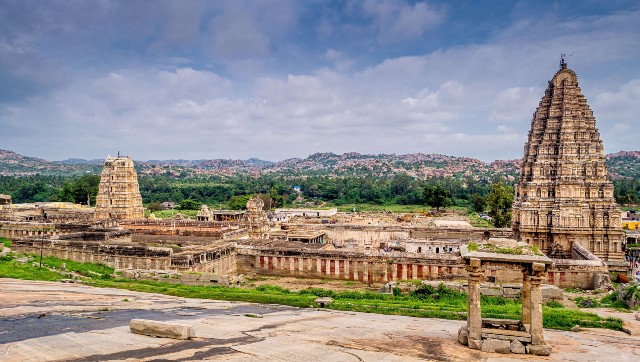
 "Why India needs to rewrite its history without falling into jingoistic traps")
Is there a need to rewrite Indian history? This is a subject which is much in the air these days, with a regular tug of war between ‘leftist’ secularists, and Hindu rightists. One thing is certain: the history of a country cannot be written in stone. Each narrative has some biases, some prejudices, some agendas. There is also the emergence of new historical facts, which can radically alter earlier academic conclusions. Rewriting Indian history is, therefore, a valid project, provided it is done as objectively (is that even possible in historical narratives?) as possible.
For long, the conventional and most acceptable version of history was that the Aryans invaded India around 1500 BCE and overran the existing Indus civilisation, driving it southwards. In the light of new facts, this theory is now considered to be rubbish. The Aryans did not ‘invade’ India, but migrated in batches, coexisting with the Indus Valley civilisation inhabitants, some two thousand years before 1500 BCE, thereby making India one of the oldest civilisations in the world. These revisions of earlier history have been necessitated by new and incontrovertible evidence relating to the elusive Sarasvati river. The Rig Veda showers praises on the Sarasvati as a mighty river flowing from the mountains to the sea in 45 of its hymns; her name appears 72 times, and 3 hymns are dedicated wholly to her.
Modern scientific tools, such as hydrological and drilling data, oceanography, morpho-dynamics, geology, remote sensing and satellite data, clearly establish that between 2500 BCE and 1900 BCE the Sarasvati dried up. It follows, therefore, that the authors of the Rig Veda, who describe the river as ‘great’, ‘vast’ and ‘tempestuous’ must have been on Indian soil at a time when the river existed in its original form, which predates Indian civilisation by a millennium — if not more. Why then is there a reluctance, even hostility, to the predating of Indian civilisation?
A second area that needs greater honesty is the assessment of the Turkic-Islamic invasion. Marxist historians have asserted that the Muslims did not wreak havoc and plunder, but the Hindus themselves preferred the egalitarianism of the Shariat to the social discrimination in their own religion. This is arrant nonsense. There was no question of democratic choice being given to the conquered Hindus. The invaders believed that those who were not Islamic were kafirs, beyond the pale. The viciousness of their attack was not for plunder alone but on grounds of religious fanaticism. Nor were these atrocities, as some argue, ‘poetic exaggeration’.
Quick Reads
View AllHistorian Will Durant writes categorically: ‘The Mohammedan conquest of India is probably the bloodiest story in history’. However, some ‘establishment’ historians have tried, perhaps for well-intentioned reasons, to whitewash history. This must end and truth must be acknowledged, even as little is served by excavating past acrimonies today, and much is gained by celebrating our ‘Ganga-Jamuni tehzeeb’.
The third area needing revision is the stubborn attempt to devalue the verifiable, remarkable and unprecedented achievements of India’s ancient past, and its dominantly Hindu character. A good example of this school is Amartya Sen. He suffers from paranoia that any tribute to ‘Hindu Civilisation’ will lead to Hindu revivalism, and therefore dilute his selective definition of ‘secularism’. Current hardline Hindutva cannot be countered by devaluing the valid achievements of our Hindu past.
Sen’s attempt to puncture ancient Hindu civilisation sometimes assumes laughable proportions. Panini, the great grammarian, who lived in the 4th century BCE was, he says, an Afghani, because his village was on the banks of the Kabul river! Does he not know that at that time, large parts of Afghanistan were part of an Indian empire and closely integrated with Indian civilisation. Samuel Huntington describes ancient India as a Hindu civilisation, but Amartya Sen maintains that India was not a ‘Hindu country even before the arrival of Islam’. He would rather that it be called Buddhist, even though he knows that both Buddhism and Jainism were offshoots of Hinduism, which for millennia shaped our history and culture.
A fourth area that needs questioning is the reluctance of certain historians to understand the seminal difference between ‘nation’ and ‘civilisation’. They endorse the false British conceit that it was colonial rule that made India a recognisable collective, and that before it there was no consciousness of a common civilisation. For some, ancient India was ‘just a hybrid, a crossroads, a mixture of elements derived from chance encounters’. What they deliberately forget is that nation states, in the modern sense, were created after the Treaty of Westphalia in the 17th century CE. But India was a unified civilisation for thousands of years before that. To give just one example, why would Adi Shankaracharya in the 8th century CE set up his four ashrams in Sringeri in the south, Dwarka in the west, Puri in the east, and Joshimath in the north — if he had no awareness of the civilisational map of India?
Thus, there are many reasons for the re-examination of our historical narrative. Our historical imagination has suffered from unacceptable sclerosis, leaving out very important parts of our history. For instance, our historical narrative should have considerably more on great rulers like Krishnadeva Raya of the Vijayanagar empire, at par with Ashok and Akbar, or Raja Raja Chola, under whose rule the cultural influence of India spread vastly beyond its boundaries.
But, in all of this, there is a danger also: jingoism. We must be vigilant against the ‘Dinanath Batra’ school of history, which asserts that ancient India had airplanes, TV, cars, artificial insemination, and so on. These ridiculous claims only trivialise the genuine achievements of what was, undoubtedly, a great civilisation. Can we today negotiate the path between these extremes, and write our own authentic history?
The author is a former diplomat, an author and a politician. The views expressed in this article are those of the author and do not represent the stand of this publication.
Read all the Latest News, Trending News, Cricket News, Bollywood News,
India News and Entertainment News here. Follow us on
Facebook,
Twitter and
Instagram.

 "In Republic Day parade, India flies Rafale BS-022 Pakistan claimed to have shot down during Op Sindoor")
 "India, EU conclude talks on ‘mother of all deals’, formal announcement likely on Tuesday")
 "‘It’s no secret’: Russia says Ukraine must cede all of Donbas for truce as part of Putin-Trump formula")
 "Pakistan's Board of Peace dilemma: Will it disarm Hamas, attack Houthis when Trump orders a strike?")
 "In Republic Day parade, India flies Rafale BS-022 Pakistan claimed to have shot down during Op Sindoor")
 "India, EU conclude talks on ‘mother of all deals’, formal announcement likely on Tuesday")
 "‘It’s no secret’: Russia says Ukraine must cede all of Donbas for truce as part of Putin-Trump formula")
 "Pakistan's Board of Peace dilemma: Will it disarm Hamas, attack Houthis when Trump orders a strike?")