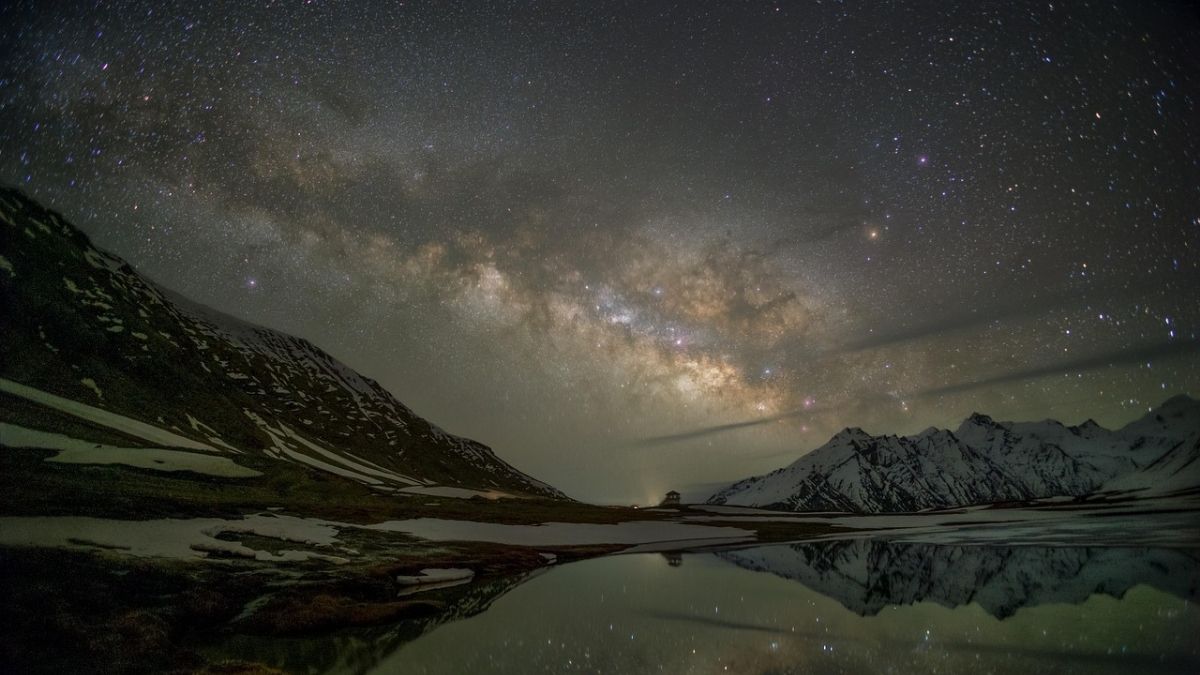
 "Milky Way galaxy view in Ladakh, India. Credits/Pixabay")
From stargazing and chasing the northern lights to night safaris, and after dark markets, travelling after sunset is rapidly gaining global momentum. Booking.com, one of the world’s largest online travel agencies, has termed ‘Noctourism’ as India’s Travel Word of the Year 2025. But what exactly does this trend entail? Simply put, noctourism is a blend of nocturnal and tourism, referring to travel experience centered around the night.
As global temperatures continue to rise and daytime heat becomes increasingly uncomfortable, especially in overcrowded tourist hotspots, travellers are rethinking when they explore. According to Booking.com, 61 per cent of respondents said they wanted to spend less time in the Sun, prompting a shift towards planning trips around destinations that offer activities during cooler evenings and early mornings.
Noctourism also taps a growing desire for immersive, low-impact travel. Travellers are seeking out dark-sky zones to marvel at the cosmos, indulge in stargazing experiences and resdiscover that take on an entirely new look as dusk hits. As National Geopraphic notes, “In an age of overtourism, when few parts of the globe are still unvisited, noctourism can provide a new perspective on established sights. It’s a chance to rediscover a world transformed at night.”
Santosh Kumar, Regional Manager for South Asia at Booking.com, describes this shift as pivotal for Indian travellers. “Fueled by the growing appetite for after-dark safaris, stargazing escapes, bioluminescent beaches and culturally rich night markets that reveal a destination’s character in entirely new ways, Noctourism emerged as India’s Travel Word of the Year,” says Kumar.
The ‘Travel Word of the Year 2025’ study examined over 10 million data points from over three lakh verified Indian sources between January and October 2025 - spanning news media, social platforms and online conversations.
Major noctourism experiences to explore
In recent years, the Northern Lights have captured the imagination of the people of India. As per reports, 2025-2026 is predicted to be the peak time period for viewing the Aurora Borealis. Closer home, Hanle in Ladakh offers a mesmerising cosmic experience, India’s own version of Northern lights.
It is the perfect area for astronomical observations because of its high altitude and open skies. Lunar phases, equinoxes, and solstices are just a few of the astronomical occurrences that are closely related to traditional Ladakhi calendar systems.
For wildlife enthusiasts, Night Safaris offer an adventurous getaway to exploring the wildlife in the dark. Several tiger reserves including Rajaji, Satpura, Kanha, Bandhavgargh, Pench spread across India offer curated night safaris for different travel groups.
Exploring vibrant markets at night gives visitors the leeway from the heat during the days and also provides attractive locations for photographs and shopping. Hyderabad’s Charminar Bazaar, Sarojini nagar in Delhi , Juhu Chowpatty in Mumbai, Anjuna flea market in Goa are few of the many places that offer varied experiences hotspots.
Night beaches are drawing travellers seeking rare natural phenomena such as offer bioluminescence, glowing water from plankton in places. This ethereal glow can be witnessed in several locations including Havelock in the Andamans, Bangaram Lakshadweep, Betalbatim in Goa , and Mattu Beach in Karnataka. This serene experience by the coastline is unmatched.
As travel habits evolve, noctourism is no longer a niche interest but a reflection of changing climate realities and travel preferences. With similar patterns expected to continue in 2026, after dark travel is likely to remain more than a trend.
Arpita Chowdhury is Sub Editor (Travel) at Firstpost. She is a writer, poet, and researcher with a strong background in human interest storytelling. She completed her MA in Journalism and International Affairs at University College Dublin in collaboration with CNN Academy. Her reporting and commentary have appeared in numerous national and international dailies. She runs on masala chai. Arpita can be reached out at arpita.chowdhury2@nw18.com