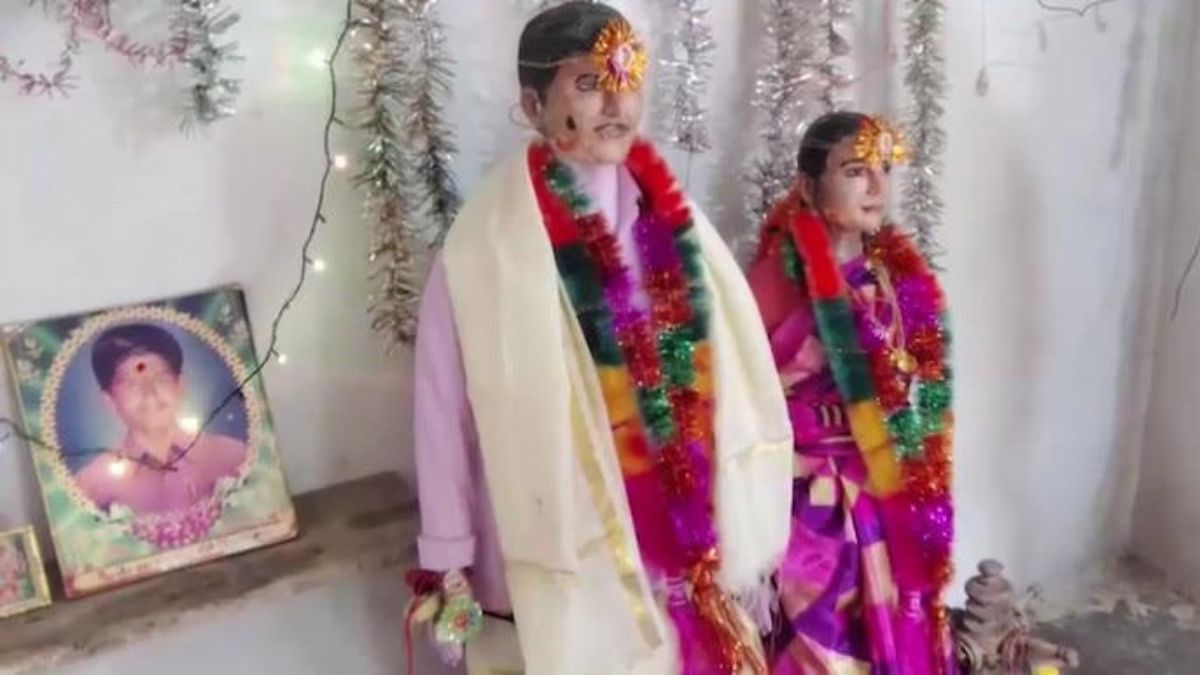
 "Parents hold wedding ritual for deceased son Telangana. Here's why")
In a deeply moving story from Telangana, a couple has turned personal tragedy into a lasting ritual of remembrance - conducting a symbolic wedding ceremony for their deceased son every year for over two decades.
A tragedy that changed everything
The incident dates back to 2003, when a young man named Ram Koti from Mahabubabad district died by suicide after his relationship faced opposition from the girl’s family.
In a heartbreaking turn of events, the young woman he loved also died by suicide just days later, leaving both families devastated.
The loss deeply affected his parents, Lalu and Sukkamma, who struggled to cope with the sudden and tragic end to their son’s life.
A dream that became a ritual
According to the family, the turning point came when the mother dreamt of her son, who asked them to perform his wedding and build a shrine.
Taking this as a sign, the couple built a small temple-like shrine inside their home, installed idols of their son and his partner together, and began conducting a symbolic marriage ceremony for the pair.
Over time, this act of grief transformed into an enduring annual tradition.
A wedding performed every year
For the past 22 years, the couple has been performing the ritual every year on Sri Rama Navami.
The ceremony mirrors a real Hindu wedding and includes traditional prayers and offerings, chanting of mantras, and full wedding customs and rituals.
The parents treat the idols as divine figures, symbolically uniting the couple in a marriage that never took place during their lifetime.
From private grief to community ritual
What began as a deeply personal act has gradually evolved into a community event.
Villagers, relatives, and visitors now gather each year as the ceremony draws people from nearby areas. It has become a shared moment of remembrance and empathy.
Quick Reads
View AllOver time, the ritual has turned into a symbol of enduring love, loss, and faith.
Anuj is a senior sub-editor (lifestyle desk) at Firstpost who covers food, travel, health, and fitness, mostly because they’re all excellent excuses to leave the house. Powered by coffee, he spends his downtime airplane-spotting and exploring spirituality, hoping one day to understand both turbulence and the universe.