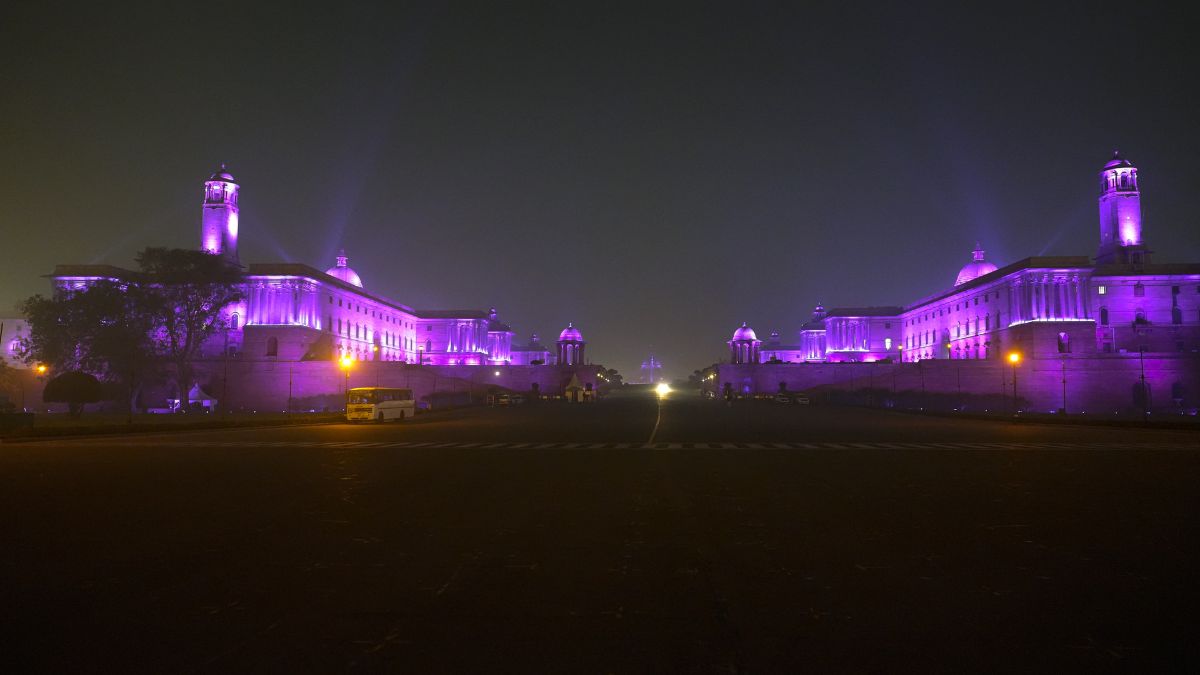
 "Built across the North and South Blocks that surround Rashtrapati Bhawan, the Yuge Yugeen Bharat National Museum is being developed by the Ministry of Culture. File image/PTI")
Delhi is soon going to house the world’s largest museum, the Yuge Yugeen Bharat National Museum. The 1.55 lakh square metres museum is being developed under the Central Vista Redevelopment Project at the Central Secretariat.
The building will be housing more than 30,000 objects showcasing 5,000 years of national history, reported TimeOut.
The announcement comes as Prime Minister Narendra Modi said the nation would be led from new headquarters, deliberately distancing itself from the legacy of colonial rule.
Here is all you need to know about the Yuge Yugeen Bharat National Museum.
The Yuge Yugeen Bharat National Museum
The Yuge Yugeen Bharat National Museum will showcase India’s cultural heritage. Meaning “Everlasting India,” the name “Yuge Yugeen Bharat” underscores the museum’s focus on India’s continuous cultural history, from the Indus Valley Civilisation to modern times.
Built across the North and South Blocks that surround Rashtrapati Bhawan, the museum is being developed by the Ministry of Culture. According to reports, the museum will house roughly 30 galleries across eight thematic zones, which will delve into the country’s cultural, political, and artistic heritage. An estimated 80,000 to one lakh artefacts from across India will be housed in the museum.
“To ensure that every aspect of India’s cultural heritage is showcased, we will bring in diverse collections located in national, state, and ASI-run museums and galleries, drawing from a list based on an extensive mapping exercise of nearly 20 lakh objects. Between 80,000 and 1 lakh objects of diverse materials are expected to be displayed at the museum,” culture secretary Vivek Aggarwal told the Times Of India.
With a display size of over 80,000 square metres for the museum, the first gallery is slated to open by late this year. Once operational, the museum will officially overtake the Louvre to become the largest museum in the world by area. It will replace the existing National Museum at Janpath.
Visitors will be expected to experience India’s heritage as exhibits will include ancient manuscripts and inscriptions, coins, sculptures, murals, and scrolls, major archaeological finds, and audio-visual and digital installations. Some of the highlights from the heritage collections will include Indus Valley terracotta artefacts from Kalibangan (2500–1700 BC), Gupta period sculptures (5th century), and iconic Chola bronzes (10th–11th centuries), as reported by news website Moneycontrol.
Indo-French collaboration and design
The museum is being developed with technical cooperation from France. In a statement, the Press Information Bureau (PIB) Delhi said the National Museum and the French Museums Development entered into a technical cooperation agreement on December 19, 2024, for the upcoming museum.
Arcop Associates is heading the design effort, with renowned Thai architect Kulapat Yantrasast as principal designer, aiming to merge Indian and French museum design approaches while preserving heritage and meeting modern exhibition needs.
Yantrasast has many renowned projects to his credit, including the Academy Museum of Motion Pictures in Los Angeles, and two new galleries for the redevelopment of the Louvre in Paris.
North-South blocks to be connected
Officials are considering an underground link between the North and South Blocks to streamline visitor access without compromising security along Kartavya Path . Envisioned as a cultural hub, the subterranean space would enhance the journey between the two buildings, though the idea remains subject to final approvals.
This underground area is proposed to be developed into a cultural hub for visitors as they move from one side to the other. TOI reported that the plans remain a work in progress and will need to be firmed up with specific design details for approval.
Museum’s impact on travel and tourism
When it opens to the public, the Yuge Yugeen Bharat National Museum is expected to stand among India’s leading cultural tourism destinations, adding to initiatives such as the PM Museum, National Archives digitisation, and the Cultural Mapping of India project.
Speaking to the TOI, Aggarwal said, “We expect around 10 million visitors each year once the museum is fully functional. Given the large numbers, we want to ensure the experience is seamless and accessible, especially for persons with disabilities, while ensuring that the heritage character of the area and buildings is not disturbed at all.”
Meanwhile, Union Culture Minister Gajendra Shekhawat was quoted by Indian Express as saying, “On ground, work for the museum will begin by year end. By 2027, we will have the first of the eight museum verticals ready. Once ready, we expect a daily footfall of 50,000 at the museum.”
Kartavya Bhavan-3 will be the government’s new address
The Kartavya Bhavan-3 is where the central government ministries are being shifted from the Central Secretariat. Inaugurated in August 2025, it is the first modern government office building completed under India’s Central Vista Redevelopment Project in New Delhi.
According to reports, home and finance ministries have been relocated from the North Block, while only a few offices attached to the Central Bureau of Investigation (CBI) are still working from there, which will also shift out soon. The government has begun the process of allocating new office spaces at the Kartavya Bhawan complex to the ministries that operate from the South Block.
With inputs from agencies