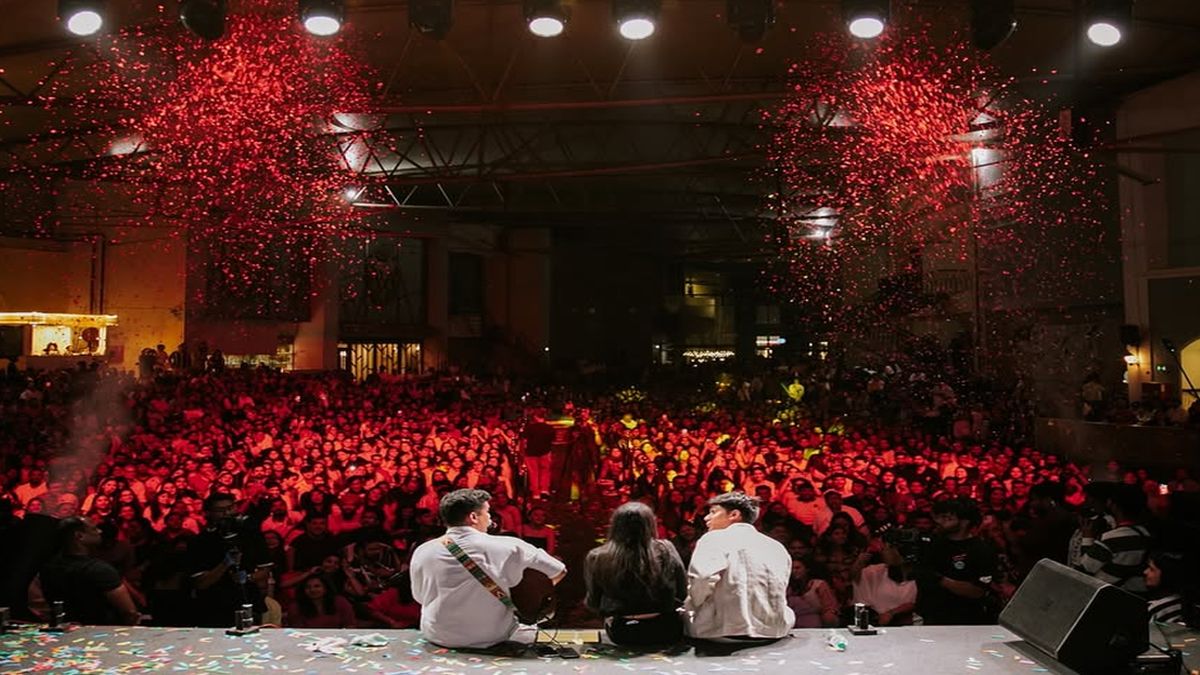
 "Backstage Siblings, a brother-sister duo, at one of their Mumbai's bhajan clubbing event. Image Courtesy: @backstagesiblings/Instagram")
On December 21, 2025, the Indira Gandhi Sports Complex in New Delhi turned into a massive rave — lights pulsed, hands sporting concert bands swayed back and forth, and young men and women twirled with no inhibitions.
But this wasn’t any regular rave; neither was typical EDM music being played, nor was it Bollywood songs that the crowd swayed to. Instead, the hundreds that had gathered were dancing and moving to the tunes of high-voltage bhajans.
Welcome to the world of bhajan clubbing — the latest Gen Z spiritual movement taking over India one bhajan at a time.
Notably, this trend has caught the attention of many, even Prime Minister Narendra Modi. In his first Mann ki Baat address of the year, he praised young India for embracing the growing phenomenon of ‘bhajan clubbing’, calling it a meaningful fusion of devotion, culture, spirituality, and modern sensibilities. He further compared this new phenomenon to global music concerts, saying the scale, energy, and participation were no less impressive.
Step inside the world of Bhajan clubbing
Across cities in India — from Mumbai to Delhi to Bengaluru and Kolkata — bhajan clubbing is becoming the buzz that everyone’s talking about. Unlike conventional clubbing, participants, who are mostly Gen Zs, collect to groove to collective chanting and ecstatic devotion.
The songs reverberating in darkened auditoriums, café-turned-concert halls or open air venues are devotional in nature, often invoking Hindu gods such as Ganesh, Shiva, Ram, and Krishna. But these aren’t your usual bhajans — they are often performed live or reworked with electronic beats and lo-fi sounds.
As Mandira Bansal, a regular bhajan clubbing participant told The Hindu, “It is like entering a world of trance. It might be a Gen-Z concept, but it’s wonderful. Why else would we be swaying to such tracks?”
Abhinav Sharma, an IT trainee with an MNC who went bhajan clubbing recently was also quoted as telling Hindustan Times, “You have to attend one to know one! We were about 80-100 people jamming together. We sang songs like Rama Rama Ratte Ratte Biti Re Umariya, Ram Ram Jai Sita Ram, Shri Krishna Govind Hare Murari. It was electric. I could feel the beats in my bones. And it was not religious at all. It was just us singing and dancing to some spiritual songs. It was such a happy high!”
And speaking about highs, these bhajan clubbing events are a strictly non-alcoholic affair, where the only intoxication is bhakti (devotion).
Gen-Z puts its own spin on spiritual expression
While anyone and everyone can be a part of the bhajan clubbing trend, it is primarily led by Gen Z, who are seeking meaningful alternatives to conventional nightlife.
As Prithviraaj Shetty, a young entrepreneur in faith-tech and founder of Bhagvad Gita For All (BGFA), told India Today, “What you’re seeing is not a fad — it’s a cultural correction. For decades, spirituality was packaged as something that belonged to elders. But India’s youth have always been spiritually curious, they just lacked formats that spoke their language. Bhajan clubbing brings devotion into spaces where young people already exist: music, community, rhythm, energy.”
Even 25-year-old Nikunj Gupta, founder of Sanatana Journey, which also offers verified Vedic pandits, online pujas, and cultural experiences, concurs on this sentiment. “Bhajan clubbing is not a rejection of tradition; it is an evolution of it. It’s a new and accessible way of connecting with spirituality in a Gen-Z style,” he was quoted as telling The Print.
And Gen Z loves bhajan clubbing so much that such events are popping up everywhere, with event organisers reporting record turnouts. In some cases, these bhajan clubbing nights are even more crowded than mid-tier EDM shows. And Google searches for “modern kirtan” and “sober rave India” have surged.
Bhajan clubbing and its appeal
There are multiple reasons why Gen Z has embraced this trend. Some point to the elevated stress levels and increasing mental health challenges as key factors influencing this shift. “Gen Z is the most anxious yet self-aware generation. They grew up with instability, a pandemic, economic uncertainty, intense competition, and constant online comparison. Spirituality offers the very things their environment lacks: certainty, inner grounding, and meaning. Unlike earlier generations that followed spirituality as tradition, Gen Z follows it as self-care,” said Dr Chandni Tugnait to India Today.
Moreover, the bhajan clubbing trend highlights the desire among young Indians to reunite with their ancient roots without all the rigidity of organised religion. As Aanya told The Print, she always found it difficult to sit still in temples with a priest droning. However, a buzzing crowd chanting “Ram Ram” or “Jai Shri Krishna” stirs something joyful in her.
Some even note that bhajan clubbing is about belonging. “It’s a trend of the new generation to show the outside world their religion or how connected they are to it,” said social commentator and brand consultant Santosh Desai to The Print.
The leaders of Bhajan clubbing
While bhajan clubbing has become all the rage today, there are some such as Backstage Siblings who are believed to be the pioneers of this movement.
Meet Raghav Agarwal and Prachi Agarwal, the brother-sister pairing, who went from hosting a living-room baithak for 50 people to selling 1,500 paid tickets in Mumbai in under a year. The response to their events has been so overwhelming that they have The response has been so overwhelming that they have quit their jobs to meet the growing demand for their performances.
They are set for a nationwide tour, starting February 8, which shall cover cities such as Mumbai, Pune, Hyderabad and Bengaluru. And tickets for this tour are costing anywhere between Rs 1,200 and Rs 1,499.
“Gen Z has forgotten how to look up in a world full of technology, this one hour gives them space to be free, to be themselves,” Raghav was quoted telling Bloomberg. Clubbing, dining out, drinking alcohol can become monotonous. Young people are seeking “experiences,” he said. They come with their dates, friends, parents, even grandparents, Prachi added.
Keshavam is another devotional band that is at the centre of bhajan clubbing. Formed two years ago, and led by singers Lovish Sheetal and Prakriti Sharma Arora, the band believes the movement is more than a passing trend.
“EDM and hip hop give adrenaline,” the band is quoted as saying. “Bhajans give emotion, belonging, and meaning. When presented with the same production value and intensity, they hit even harder. Bhajan clubbing lets people feel proud of their roots without feeling boxed in. It’s not about replacing playlists, it’s about expanding them.”
Brands cashing in on Bhajan clubbing
For marketers, bhajan clubbing serves as a meaningful cultural signal. With the popularity of bhajan clubbing only rising, it’s a clear sign that soft spirituality is a becoming a driver of consumption.
Wellness brands, music platforms, event organisers, fashion labels, and even food and beverage companies are beginning to engage with this space through mindful branding, devotional playlists, calm cafés, and spiritually themed experiences.
It also offers deeper insight into Gen Z’s evolving mindset. Young consumers are increasingly drawn to meaning-driven experiences that align with emotional well-being and cultural sensitivity.
If things continue the same way, may be next time you won’t hear someone ranting about a Coldplay concert being sold out, but a bhajan clubbing night.
With inputs from agencies