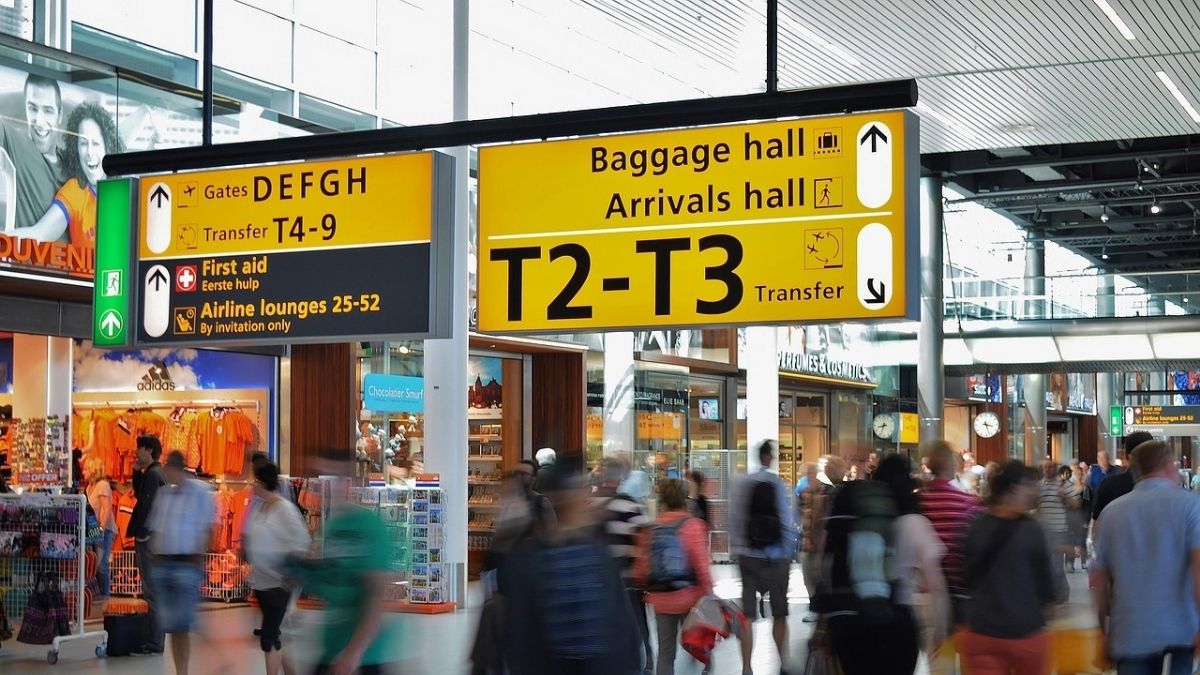
 "Future of digital travel is smarter borders. Representational image/Pixabay")
Long immigration queues, paper visas and manual passport checks are fast becoming relics of a pre-digital era. As global travel rebounds and accelerates, borders are emerging as strategic assets. According to the World Travel & Tourism Council (WTTC), aviation is expected to carry 14 billion passengers annually by 2035, making traditional border management systems increasingly unsustainable.
A new report of WTTC, ‘Better Borders: Smarter Border Controls’, argues that the future of travel lies in fully digital, data-driven and biometric-enabled borders. It also highlights countries that are already setting the benchmark. Collectively, these models show how technology can enhance security while making travel faster, friendlier and more economically rewarding.
Here are five countries that are providing a seamless travel experience:
Singapore: The passport-free border
Singapore has built one of the most advanced border systems in the world. Since 2024, travellers departing from Changi Airport and residents returning home can clear immigration using only facial and iris biometrics. Doing away with the need for a physical passport.
Under its New Clearance Concept, Singapore has shifted risk assessment from arrival to pre-arrival, allowing authorities to flag higher-risk travellers in advance. In 2024, the country upgraded its multi-modal biometric system, increasing matching speeds 20-fold and reducing average clearance time from 25 seconds to just 10 seconds.
United States: Scaling biometrics at volume
Few countries process international travellers at the scale of the United States and yet, US Customs and Border Protection (CBP) has emerged as a global leader in biometric border management. Facial recognition technology is now deployed at more than 230 airports, including all pre-clearance locations abroad.
Programmes such as Global Entry and Seamless Border Entry allow pre-vetted travellers to move through immigration at walking pace. While mobile apps enable customs declarations and identity verification before arrival. Today, millions of low-risk travellers are processed with minimal officer interaction.
United Arab Emirates: AI-powered visas
The UAE demonstrates how digitalisation begins long before a traveller reaches the airport. Its AI-driven visa system uses automated document checks, smart form validation and predictive analytics to issue tourist visas in days or even hours.
Artificial intelligence flags errors, scans documents for authenticity and forecasts demand surges around peak travel periods. The result is faster processing times without compromising security, and a visa system aligned with the country’s ambition to be a global tourism and transit hub.
End-to-end digital visas powered by AI, replacing slow, paper-heavy consular processes with scalable and secure systems.
Aruba: The fully digital journey
The Caribbean island of Aruba offers a glimpse of what a truly seamless travel ecosystem looks like. Through the Aruba Happy One Pass, travellers can convert their passport into a secure digital credential and move through airport checkpoints without showing physical documents.
By integrating airlines, border control and tourism stakeholders, Aruba has reduced friction across the entire journey. The impact is measurable: higher tourist spending, increased arrivals and growth across age demographics.
Australia: Biometrics as the default
Australia was among the first countries to introduce Electronic Travel Authorisations (ETAs) and has steadily expanded biometric processing through SmartGates at major airports. Today, nearly four in five arriving passengers are eligible to use automated gates, significantly reducing wait times.
By linking ETA data, passport information and facial recognition, Australia has created a high-throughput, low-friction border system suited to growing traveller volumes. Making biometrics the norm for low-risk travellers, supported by clear digital communication and widespread infrastructure.
A blueprint for the future
The WTTC–SITA report estimates that smarter borders could unlock an additional $401 billion in GDP and create 14 million jobs across major economies over the next decade. The core principles are clear: fully digital visas and travel authorisations, pre-clearance of travellers, biometric identity verification and stronger collaboration between border agencies and tourism authorities.
As travellers grow increasingly comfortable sharing data in exchange for speed and convenience, the question is no longer whether borders should go digital but how quickly governments can adapt.
The countries leading the way show that when technology, security and tourism strategy align, borders can become gateways not just to nations but to economic growth and global connectivity.
Arpita Chowdhury is Sub Editor (Travel) at Firstpost. She is a writer, poet, and researcher with a strong background in human interest storytelling. She completed her MA in Journalism and International Affairs at University College Dublin in collaboration with CNN Academy. Her reporting and commentary have appeared in numerous national and international dailies. She runs on masala chai. Arpita can be reached out at arpita.chowdhury2@nw18.com