 "Did you know this village in Portugal has only one resident?")
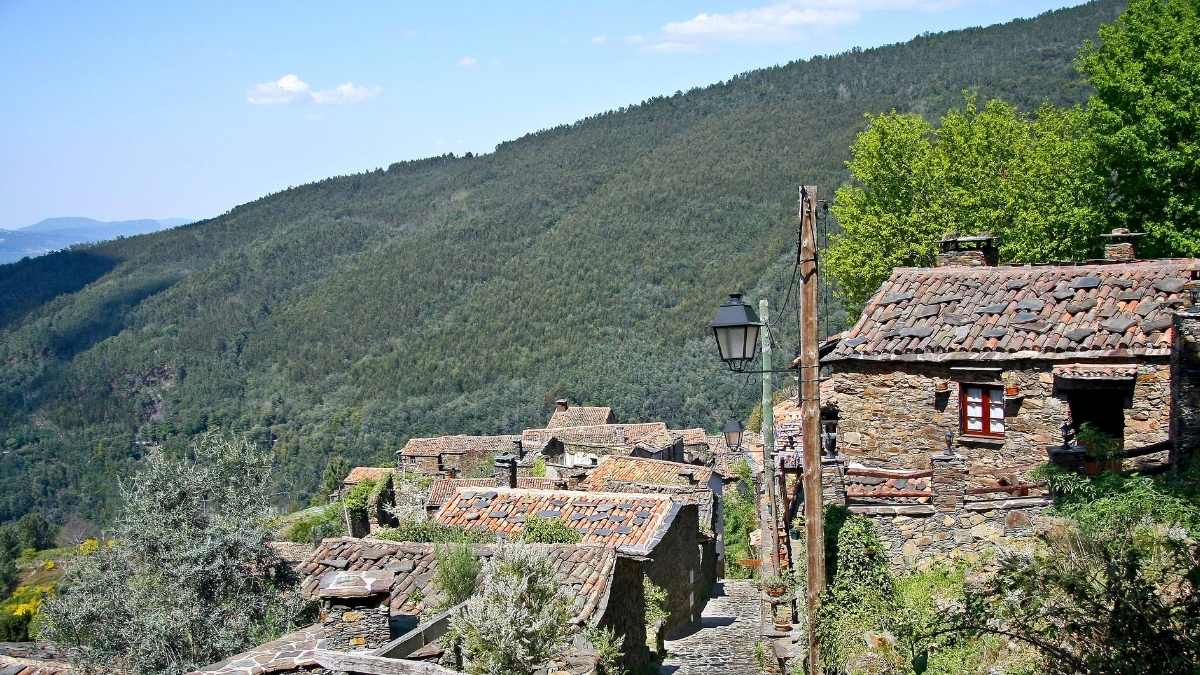
At the heart of the Serra da Lousã mountain range in Portugal lies the village of Talasnal, which seems to belong to another era.
Visitors discover a cluster of slate houses (a layered rock characteristic of the region), narrow cobbled lanes, steep stairways and an all-pervading silence.
At the entrance to the village stands a single letterbox: only one person lives here all year round. Far from being a simple deserted hamlet, Talasnal has become a symbol of resilience and reconciliation between people, stone and nature.
History of Talasnal
The origins of Talasnal date back several centuries, to a time when mountain life dictated the rhythm of daily existence.
Until the mid-20th century, more than 200 people lived here, sustained by agriculture, livestock farming and forestry.
Slate, abundant in the region, shaped the entire village: houses, staircases, fountains and low walls were all built directly from the stone.
Like many Portuguese villages, Talasnal was deeply affected by the rural exodus of the 1950s and 1960s.
Families left the mountains for cities and foreign countries, leaving behind a landscape slowly reclaimed by vegetation. Yet this prolonged silence did not mark the end of the village.
In the early 2000s, Talasnal benefited from the Aldeias do Xisto programme, aimed at promoting Portugal’s slate villages.
Careful restoration, discreet modernisation of infrastructure and respect for original materials transformed the hamlet without stripping it of its character.
The sole resident
Today, Jorge is the sole permanent resident of Talasnal. In his bar, O Curral, he welcomes hikers and passing visitors with disarming simplicity.
The establishment has become both a meeting point and a living heart of the village. Jorge embodies that small but essential human presence that prevents Talasnal from becoming nothing more than a postcard setting.
Quick Reads
View AllHere, time slows down. People exchange a few words, sit on a stone step and listen to the silence. Talasnal is not a frozen backdrop after all, it simply lives at its own pace.
Speaking to Panni Anikó Cser, a former TV reporter who explored the village herself, Jorge said, “I’m the only resident - the only one with a mailbox.”
“At one point, over 200 people lived here… many families,” Jorge continued.
Jorge mentioned he frequently prepares Chanfana, a regional speciality, for visitors.
“My son was a Scout and he came here with his Scout group to camp in the village - he’s the one who told me about this village,” Jorge recounted, describing how his relocation to Talasnal occurred. “I visited and fell in love with the village.”
Travelling around the postcard village
Today, Talasnal welcomes a small number of visitors in renovated houses, rural accommodation and modest eateries faithful to local flavours.
Exposed beams, fireplaces, flower pots and vines climbing the walls all tell the story of a simple, authentic way of life.
A travel blog ‘Road Trips Around the World’ writes, “To reach Talasnal requires to drive on typical mountains roads: small winding roads that can sometimes be frightening high. It takes about one hour from Coimbra to reach Talasnal. The nearest ‘big’ town is Lousã. Your GPS might say it will only take 25 minutes to reach it but it took us a good 40 minutes!”
Talasnal is about 8–10 km from Lousã centre. The village doesn’t have a direct train station. From Lousã to Talasnal, it takes about 15–20 minutes by taxi; prices vary between €10–€15.
The blog further reads, “All the houses of the village have been redone in their original state with the addition of modern commodities. All are made of schist stone which give the village this incredible look and color.”
As you walk down in Talasnal, you will find some houses that have still not been rebuilt. An old mill here, some smaller storage buildings there. These ruins add to the charm of the place.
Several travel websites provide practical tips:
**Best Season:** Spring to autumn (for hiking and outdoor views).
**Footwear:** Comfortable shoes for narrow paths and uneven terrain.
**Parking:** Early morning arrival increases parking options in Talasnal.
**Language:** Portuguese; English is often understood in tourism areas.
“Talasnal is charming by day but the true magic happens when the evening approaches and the few tourists, who came for the day, have gone. The village becomes a quiet heaven where all you can hear is the trickling water of the fountain, the birds chirping and the whisper of the leaves rustling delicately, as the breeze gently blows through the narrow streets,” the blog further notes.
Panni went on to advise: “We stayed here for a few days and you can too. A community effort renovated the village in the early 2000s, and guesthouses and small restaurants brought life back to this magical village.


 "Iran War News Live: Azerbaijan withdraws envoys from Iran after drone strike on its airport")
 "'Hopeful not confident': Finnish President on a peace deal between Russia and Ukraine")
 "Decision to attack Iran taken after Modi had left the shores, says Israeli foreign minister")
 "Why US has given India a 30-day waiver to buy Russian oil")
 "Iran War News Live: Azerbaijan withdraws envoys from Iran after drone strike on its airport")
 "'Hopeful not confident': Finnish President on a peace deal between Russia and Ukraine")
 "Decision to attack Iran taken after Modi had left the shores, says Israeli foreign minister")
 "Why US has given India a 30-day waiver to buy Russian oil")