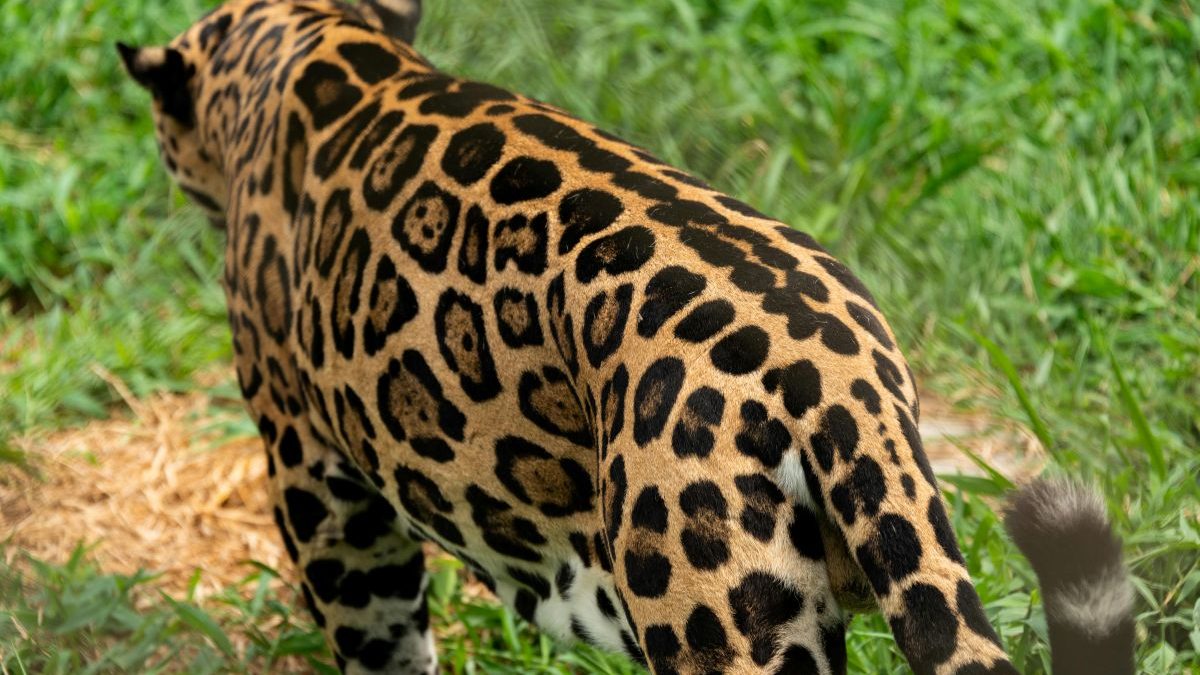
 "Representational Image. Image Courtesy/ Pexels")
At 9:10 on a Saturday night in September, a jaguar walked onto a cattle farm in Miranda, in Brazil’s Mato Grosso do Sul state, and straight into a snare trap.
Researchers from Reprocon, a group specialising in assisted wildlife reproduction, had been trying for three days. Two previous attempts ended with the cats springing the traps and vanishing. This one — a scarred male, battle-marked around the face the way older males tend to be — went straight for the bait without hesitation.
Reprocon’s founding scientific director, Gediendson Ribeiro de Araujo, administered the anaesthetic dart. Once sedated, the jaguar, later named Leonço, aged around eight and weighing 113 kilograms, was laid out on a makeshift operations table. The team took blood, fur, tick samples, physical measurements, a semen collection, and finally a small piece of ear tissue: roughly two centimetres of skin.
That scrap of ear turned out to be the only thing worth taking. Back at Reprocon’s lab in Campo Grande, the tissue was cultivated in a nutrient solution and released between 20 and 30 million fibroblast cells within a month — each one containing a complete copy of Leonço’s genome. His semen sample, when processed, was dead, probably killed by the cold air during the capture. Without the ear tissue, the operation would have counted for nothing.
A species running out of road
In the Amazon, population estimates run between 10,000 to 21,000 individuals. The Pantanal holds up to 5,000 more. In the Atlantic Forest and the Caatinga, fewer than 250 adult jaguars remain across both biomes combined, and the species is critically endangered in each.
Numbers alone don’t capture the problem. Jaguars need between 400 and 500 square kilometres of territory per animal. Deforestation has shredded that territory into fragments, leaving isolated groups with no way to reach one another.
Quick Reads
View AllWhen a population can’t disperse, it inbreeds — and inbreeding means reproductive failure, malformations, and an eroding capacity to adapt. Between 2016 and 2023, nineteen jaguars were killed on a single stretch of the BR-262 highway in Mato Grosso do Sul alone. Retaliatory killings by ranchers remain a persistent drain. Across the wider continent, the jaguar has already disappeared from more than half its historic range in South America.
What cloning can and cannot do
Reprocon was formed in 2017 with a focus on genetic conservation across multiple Brazilian species. The work centered on semen collection for years, until the limitations became impossible to ignore. Cold temperatures, the age or condition of the animal, the stress of capture: any of these can render a sample useless. A female jaguar caught in a trap offered nothing under the old approach. Somatic cell cloning changed that.
Any capture, any animal, any age or sex, can now yield viable genetic material. The biobank Reprocon has built holds frozen blood from roughly 160 jaguars, tissue from 60 individuals, and semen from 30 males. One sample comes from a young female killed on a road — an animal that would otherwise have left no genetic trace.
The cloning process works as follows: a fibroblast cell is stripped of its nucleus, which is then inserted into an egg cell that has had its own genetic material removed. An electric pulse activates the fused cell and triggers it to divide. In 2024, working with an Argentine team, Reprocon reached the morula stage (an early embryonic milestone) within three days of fertilisation. The first embryo transfer to a surrogate female is planned for this year.
There is a working precedent. In the United States, scientists spent years cloning the black-footed ferret from tissue preserved in 1988 from an animal named Willa, which died before ever reproducing. In June 2024, one of Willa’s clones gave birth to two surviving offspring at the Smithsonian’s National Zoo — the first time a cloned endangered species had reproduced. By the end of 2025, fifteen ferrets in the breeding programme carried Willa’s genes, establishing her as an effective eighth founder and breaking a genetic bottleneck that had constrained the species for decades. Reprocon has that model in mind.
The doubts are real, though. Success rates in domestic animal cloning remain low and health complications in cloned individuals are not unusual. Cloning does nothing about the roads, the ranches, or the shrinking forest corridors that are killing jaguars in the first place.
The biobank, then, is a hedge — a store of genetic material that might one day help a population that has run out of diversity to sustain itself from within. Leonço recovered from the anaesthetic within minutes and walked back into the dark. Whilst no one knows if he is still alive, a copy of him may return to the same forest.
Treya Sinha is an Arts and Lifestyle writer. She loves literature and music and wants to have a Mary Oliver-esque affinity with the world.