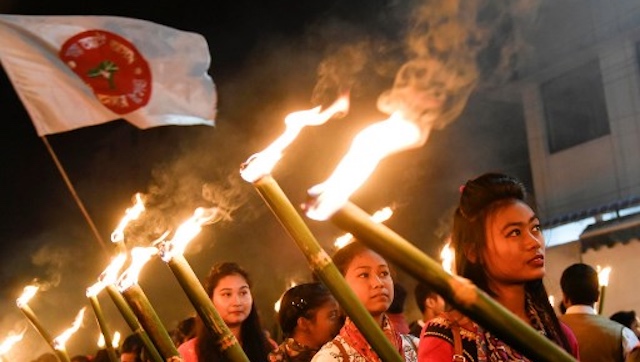
 "Who qualifies as 'Assamese'? A look at confidential report on Clause 6 of Assam Accord released by AASU")
On 25 February, a high-level committee formed by the Ministry of Home Affairs (MHA), had submitted its recommendations for implementation of Clause 6 of the Assam Accord, to Chief Minister Sarbananda Sonowal, so that it could be handed over to Union Home Minister Amit Shah. This confidential report was made public on Tuesday (11 August), by the All Assam Students Union (AASU). According to PTI, AASU said that the public has the right to know of the contents of the report on Clause 6 of the Assam Accord, a key provision that has been contentious for decades as it debates over who can be defined as ‘“Assamese people”. This report on Clause 6 defines “Assamese people” as all persons residing in the territory of Assam on or before 1 January, 1951, and their descendants. It has selected 1951 as being selected as a cut-off year, has left minority groups worried . The AASU and another committee member Nilay Dutta, who is the advocate general of Arunachal Pradesh, addressed a press conference, saying that they were releasing it only because the “government is just sitting idle”.
“It has been more than five months since we submitted the report but there is simply no action from the government. People are asking us daily what happened to it. We have finally decided to release it as the people have the right to know,” AASU chief advisor Samujjal Kumar Bhattacharya said.
So what is Clause 6 of the Assam Accord?
As per Clause 6, Constitutional, legislative and administrative safeguards, as may be appropriate, shall be provided to protect, preserve and promote the culture, social, linguistic identity and heritage of the Assamese people. The bone of contention since the signing of the pact on 13 August, 1985 has been the definition of Assamese people, which the committee tried to fix as the tribal, indigenous and all other Indian citizens residing within the territory of Assam as per the First Schedule of the Constitution on or before 1 January, 1951 along with their descendants. The signing of the accord in 1985 ended a six-year-long, violent anti-immigrant movement, sparked by anxiety by the migration into Assam from Bangladesh in the aftermath of the Bangladesh War of 1971. According to Scroll.in
, using the war as the cut-off, the Accord defined anyone who came before midnight on 24 March, 1971 as an Indian citizen in Assam. But the accord did not define who falls under the ambit of “Assamese people”. On 25 February, the high-level committee on the implementation of Clause 6, headed by Justice (Retired) BK Sharma, had submitted the report to Chief Minister Sarbananda Sonowal for handing it over to Union Home Minister Amit Shah. The chairman of the committee had submitted the report to the chief minister in the presence of the entire state cabinet, top government officials, and journalists.
‘Not acceptable for govt to neglect report’
“We do not know where the report is. Is it in the chief minister’s almirah or somewhere? Has it been sent to Delhi? It is not acceptable to neglect the report this way,” Bhattacharya said during the press conference on Tuesday. When asked if there will be any legal implication for making the report public, senior advocate Dutta said it will not have any repercussions. According to The Telegraph, the ASSU also noted that the BJP’s state unit president Ranjeet Kumar Dass’s recent observation that several recommendations in the report would be difficult to implement had forced their hands. “It is clear that the report is out in some quarters. Let there be debate and discussion on what it is not implementable,” AASU general secretary Lurinjyoti Gogoi said. Unfortunate that report was made public, says CM Soon after the report was made public, Assam chief minister Sarbananda Sonowal termed it as “unfortunate” that the AASU made the report public. Assuring that the state government is committed to implementing the said provision of the 1985 agreement, Sonowal in a statement said, the BJP-led government will not do anything that will harm the interests of the people. The Union Home Ministry had in January last year formed the committee headed by retired Union Secretary P Bezbaruah, but six of the nine members declined to be part of it, following which the panel was reconstituted on 16 July, 2019 with 14 members and Justice Sharma as its chairman. With inputs from agencies