It is highly unlikely that Manmohan Singh will ever get to write a tell-all book about his eventful 10-year tenure as Prime Minister-cum-Trustee of Gandhi Family Political Interests. If he was the tell-all type, he probably wouldn’t have been trusted as PM by Sonia Gandhi in the first place. So, at best, one can expect a book highlighting the known aspects of his prime ministership, with the juicy details of what really transpired between him and Sonia Gandhi, Rahul Gandhi and his cabinet colleagues – things that brought UPA-2 into disrepute - being left out.
The Economic Times
today (11 March) published what looks like a semi-unauthorised preface to this yet-to-be written virtual book, based on talks with PMO officials and people close to Singh. Few people come on record, but the tone and tenor of the article suggests that the author is discussing Manmohan Singh’s real concerns as he prepares to walk off into the sunset after 16 May. So what does this peek into Manmohan Singh’s key concerns tell us? We can see three concerns driving him in his last two months as PM. First, he is concerned about how history will judge him. He is terrified of being seen as another Narasimha Rao – unloved and unsung despite his achievements. [caption id=“attachment_1429499” align=“alignleft” width=“380”]
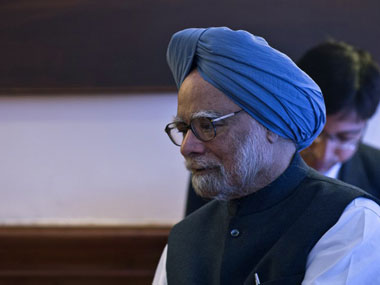
 Manmohan Singh. AFP.[/caption] Second, he is terrified by the prospect that the next government, if led by Narendra Modi, will seek to implicate him in the many scams that unfolded during UPA-2. Third, he is worried that he will not be seen as his own man, that he actively pushed projects that Sonia Gandhi or Rahul may have wanted, and nothing more. Not unexpectedly, he is, first of all, bothered by the legacy he leaves – which, he believes, is better than it looks. At his press conference in January,
he had said:
“I honestly believe that history will be kinder to me than the contemporary media, or for that matter, the Opposition parties in Parliament.” One wonders how history will be kinder when scam after scam has tumbled out of the UPA closet (2G, Coalgate, Commonwealth Games, Adarsh); when his tenure has been marked by one diplomatic mess-up after another (the deteriorating situation on the Indo-Pak LOC, where our soldiers were beheaded, the Balochistan gaffe at Sharm-el-Sheikh, failure to sign the Teesta accord with Bangladesh, blundering in our dealings with China, particularly in the face of its calculated incursions into our territory), and letting ties with Sri Lanka deteriorate); and when he leaves behind an economy mired in high inflation and low growth, among other things. It is difficult to spot too many bright spots in Singh’s second tenure beyond these two things: reducing poverty, which is his best achievement (but probably unsustainable), and legislating all kinds of rights that the state may be unable to fulfil, given straitened means. Under siege at home, Manmohan Singh has tried to showcase achievements abroad. He called the India-US nuclear deal his most satisfying moment, and last August, speaking in parliament, he spoke of the respect the rest of the world had for him: “I command certain status, certain prestige, certain respect in the council of the Group of 20,” he said. But the US’s cavalier attitude to India showed in the Devyani Khobragade affair, and the world lost respect for India once we lost our footing on the economy. Time magazine ran a cover in July 2012 calling Singh an “
Underachiever
.” The real pity is that Singh failed to command any respect back home, thanks to his secondary status in the power structure where Sonia Gandhi was seen to be the one calling the shots. Singh would like us to see his achievements in the context of the constraints he was operating under. This is probably why he said at his January press meet: “I think, taking into account the circumstances, and the compulsions of a coalition polity, I have done as best as I could…I have tried my very best to serve this country with all sincerity, with all dedication.” But the unstated Sonia-Manmohan Singh power sharing pact – where she takes the credit for good things and he the blame for things gone wrong - left Singh holding the baby in major scams. This is why the ET story talks of Singh’s second major concern: that he will be vulnerable to political witch-hunts by the next government, especially if it is headed by Narendra Modi. Says the newspaper, quoting a Singh confidant: “The PM thinks he will be targeted if Narendra Modi becomes Prime Minister. He has asked his legal team to look at cases like 2G and the coal scam, where his name figured. He is worried, withdrawn and dejected.” Politically, the PM’s worries may be overstated, for Modi has seldom targeted Manmohan Singh. His attacks have been focused more on Sonia Gandhi and Rahul, and Modi knows that attacking a meek individual like Singh won’t go down well in the polity. But the PM obviously does not think so and, in the January press conference, was particularly harsh on Modi. Not only did he say that “it will be disastrous for the country to have Shri Narendra Modi as the Prime Minister,” but he also slipped the knife in quietly: “I do not believe that I have been a weak Prime Minister. But if by ‘strong Prime Minister’ you mean that you preside over a mass massacre of innocent citizens on the streets of Ahmedabad, (if) that is the measure of strength, I do not believe that sort of strength this country needs, least of all, in its Prime Minister.” Touche. This is really Singh’s real strength: his ability to roll with the punches and then drive a knife in where it hurts most. He did this with LK Advani in parliament, who had made the same charge of weakness in 2009.
Singh said:
“Unlike the NDA’s prime ministerial candidate, I will not be found weeping in a corner while hoodlums tear down a centuries-old mosque. Nor will I be found wringing my hands in frustration while one of my Chief Ministers condones a pogrom targeted at minorities.” Singh scored with his ability to turn weakness into a strength on occasion, but he reserved his best only for those who called him weak – and especially for the BJP. In every other case, he showed far less spine, especially when it was about standing up to people in his own cabinet or his party. Thus, when A Raja decided to offer spectrum on the cheap to his cronies, Singh backed off and said he would prefer to remain at “arm’s length” from those decisions. After proposing that coal should be auctioned, Singh sat on his hands and let vested interest hijack coal blocks for free. This is one reason why he is now keen to prove that nothing wrong was done. “I have done nothing wrong, I want to go as an honourable man,” ET quoted the PM as saying to a confidant. On another occasion, he said: “I have never used my office to enrich my friends or relatives.” When it came to standing up for the country’s interests, Singh certainly played weak. His honesty was restricted to not enriching himself when he could. Worse, he proved weak even while dealing with his own cabinet colleagues. Take the case of the hugely damaging row over the date of birth of the previous Army Chief, Gen VK Singh. Defence Minister AK Antony managed to make a hash of it by failing to resolve the row before it went to court. Or by taking the general to task when he could have. And what did Manmohan Singh do? The ET story quotes one of the PM’s aides as saying that the “PM was very angry and upset but his hands were tied….he wanted the initiative to come from Antony, who said he did not want blood on his hands.” Why were Singh’s hands tied? Did Sonia Gandhi tie them, or was it his own doing? Remember, Antony is built in the same mould as Manmohan Singh, but Singh proved weak even while dealing with a weak minister. It was double jeopardy. Not only that, when Rahul Gandhi tore up his ordinance on convicted MPs, calling it “nonsense”, Singh put up with the insult, apparently with the party’s larger interests in mind. Are party interests above that of the prestige of the Prime Minister’s office? Manmohan Singh’s third major concern appears to have been to prove that he is his own man – which few believe. Thus we learn from the ET story that he was trying to push through a scheme to hand over free mobiles to poor families (har haath mein mobile) but last minute glitches put paid to this plan; that he put Shahbaz Sharif in his place when the latter invited him to visit gurdwaras in Pakistan (to which Singh apparently replied, ‘don’t bring my religion into it’). But neither story is convincing, for the popular impression is that Singh was trying to curtail more freebies. So free mobiles? As for not bringing religion into it, isn’t this the man who said that minorities have the first right to the country’s resources? Perhaps the most interesting contradiction comes in the question that everybody wants to know: why didn’t he resign if he thought some things were wrong? At the January press conference, Manmohan Singh said he never felt like resigning. He said: “I have never felt like resigning at any time. I have enjoyed doing my work. I have tried to do my work with all honesty, with all sense of integrity, without regard, or fear or favour.” But the ET story has a different tale to tell, quoting a PMO insider: “The PM was always willing to resign, but refrained from putting in his papers so as not to cause embarrassment to his party or Mrs Gandhi, with whom he shares a very good equation.” Perhaps this is the answer to the enigma called Manmohan Singh. He was blinded by loyalty to an individual called Sonia Gandhi. This loyalty enabled him to turn a blind eye to things he would otherwise have objected to. He failed to do what the country needed him to do. (Read the complete Economic Times story
here
)
Manmohan Singh. AFP.[/caption] Second, he is terrified by the prospect that the next government, if led by Narendra Modi, will seek to implicate him in the many scams that unfolded during UPA-2. Third, he is worried that he will not be seen as his own man, that he actively pushed projects that Sonia Gandhi or Rahul may have wanted, and nothing more. Not unexpectedly, he is, first of all, bothered by the legacy he leaves – which, he believes, is better than it looks. At his press conference in January,
he had said:
“I honestly believe that history will be kinder to me than the contemporary media, or for that matter, the Opposition parties in Parliament.” One wonders how history will be kinder when scam after scam has tumbled out of the UPA closet (2G, Coalgate, Commonwealth Games, Adarsh); when his tenure has been marked by one diplomatic mess-up after another (the deteriorating situation on the Indo-Pak LOC, where our soldiers were beheaded, the Balochistan gaffe at Sharm-el-Sheikh, failure to sign the Teesta accord with Bangladesh, blundering in our dealings with China, particularly in the face of its calculated incursions into our territory), and letting ties with Sri Lanka deteriorate); and when he leaves behind an economy mired in high inflation and low growth, among other things. It is difficult to spot too many bright spots in Singh’s second tenure beyond these two things: reducing poverty, which is his best achievement (but probably unsustainable), and legislating all kinds of rights that the state may be unable to fulfil, given straitened means. Under siege at home, Manmohan Singh has tried to showcase achievements abroad. He called the India-US nuclear deal his most satisfying moment, and last August, speaking in parliament, he spoke of the respect the rest of the world had for him: “I command certain status, certain prestige, certain respect in the council of the Group of 20,” he said. But the US’s cavalier attitude to India showed in the Devyani Khobragade affair, and the world lost respect for India once we lost our footing on the economy. Time magazine ran a cover in July 2012 calling Singh an “
Underachiever
.” The real pity is that Singh failed to command any respect back home, thanks to his secondary status in the power structure where Sonia Gandhi was seen to be the one calling the shots. Singh would like us to see his achievements in the context of the constraints he was operating under. This is probably why he said at his January press meet: “I think, taking into account the circumstances, and the compulsions of a coalition polity, I have done as best as I could…I have tried my very best to serve this country with all sincerity, with all dedication.” But the unstated Sonia-Manmohan Singh power sharing pact – where she takes the credit for good things and he the blame for things gone wrong - left Singh holding the baby in major scams. This is why the ET story talks of Singh’s second major concern: that he will be vulnerable to political witch-hunts by the next government, especially if it is headed by Narendra Modi. Says the newspaper, quoting a Singh confidant: “The PM thinks he will be targeted if Narendra Modi becomes Prime Minister. He has asked his legal team to look at cases like 2G and the coal scam, where his name figured. He is worried, withdrawn and dejected.” Politically, the PM’s worries may be overstated, for Modi has seldom targeted Manmohan Singh. His attacks have been focused more on Sonia Gandhi and Rahul, and Modi knows that attacking a meek individual like Singh won’t go down well in the polity. But the PM obviously does not think so and, in the January press conference, was particularly harsh on Modi. Not only did he say that “it will be disastrous for the country to have Shri Narendra Modi as the Prime Minister,” but he also slipped the knife in quietly: “I do not believe that I have been a weak Prime Minister. But if by ‘strong Prime Minister’ you mean that you preside over a mass massacre of innocent citizens on the streets of Ahmedabad, (if) that is the measure of strength, I do not believe that sort of strength this country needs, least of all, in its Prime Minister.” Touche. This is really Singh’s real strength: his ability to roll with the punches and then drive a knife in where it hurts most. He did this with LK Advani in parliament, who had made the same charge of weakness in 2009.
Singh said:
“Unlike the NDA’s prime ministerial candidate, I will not be found weeping in a corner while hoodlums tear down a centuries-old mosque. Nor will I be found wringing my hands in frustration while one of my Chief Ministers condones a pogrom targeted at minorities.” Singh scored with his ability to turn weakness into a strength on occasion, but he reserved his best only for those who called him weak – and especially for the BJP. In every other case, he showed far less spine, especially when it was about standing up to people in his own cabinet or his party. Thus, when A Raja decided to offer spectrum on the cheap to his cronies, Singh backed off and said he would prefer to remain at “arm’s length” from those decisions. After proposing that coal should be auctioned, Singh sat on his hands and let vested interest hijack coal blocks for free. This is one reason why he is now keen to prove that nothing wrong was done. “I have done nothing wrong, I want to go as an honourable man,” ET quoted the PM as saying to a confidant. On another occasion, he said: “I have never used my office to enrich my friends or relatives.” When it came to standing up for the country’s interests, Singh certainly played weak. His honesty was restricted to not enriching himself when he could. Worse, he proved weak even while dealing with his own cabinet colleagues. Take the case of the hugely damaging row over the date of birth of the previous Army Chief, Gen VK Singh. Defence Minister AK Antony managed to make a hash of it by failing to resolve the row before it went to court. Or by taking the general to task when he could have. And what did Manmohan Singh do? The ET story quotes one of the PM’s aides as saying that the “PM was very angry and upset but his hands were tied….he wanted the initiative to come from Antony, who said he did not want blood on his hands.” Why were Singh’s hands tied? Did Sonia Gandhi tie them, or was it his own doing? Remember, Antony is built in the same mould as Manmohan Singh, but Singh proved weak even while dealing with a weak minister. It was double jeopardy. Not only that, when Rahul Gandhi tore up his ordinance on convicted MPs, calling it “nonsense”, Singh put up with the insult, apparently with the party’s larger interests in mind. Are party interests above that of the prestige of the Prime Minister’s office? Manmohan Singh’s third major concern appears to have been to prove that he is his own man – which few believe. Thus we learn from the ET story that he was trying to push through a scheme to hand over free mobiles to poor families (har haath mein mobile) but last minute glitches put paid to this plan; that he put Shahbaz Sharif in his place when the latter invited him to visit gurdwaras in Pakistan (to which Singh apparently replied, ‘don’t bring my religion into it’). But neither story is convincing, for the popular impression is that Singh was trying to curtail more freebies. So free mobiles? As for not bringing religion into it, isn’t this the man who said that minorities have the first right to the country’s resources? Perhaps the most interesting contradiction comes in the question that everybody wants to know: why didn’t he resign if he thought some things were wrong? At the January press conference, Manmohan Singh said he never felt like resigning. He said: “I have never felt like resigning at any time. I have enjoyed doing my work. I have tried to do my work with all honesty, with all sense of integrity, without regard, or fear or favour.” But the ET story has a different tale to tell, quoting a PMO insider: “The PM was always willing to resign, but refrained from putting in his papers so as not to cause embarrassment to his party or Mrs Gandhi, with whom he shares a very good equation.” Perhaps this is the answer to the enigma called Manmohan Singh. He was blinded by loyalty to an individual called Sonia Gandhi. This loyalty enabled him to turn a blind eye to things he would otherwise have objected to. He failed to do what the country needed him to do. (Read the complete Economic Times story
here
)
The truth of Manmohan's legacy: He failed to do what India needed
R Jagannathan
• March 12, 2014, 09:15:17 IST
As Manmohan Singh prepares to demit office in May, he is concerned by how history will judge him. He is also worried about Modi launching a witch-hunt, if he comes to power.
Advertisement
 "The truth of Manmohan's legacy: He failed to do what India needed")