

 "The midnight that changed a nation: Inside the first hours of Independence")
At the stroke of the midnight hour, as the date changed to August 15, 1947, the centuries-old British rule came to an end.
For most of the people, it was a moment they had longed for decades when India finally achieved independence from the colonial rule. For millions, however, it was less about independence and more about the Partition.
As two new nations rose with the fall of the British rule, a Hindu-majority India and a Muslim-majority Pakistan, one of the largest mass migrations and worst episodes of communal violence began. Estimates say that around 8 million non-Muslims moved from Pakistan to India and around 7.5 million Muslims moved from India to Pakistan — both West and East Pakistan. Up to 1 million people are believed to have been killed in the communal violence.
As India embarked on a new journey, people saw the Independence Day differently — celebrations and communal violence, flag-hoisting and negotiations with princely states, and a political crisis and a new enmity were all happening at the same time.
Here is how the first few hours of independent India played out.
‘Tryst with destiny’: Nehru ushers India into independent era
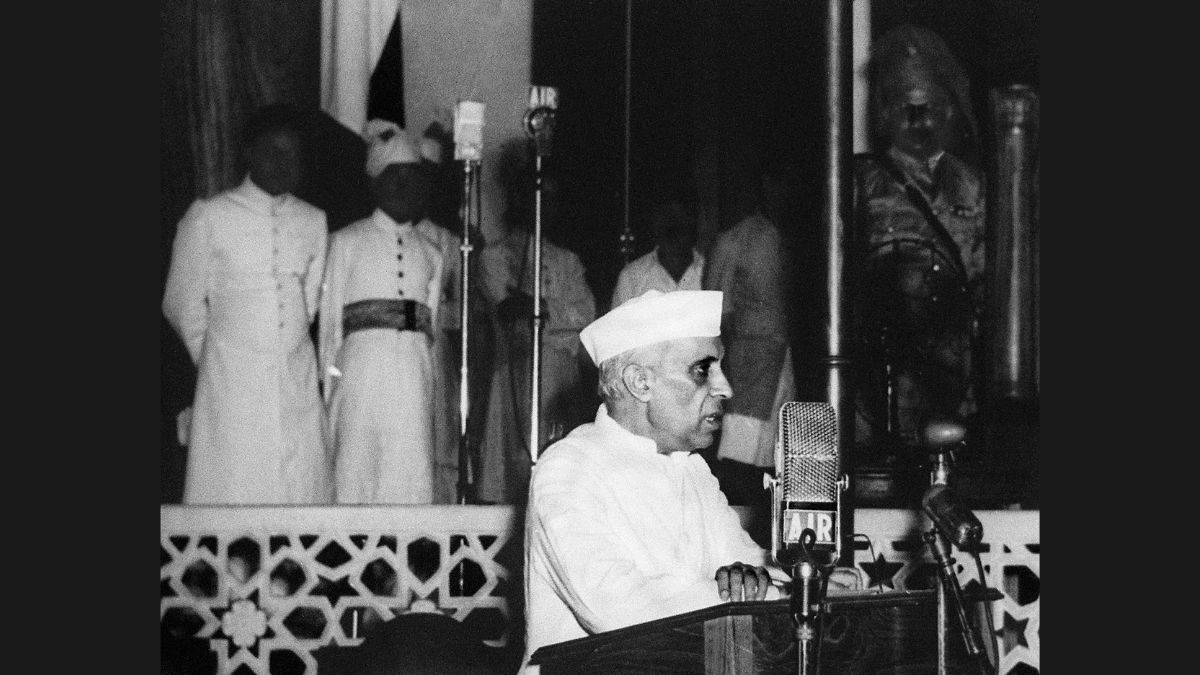
In one of the most memorable speeches of all times, Pandit Jawaharlal Nehru addressed the nation from the Parliament House on the eve of the Indolence Day.
Nehru, the first Prime Minister of India, laid down the promise that India had fulfilled that day and the promises it was setting out to fulfil in the new era.
“Long years ago, we made a tryst with destiny. And now the time comes when we shall redeem our pledge, not wholly or in full measure, but very substantially. At the stroke of the midnight hour, when the world sleeps, India will awake to life and freedom. A moment comes, which comes but rarely in history, when we step out from the old to the new — when an age ends, and when the soul of a nation, long suppressed, finds utterance,” said Nehru.
Firmly establishing India as a civilisational state, and not just an entity created from scratch in 1947, Nehru said, “At the dawn of history, India started on her unending quest, and trackless centuries are filled with her striving and the grandeur of her successes and her failures. Through good and ill fortune alike, she has never lost sight of that quest or forgotten the ideals which gave her strength. We end today a period of ill fortune and India discovers herself again.
Quick Reads
View All“The achievement we celebrate today is but a step, an opening of opportunity, to the greater triumphs and achievements that await us. Are we brave enough and wise enough to grasp this opportunity and accept the challenge of the future?”
India raises its own flag
One of the first known flag-hoisting in Independent India took place in Chennai, Tamil Nadu, which was called Madras at the time.
At 5:30 am, hours after Nehru’s speech, a 12-foot long, 8-foot wide flag, which is now at the Fort St. George Museum, was hoisted at Fort St. George.
Hours later, at 10:30 am, Nehru hoisted the flag at the Parliament House in New Delhi after the oath ceremony.
In the afternoon, Nehru hoisted the national flag publicly for the first time near the India Gate.
While the Red Fort is synonymous with the Independence Day today, it was not until the morning of the next day, at 8:30 am on Aug. 16, 1947, that the national flag was hoisted at the Red Fort.
Gandhi camps in Bengal
While millions celebrated, India’s tallest leader, Mahatma Gandhi, was neither in Delhi nor part of celebrations elsewhere.
Instead, Gandhi was in Calcutta in a last-ditch effort to contain the Partition’s violence.
Gandhi arrived in Calcutta on Aug. 9 and travelled to Noakhali in present-day Bangladesh where violence was at its peak against Hindus for months.
Hindu men were being killed, women were being abducted and raped, Hindus were being forced to convert to Islam, and their properties were being destroyed en masse. As many as 50,000 Hindus were trapped with no state protection.
Gandhi sought to be a bridge between the two communities and pledged to ensure the protection of Muslims in India if Hindus would be protected in Noakhali and elsewhere in East Pakistan (now Bangladesh).
In Bengal, tensions had been brewing for a year. After all, in 1946, the Muslim League had unleashed ‘Great Calcutta Killings’ with its call of ‘Direct Action Day’ that began with organised attacks on Hindus and spiralled into widespread communal violence, killing between 5,000 to 10,000 people.
Gandhi remained in Calcutta throughout August to work towards peace in Calcutta. He moved to Hyderi Manzil (now Gandhi Bhavan) in Beliaghata, a riot-affected area with mixed population, with HS Suhrawardy, the Muslim League leader blamed for the 1946 violence. The idea was to project unity in the face of violence.
As violence began again in late August, Gandhi began a fast on September 1 and was joined by Calcutta Police and Bar Association joined the fast in solidarity and university students, and even critics like the Statesman newspaper supported it. As many as 27 people surrendered their weapons on Sept. 4 and leaders across communities pledged to maintain peace. Gandhi broke the fast that day and peace largely returned to the city.
A divided country on path to be a republic
As Nehru set about governing the country with his new government, and Gandhi pursued a peace mission in Calcutta, large swathes of the country remained in the grips of violence as millions of people migrated and hundreds of thousands were killed in the accompanying violence.
One of the main challenges before the government was to keep the country united. Another challenge was to be truly independent.
To be sure, India was no longer under British rule. But India was yet to develop a constitution, which was finalised in 1950. Elections were held later and the first elected government took office in 1952.
In his midnight speech, Nehru acknowledged the responsibility that he and his fellow leaders had He said that “freedom and power bring responsibility” and “that responsibility rests upon this assembly, a sovereign body representing the sovereign people of India”. But he knew the road ahead would not be easy. He said “we have to labour and to work, and work hard to give reality to our dreams”.
Nehru concluded the speech with an appeal, “To the people of India, whose representatives we are, we make appeal to join us with faith and confidence in this great adventure. This is no time for petty and destructive criticism, no time for ill will or blaming others. We have to build the noble mansion of free India where all her children may dwell.”
Pakistan wages war on India
As if the Partition’s violence was not a big enough challenge, a bigger challenge was in the making.
The princely state of Jammu and Kashmir had not acceded to India.
In August, Hari Singh, the Maharaja of J&K, deliberated independence from both the new nations and sought standstill agreements with India and Pakistan. While Pakistan accepted the request, India called for negotiations.
Even though Pakistan accepted the request, it secretly worked on ‘Operation Gulmarg’ that sought to take over J&K with an armed invasion, which began with small thrusts on October 2 and escalated over the coming days. On October 20, as many as 20,000 Pakistanis launched the full-scale invasion of J&K, overwhelming the princely state’s forces, and threatening to capture the entire state within days.
As Pakistani forces neared J&K’s capital, Singh pleaded India for help and Nehru conditioned help on J&K’s accession. On October 27, J&K formally acceded to India and Indian troops were dispatched to Srinagar.
In a critical battle on November 3, around 120 Indian soldiers stationed at Budgam near the Srinagar airport battled 500-700 Pakistani attackers. They held off the Pakistanis for several hours and repelled several waves of attacks, buying the Indian forces critical time to dispatch reinforcements. They prevented Pakistanis from capturing the Srinagar airport that would have essentially allowed them to control the entire J&K. The commander of the Indian troops, Major Somnath Sharma, was killed in the battle along with over a dozen soldiers. He was awarded the first Param Vir Chakra, the nation’s highest wartime gallantry award.

 "US seizes oil tanker off Venezuela coast as Trump's pressure campaign against Maduro rages on")
 "Trump launches $1 mn 'Gold Card', platinum visa priced at $5 mn to be released soon")
 "Ukraine submits response to new 20-point peace plan to Trump administration: Report")
 "US DHS signs $140 mn deal to buy 6 Boeing 737s for deportation operations")
 "US seizes oil tanker off Venezuela coast as Trump's pressure campaign against Maduro rages on")
 "Trump launches $1 mn 'Gold Card', platinum visa priced at $5 mn to be released soon")
 "Ukraine submits response to new 20-point peace plan to Trump administration: Report")
 "US DHS signs $140 mn deal to buy 6 Boeing 737s for deportation operations")



