

 "Solving Kashmir bilaterally: Why the human security approach may help")
The Chief Minister of Jammu and Kashmir, Omar Abdullah, has said that Pakistan has a role in the Kashmir issue and that this fact has been established by several bilateral agreements. Abdullah added that it was the partition of the Indian subcontinent that gave rise to the issue. He also implied that that the root of the issue lay in competing versions and narratives of nationalism held by India and Pakistan. Is Abdullah correct in making these assertions? Does Pakistan have a role in helping resolving the Kashmir conflict? What could be such a role? [caption id=“attachment_1084831” align=“alignleft” width=“380”] 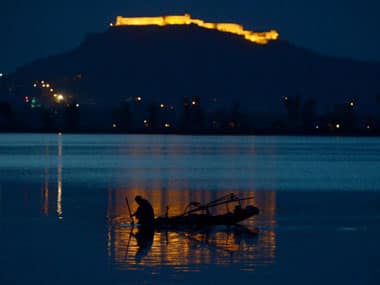 Representational image. AFP[/caption] The conflict over Kashmir between India and Pakistan can be attributed to the competing ideas of self and narratives of nationalisms and ideologies of the respective states. While Pakistan claimed and opted for separate nationhood on the basis of religion, India claimed a centuries-old composite and syncretic culture wherein different faiths and cultures formed its firmament. In a modern avatar, it was believed that a liberal, democratic and secular nature would complement this culture and a multicultural and multi-denominational India would be at peace with itself and the world at large. In this schema, Kashmir was central to both countries’ sense of self and selfhood. Both these narratives were at odds and cross purposes with each other. This is where the roots of the conflict lie and emanate from. Tremendous energy has been devoted by Pakistan to wrest Kashmir from India while as India as the status quo power has assiduously maintained its sovereign remit over Kashmir. Pakistan’s strategic objective has been to internationalise the dispute and thus catalyse third party intervention (read US intervention). The tactical means chosen for this has been the fostering and crystallising Low Intensity Conflict (LIC) in Kashmir. India, on the other hand, has resisted third party intervention and asserted that resolution of outstanding issues between India and Pakistan should be carried out in a bilateral framework. Given that Kashmir is integral to the self-hood of both nations and both are determined to stay this way, what are the chances for a comprehensive and ‘final solution’ to the conflict? The chances are slim unless there is a paradigm shift in how both nations view the conflict. If it is viewed in narrow national security and ideological terms, then the narrative will remain the same and there will be no end to the conflict. If, however, a new and a fresh look is taken at the conflict, there may be some forward movement. What new narrative could lead to a paradigm shift? The answer lies in taking a human security approach. This means that the powers-that-be in both India and Pakistan look at Kashmir from the perspective of an expansive notion of security wherein human welfare becomes sacrosanct. The subcontinent is defined by poverty and lack of development. This has naturally affected the nature and quality of lives that people live here. If people in India and Pakistan see each other as people and humans first, and Indians and Pakistanis secondarily, they can relate to and empathise with each other’s plight. The focus can then morph into improving their lives and not on fratricidal conflict. They may then also realize that there is a lot in common between the two and view the conflict as irrational. A human security approach will release the resources and energies locked in and devoted to conflict towards prosperity and development. The world beyond India and Pakistan has moved on. The European Union is a classic example of this shift. Fratricidal conflict which almost destroyed Europe has been shelved and a new idiom of cooperation defines the continent. Conflictual tendencies have been sublimated and the region is now a fully fledged democratic security community. It is not implied here that India and Pakistan collapse their sovereignty and adopt a regional identity but that they take cues from Europe and resolve all their conflicts. In this sense then prudence dictates that both countries see sense and merit in talking to each other and developing a framework and template where conflict gets transformed into co-operation and amity. Given that Kashmir is central to both India and Pakistan, all roads lead to it. Instead of becoming a sticking point and a point of contention which leads to an impasse between the two countries, Kashmir can become the bridge and a source of cooperation. What is needed is a change of perspective and perception. This can be brought about by prudent and sagacious statecraft-something that has unfortunately not been in great abundance in both countries. It is about time that this changes so it can be it be clearly demonstrated to the world at large that we, the peoples of the subcontinent, are not children and that we can sort out our issues in a mature manner. It is this approach that will redeem us, especially in our own eyes and one that will bequeath a legacy defined by peace and prosperity upon posterity.
The conflict over Kashmir between India and Pakistan can be attributed to the competing ideas of self and narratives of nationalisms and ideologies of the respective states.
Advertisement
End of Article


 "Russian drones over Poland: Trump’s tepid reaction a wake-up call for Nato?")
 "As Russia pushes east, Ukraine faces mounting pressure to defend its heartland")
 "Why Mossad was not on board with Israel’s strike on Hamas in Qatar")
 "Turkey: Erdogan's police arrest opposition mayor Hasan Mutlu, dozens officials in corruption probe")
 "Russian drones over Poland: Trump’s tepid reaction a wake-up call for Nato?")
 "As Russia pushes east, Ukraine faces mounting pressure to defend its heartland")
 "Why Mossad was not on board with Israel’s strike on Hamas in Qatar")
 "Turkey: Erdogan's police arrest opposition mayor Hasan Mutlu, dozens officials in corruption probe")



](https://images.firstpost.com/wp-content/uploads/2013/09/kashmir_AFP.jpg)