Section 377 Reactions LATEST Updates: The International Commission of Jurists (ICJ) welcomed the Supreme Court verdict decriminalising the act of consensual sex between individuals identifying as homosexuals. However, the commission’s Asia Pacific Director Frederick Rawski said: “Even a landmark decision by the Indian Supreme Court cannot alone end the discrimination against people based on their sexual orientation or gender identity. It is time for the Indian Parliament to conduct wide-ranging review of existing legal framework, repeal discriminatory laws, and address other gaps in the law that prevent LGBT persons from fully exercising their rights." Kiruba, secretary at the Tamil Nadu Aravanigal Association — the first association of transwomen in Tamil Nadu — told Firstpost that the transwomen who indulge in illegal activities, like if taking up sex work, will continue to face harassment from the police and their clients. “Complaints that individuals make to the police about harassment by transwomen may not lead to a Section 377 case. But the police will still file cases of fraud, theft, public nuisance, etc.” they said. A transgender activist from Calcutta, Raina Roy, told Firstpost, “People have been calling Section 377 gay law or homosexuality law for the longest time when in fact it does not pertain to the sexual behavior of just this group of people.” She said that, personally for her, it is a big win as a transwomen in Calcutta as she has been working against this Section for the longest time. While majority of the nation is cheering Supreme Court verdict by decriminalising Section 377, transpersons are not very excited over the verdict. Transman and independent researcher from Karnataka Sunil Mohan told Firstpost that the major drawback was while conducting sensitization programs for the Police and authorities from the government is on the question of sexuality of the trans community. This judgment has rightfully upheld the point that sexuality should be decided on the basis of constitutional morality and not otherwise. Author of ‘The Truth About Me: A Hijra Life Story’ and ‘A Life in Trans activism’ Revathi told Firstpost, “A lot of effort has gone into this judgment, I am thankful to all those who have made this possible. But realistically speaking, the judgments of the Supreme Court has little to do with the manner in which it transforms into rights or as to how society functions. The Dalit and Adivasi community has led struggles for inclusivity and policies reflecting affirmative action but their reality is a different question altogether. We live in times where the ruling government isn’t sensitive to people’s struggles or choices. How far will governments really try to incorporate policies which translate into something tangible for the community? Section 377 has been struck down but I don’t see any connection between this and the lived realities of transwomen.” Filmmaker and producer Karan Johar took to Twitter soon after it became clear that the Supreme Court is most likely to strike down the anti-LGBT Section 377 of the IPC and said, “Historical judgment!!!! So proud today! Decriminalising homosexuality and abolishing #Section377 is a huge thumbs up for humanity and equal rights! The country gets its oxygen back!” Supreme Court’s landmark ruling has been hailed by people from all walks of the society. Homosexuality is not an offence in India and it is not a mental disorder, five Supreme Court judges declared in a spectacular leap for gay rights in the country and a rainbow moment in its history. The Supreme Court overruled its own 2013 decision and partially struck down Section 377, a controversial British-era law that banned consensual gay sex. The ban is irrational, indefensible and manifestly arbitrary, the judges said. “Take me as I am,” said Chief Justice of India Dipak Misra, toasting gay pride. A five-judge Constitution bench of the Supreme Court Thursday unanimously decriminalised part of the 158-year-old colonial law under Section 377 of the IPC which criminalises consensual unnatural sex. In a strongly-worded order, the court said that Section 377 of IPC was weapon to harass members of LGBT community, resulting in discrimination. SC terms part of IPC’s Section 377, which criminalises consensual unnatural sex, irrational, indefensible and manifestly arbitrary. The Supreme Court also said that other aspects of Section 377 dealing with unnatural sex with animals and children remain in force. Section 377 of IPC was weapon to harass members of LGBT community, resulting in discrimination. Any kind of sexual activity with animals shall remain penal offence under Section 377 of the IPC, the Supreme Court noted. [caption id=“attachment_4895941” align=“alignleft” width=“380”]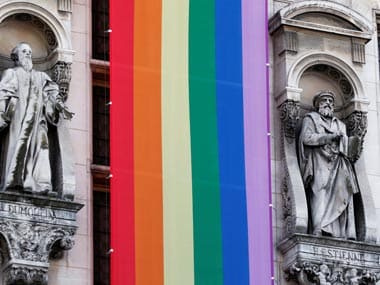 Representational image. Reuters[/caption] A five-judge Constitution bench headed by Chief Justice Dipak Misra termed the part of Section 377 of the Indian Penal Code which crimiminalises unnatural sex as irrational, indefensible and manifestly arbitrary. The bench, which also comprised Justices R F Nariman, A M Khanwilkar, D Y Chandrachud and Indu Malhotra, struck down Section 377 as being violative of right to equality. The top court, in four separate but concurring judgements, set aside its own verdict in the Suresh Kaushal case. Section 377 refers to ‘unnatural offences’ and says whoever voluntarily has carnal intercourse against the order of nature with any man, woman or animal shall be punished with imprisonment for life, or with imprisonment of either description for a term which may extend to 10 years, and shall also be liable to pay a fine. The apex court, however, said other aspects of Section 377 of IPC dealing with unnatural sex with animals and children shall remain in force. The historic judgement came on a batch of writ petitions filed by dancer Navtej Jauhar, journalist Sunil Mehra, chef Ritu Dalmia, hoteliers Aman Nath and Keshav Suri and business executive Ayesha Kapur and 20 former and current students of the IITs. They had sought decriminalisation of consensual sex between two consenting adults of the same sex by declaring Section 377 illegal and unconstitutional. The issue was first raised by the NGO, Naaz Foundation, which approached the Delhi High Court in 2001. The Delhi High Curt had in 2009 decriminalised sex between consenting adults of the same gender by holding the penal provision as “illegal”. This high court judgement was overturned in 2013 by the apex court which also dismissed the review plea against which the curative petitions were filed which are pending. The writ petitions were opposed by Apostolic Alliance of Churches and Utkal Christian Association and some other NGOs and individuals, including Suresh Kumar Kaushal.
Section 377 reactions updates: Time for Parliament to review existing laws, says International Commission of Jurists
The International Commission of Jurists (ICJ) welcomed the Supreme Court verdict decriminalising the act of consensual sex between individuals identifying as homosexuals. However, the commission’s Asia Pacific Director Frederick Rawski said: “Even a landmark decision by the Indian Supreme Court cannot alone end the discrimination against people based on their sexual orientation or gender identity."
)
‘What makes life meaninful is love’: Excerpt from DY Chandrachud’s judgment
‘SC judgment closes door on dark chapter of Indian history’
Hailing the Supreme Court judgment decriminalising consensual gay sex, Amnesty International India Thursday said the verdict gave hope to everyone fighting for justice and equality.
“The judgment closes the door on a dark chapter of Indian history. It marks a new era of equality for millions of people in India," said Asmita Basu, Programmes Director, Amnesty International India.
“The remarkable victory today is a milestone in the three decade old struggle by the LGBTI community and their allies in India,” she added. However, the LGBTI community’s struggle for their rights including marriage, adoption and inheritance will continue, Basu said.
Time for the Parliament to conduct wide-ranging review of existing legal framework: International Commission of Jurists
The International Commission of Jurists (ICJ) welcomed the Supreme Court verdict decriminalising the act of consensual sex between individuals identifying as homosexuals. In a statement, the commission said, “This long-awaited judgment testifies to the work of activists and lawyers in India, who have shown the potential of the law to affirm human rights and equality.”
The commission’s Asia Pacific Director Frederick Rawski said: “This judgment will not only have an impact in India. Its influence should extend across the world. The ICJ hopes that it will provide an impetus for other countries, especially those of the Commonwealth of Nations, to revoke similar provisions that criminalise consensual sexual relations."
“Even a landmark decision by the Indian Supreme Court cannot alone end the discrimination against people based on their sexual orientation or gender identity. It is time for the Indian Parliament to conduct wide-ranging review of existing legal framework, repeal discriminatory laws, and address other gaps in the law that prevent LGBT persons from fully exercising their rights,” Rawski added.
‘Supreme Court judgment will be a strong weapon for us’
Somya, transgender activist and politician, has contested from Gandhinagar Constituency in the Karnataka Legislative elections as the BSP candidate. He said, “This judgment has been made possible because of the collective struggle of LGBTIQ+ movement. It is upsetting that as this is happening, there are still so many groups who continue to oppose us. But I am not going to spend my time worrying about them or reacting to them. This is a time for celebration.
“After this, state governments and the central government cannot keep us out of the purview of policy level inclusion and will have to go beyond superficial steps. They will have to consider us a political bloc more seriously. These governments have shown concern towards us no doubt, it is clear from the Bills being discussed in the Lok Sabha like the Trans Bill. The Karnataka government brought about a policy in September 2017 for discussion. But at the level of implementation, I don’t see much progress. But with this historic judgment, I feel like we can use this a source of pressure to force governments to act. Now this judgment, read with Nalsa judgment, will be a really strong weapon for us. But it is on the community to use it in this manner, to our advantage.”
‘There is clarity about Section 377 now’
Noorie, India’s longest PL-HIV (person living with HIV), said, “There is a clarity about Section 377 in society now. Facing cruel atrocities back in the day, we’ve been fighting this Section since 1993. The brutalities by the police used to be horrible in those days. This was a time when there was absolutely zero acceptance for transwomen. They would pick up transwomen according to their whim and torture them in custody. What they would do is foist petty cases on us like theft, ganja smuggling but also this section which was non-bailable. This started becoming a pattern. Any transwomen they would find would be beaten up, abused, and thrown into jail with this Section against her. She would remain in jail and be abused every day.
“That is why we started this struggle against this Section. I remember a case where Pandian, a transwoman was arrested by the Tamil Nadu Police under Section 377. She was sexually tortured in custody on an everyday basis. Not being able to tolerate this, she immolated herself in front of the police station. There was nothing in the ambit of the Indian Penal Code to recognize the brutalities faced by her. We followed up her case till the Supreme Court but ultimately it fell flat. Nothing came out if it. Many leaders have emerged over the years to further this struggle and I am glad that the present generation of leaders have made today’s judgment possible for the community.”
‘SC judgment won’t change much for transwomen’
Kiruba, secretary at the Tamil Nadu Aravanigal Association — the first association of transwomen in Tamil Nadu — said,“Section 377 has been used to foist false cases on transwomen in the past, I agree. But transwomen also have a role in this. Let me be very frank. Even now, if they keep sex to their families and their house, there won’t be a problem. But if they indulge in illegal activities, like if they take up sex work, do you think the police won’t arrest them? It is true that they turn to sex work because they don’t have other livelihood options. Also, now, complaints that individuals make to the police about harassment by transwomen may not lead to a Section 377 case. But the police will still file cases of fraud, theft, public nuisance, etc. Clients go to police to complain many times too.
“Now, instead of 377, the police will say that ’this transwoman stole a ring from her client’, or ’that transwoman publicly created nuisance’. These cases won’t stop with one judgment. Just a few days back, an educated woman studying in Canada was arrested for talking against the government. Everybody opposed this and she got bail within a day only because she was educated. Would the same happen with the false cases against transwomen? Will people rally against the authorities in such cases too? I don’t think so. But our association had a lot of difficulties to discuss sexuality of the community, striking down Section 377 will make it easier.
“I think gay men will benefit most out of this. They’ve been hiding their sexuality behind closed doors till now, from here on they can be open about it, as they’ve been demanding. I don’t think it will change much for my community.”
‘We have a long road ahead to make India truly LGBTQ-inclusive’
Parmesh Shahani, Head, Godrej India Culture Lab told Firstpost: “When I wrote my book back in 2008, the queer movement in India was on the cusp of change and we had the landmark Delhi High Court judgement 2009. I could have never imagined the rollercoaster ride that lay ahead with the resurgence of Section 377 in 2013. But today has alleviated all that. It’s not just the verdict but the language used by the honourable judges. We have come a long way and never has the rate of change been as fast as it has over the past two years. What we are seeing is the culmination of a very long struggle by individuals and collectives who have pledged to create a free and equal India for its queer citizens.
“While we celebrate this victory, we must acknowledge that we have a long road ahead to make India truly LGBTQ-inclusive. Civil society needs to come together to convert the intent of the Supreme Court verdict to action. The real work starts now. I feel the corporate world is the grounds on which the next victories for equal rights will be won. A lot of companies are progressive and want to promote equality at work but had erroneously believed that Section 377 made inclusive policies illegal. With today’s verdict many more corporates will come out in support. To translate it into action, it would mean the conscious introduction of anti-discrimination policies, same-sex partner benefits, adoption leave, inclusive health insurance, gender transition policies, and so on. At the Culture Lab, we are presently working on a paper on Transgender inclusion at the workplace, which will have steps provided to be replicated in other corporates. I am ecstatic that the first breakthrough has been provided in the highest court of law in India and excited about the road ahead. Today, we all celebrate.”
Humsafar Trust takes out pride parade in Mumbai
Humsafar Trust is a Mumbai-based NGO which promotes LGBT rights.
Parliament has already recognised non-discrimination on basis of sexual orientation
In his judgment, Justice RF Nariman said that Parliament in the Mental Healthcare Act has already recognised non-discrimination on the basis of sexual orientation.
‘Getting religious groups to accept LGBT individuals is our biggest obstacle’
Romal L Singh, 32, is a Bengaluru-based LGBT/human rights activist and identifies openly as gay. Speaking on the Centre to carry out sensitisation of police forces etc, he said, “Even if the government doesn’t do it, we will do it. We would love for the Centre and state governments to do it, but even if they don’t take the reading down that seriously, its not like the movement ends. The movement is not over. For those of us working, our job is not done, this is just the first step. Now that the court is on our side, we will go ahead and sensitise people. We will barge into public service offices and say, ‘Hey, we want to talk to you about who we are, so that you know how to treat us.’ And we won’t be scared because we are not criminals anymore. We can finally have that conversation without constantly fearful of being arrested.”
On homosexuality and religion, he said, “Our biggest obstacle now is to get religious groups to accept us. 80 percent of the country is under some religion or the other. If religious leaders stop saying the crap they say about us constantly and start understanding that we just want to co-exist alongside them, I think we’d have penetrated most of the country in a much much more effective manner.”
Swiggy, Indigo embrace SC ruling
App-based delivery service Swiggy also changed it’s logo colour from orange to the hues of a rainbow.
Milli Gazette calls SC verdict ‘a step towards self-destruction’
Reacting to the Supreme Court verdict on Section 377, English-language fortnightly Milli Gazette said that it was a “step towards self-destruction”. The newspaper describes itself as the “Indian Muslims’ Leading English Newspaper”,
‘Today, we are no more criminals’
Ankit Bhuptani, head of the Mumbai branch of Gay and Lesbian Vaishnava Association said, “It is a day of celebration, extremely happy. The law now says not just homosexuals, but even heterosexuals can indulge in oral and anal sex. The impact of the judgment is going to be huge because earlier we could not ask for civil rights, adoption rights and marriage equality and we were considered as criminals. Today, we’re no more criminals, we can go ahead and think of marriage equality and so on.
“I was considered a criminal from the day I was born until today just because of my sexual orientation was different from the people. Today is a huge day and I’m no more a criminal. For the first time, I’m breathing in a free India. The British left us 71 years ago, but the law still ruled us. Finally we’ve gotten independence from the law.
“The next step would be exploring how we can file for equal civil rights, laws against discrimination based on gender and sexuality, civil partnership rights and adoption rights.”
SC verdict an important step forward towards a liberal, tolerant society, says Randeep S Surjewala
Congress spokesperson Randeep S Surjewala took to Twitter to hail the Supreme Court verdict decriminalising consensual sex between individuals belonging to the LGBTQIA+ community.
‘Justice for all, freedom for all, freedom to choose, freedom to be. This is India,’ says actor Ritesh Deshmukh
RSS says that homosexulaity is not a crime but same-sex marriages are ’not natural’
“RSS does not believe homosexuality is a crime, but marriages between same sex partners are against nature,” RSS functionary Arun Kumar told PTI.
Congress puts out mock video to criticise BJP’s conservative stand
RSS reacts to SC verdict, says homosexuality not criminal but unnatural
The RSS has put out a statement saying that it does not believe that homosexuality is a criminal offence but its not natural. “The Indian society did not accept such relations and this issue needs a social and psychological solution,” it said.
‘New dawn for members of LGBTQ community, activists’
Hailing the Supreme Court’s landmark judgement, Manabi Bandyopadhyay, the country’s first transgender college principal, told PTI that it was a “new dawn” for members of the LGBTQ community and activists. The judgment would enable every community member to claim his/her rightful place in the society, she said.
“I have been fighting for my rights since 2001. I have seen many highs and lows but never gave up,” Bandyopadhyay, the principal of Krishnanagar Women’s College said. “Today, for the past half an hour, I have been getting innumerable congratulatory calls. It is like a new era and a new dawn for all of us associated with the movement,” she added. She however, said that she did not think that the verdict would overnight change the attitude of people with patriarchal mindsets towards the transgender community. But, she said that, “With the apex court judgment,the society at large will begin to look at LGBTQ community, including transgenders, in a more positive way. We have come half way, there is still a long road ahead.”
The activist, who took charge as the principal in 2015, had resigned the following year, citing non-cooperation from teaching, non-teaching staff and students of her college. Her resignation, however, was not accepted by the state education department and she resumed office in January, 2017.
Director Hansal Mehta congratulates Apurva Asrani
‘Not going back anymore’
“Growing up queer for me, like many others of my age, was extremely difficult. Mainly because of the stigma we are subjected to and the lack of awareness around gay rights. Ever since I have found assurance in my orientation, I have met so many inspiring people, who have had greater struggles’,” comedian Navin Noronha told Firstpost.
“An archaic and stupid law like Section 377 was a challenge to my integrity fundamentally. I remember when the 2013 verdict was announced, I was traveling in a local train and I broke down, sobbing uncontrollably. Today again I wept the same way, but the circumstances are far more different. The main things that have changed from 2009 to today is that, the queer population is not in the backend anymore. We are brushing shoulders with mainstream celebrities and claiming our space in the popular culture. At the same time, there are activists who are working at the health and safety level, who also need to be commemorated. It’s just the beginning, but the revolution has kicked off,” Noronha said.
“No going back anymore,” he concluded.
Ayushman Khurana calls the verdict ’the new sunshine of a progressive India’
‘I don’t know how things will be few years from now, but this verdict is a personal victory for me’
A transgender activist from Calcutta, Raina Roy, told Firstpost, “People have been calling Section 377 gay law or homosexuality law for the longest time when in fact it does not pertain to the sexual behavior of just this group of people.”
“In 2011, newspapers across the country put out statements like ‘sex between homosexuals is criminal’ and ‘homosexuality is criminal’. This kind of reductionist behavior should stop, now that that judgment is here. The judgment clearly says this is about sexual relationships between individuals and ingrains fundamental rights into the discourse,” she remarked.
She said that, personally for her, it is a big win as a transwomen in Calcutta as she has been working against this Section for the longest time. “I’m being told that this will make me and my community more acceptable in the eyes of society but I don’t know if that is the case. We had a similar judgment before and it was overturned. I don’t know what to expect or how things will be few years down the line but, for the moment, I am overjoyed that this has come at a time when I am alive,” said Roy.
‘Public understanding of the sexuality of the community is very complicated’
Transman and independent researcher from Karnataka Sunil Mohan told Firstpost that the major drawback was while conducting sensitization programs for the Police and authorities from the government is on the question of sexuality of the trans community. This judgment has rightfully upheld the point that sexuality should be decided on the basis of constitutional morality and not otherwise.
“Public understanding of the sexuality of the community is very complicated. There are so many myths and curiosity around our sexuality but there is a hesitation to understand this and also reluctance. Though we had the NALSA judgment talking about rights of the community, it left the question of sexuality open. The Police has always used this as a weapon against transwomen. Violation of their bodily rights by the State could never be viewed as sexual assault or as sexual harassment. Post-Nalsa, though authorities have been pretending to be inclusive, they always seemed to reduce identity of transwomen to sex work and the illegality of ‘sex’. We’ve had umpteen conversations about why transwomen need to take to sex work but Section 377 was being used against sex workers from the community. Section 377 has affected the trans community the most and I’m glad that this section being struck down will help in this regard.”
Hrithik Roshan tweets
“Nothing will change overnight”
Speaking to reporters outside the Supreme Court, ecstatic group of people for whom the verdict changes the way they live, said that the verdict is not a magic lamp. “The community should keep this in mind that things won’t change overnight.”
The verdict will not change the mindset in a day, and the real task will actually begin now as the LGBTQ community becomes part of the mainstream. When there is a monumental change in the way society lives, challenges will arise but only through dialogue and discussion can the two opposing views start seeing each other’s point of view.
Thanks for giving us our right: Sridhar Rangayan
Filmmaker, festival director of KASHISH Mumbai International Queer Film Festival and a petitioner in the Section 377 case Sridhar Rangayan told Firstpost that the only way to describe this was with one word — Epic.
“I am so thankful to the Supreme Court for this historic judgement, so thankful to India for finally giving us our rights. But most importantly, I’m so thankful to all the allies who have stood with us over the years lending us support and giving a voice to our struggle.”
Transperson Speaks: SC judgments has little to do with the manner in which it transforms into rights or as to how society functions
Author of ‘The Truth About Me: A Hijra Life Story’ and ‘A Life in Trans activism’ Revathi said:
“A lot of effort has gone into this judgment, I am thankful to all those who have made this possible. But realistically speaking, the judgments of the Supreme Court has little to do with the manner in which it transforms into rights or as to how society functions. The Dalit and Adivasi community has led struggles for inclusivity and policies reflecting affirmative action but their reality is a different question altogether. We live in times where the ruling government isn’t sensitive to people’s struggles or choices. How far will governments really try to incorporate policies which translate into something tangible for the community? Section 377 has been struck down but I don’t see any connection between this and the lived realities of transwomen. We still won’t be overnight granted access to the basic necessities of life that we’ve been struggling for. This section has been used as a tool to oppress transwomen for the longest time by foisting false cases on them. Now instead of that, they’ll use other sections. There are so many loopholes in the legal system. They’ll foist cases of theft, smuggling and other similar crimes to continue this reduction of our existence to that of criminals, like they’ve been doing for a while. Tara died in front of a Police Station in Chennai less than a year back. The police says she immolated herself but they took a video of her doing this. Who is to be blamed here? In front of a Police station if a woman burnt herself and isn’t stopped, that means the authorities still don’t view as they should. As the Nalsa judgment tells them to view us. I am 58 now and in my experience, in spite of everything that we take out campaigns for, there is so much that needs to change at the level of just perspective towards the community.”
Popular commentator and satirist Ramesh Srivats tweeted:
‘Section 377 decriminalised but this in no way takes away the vulnerabilities of transpersons’
Transwoman leader and founder of Telanaga Hijra Transgender Samiti Rachana Mudraboyina said:
“Consensual sex between two adults has been decriminalised but this in no way takes away the vulnerabilities of transpersons, for instance those on the roads doing sex work or begging. I would kike to talk about three points. The court is silent about civil rights like surrogacy rights, marriage rights and property rights. This is still a grey area. Secondly, there is both the Trans Bill and anti-trafficking bill which criminalizes the community. Does this judgment mean that members of the community who are sex workers are safe? Thirdly, it decriminalizes same sex relationships but what about crime and violence faced by the community within their families? There is so much intimate partner violence within the community. Does this law protect the community from intimate partner violence? Will transpersons be able to complain against this form of violence? Or does it go against them? After the coming of the Nalsa judgment, we’ve been regularly following up with the local authorities in Telangana and Andhra Pradesh regarding the violence faced by the community. It has worked as a source of pressure as this has helped us in our collectivization. But still, the inclusivity that we expected at the level of policy and laws hasn’t happened. The sensitization within professional spaces across the spectrum hasn’t happened too. Sonia, a hijra transwoman from Hyderabad faced an acid attack and it took us three years to claim her compensation. The authorities wanted to physically verify if she is a transwoman, inspite of the Nalsa judgment. That brings us back to our core argument that acknowledgment of a right means nothing. It is a good beginning but on the ground we face these difficulties every day. The push for inclusiveness using this right will have to be led by the community itself, the government has never proactively taken steps in this regard.”
Bye Bye 377, Thank you Supreme Court, tweets Farhan Akhtar
Decriminalisation is but the first step: DY Chandrachud
The Supreme Court noted that Decriminalisation is but the first step.“The Constitution envisages much more.” Justice DY Chandrachud said, “LGBTs victim of Victorian morality. Constitutional morality and not Societal morality should be the driving force for deciding validity of Section 377.”
The country gets its oxygen back, says Karan Johar
Filmmaker and producer Karan Johar took to Twitter soon after it became clear that the Supreme Court is most likely to strike down the anti-LGBT Section 377 of the IPC and said, “Historical judgment!!!! So proud today! Decriminalising homosexuality and abolishing #Section377 is a huge thumbs up for humanity and equal rights! The country gets its oxygen back!”
While we must celebrate the decision, we should also remember that it is this very Court that overturned the Delhi High Court’s 2009 judgment
While Supreme Court collected applause for delivering a landmark judgment by ruling that homosexuality isn’t an offence in India, a few said that it is crucial to remember that the institution “is not without fault.”
‘2009 judgement was a breath of fresh air and we soaked it all in’
Model, actor and equal rights activist Sushant Dighvikar — who was Mr Gay India in 2014 — spoke with Firstpost in light of the Supreme Court’s ruling on Section 377. Edited excerpts:
What for you have been the major milestones along this journey of scrapping Section 377?
(What we appreciate is that) there have been so many supporters of equal rights for the LGBTQ community, from even outside the community. Straight allies have been with us all through our fight for equality. We are going through a revolution and I think we deserve to be heard and respected.
One also thinks of the 2009 Delhi HC ruling, which had felt like such a landmark at the time — only to be overturned by the SC in 2013. What did those intervening years feel like?
They weren’t the easiest. The 2009 judgment was a breath of fresh air and we soaked it all in. And then in 2013, our brief moment of triumph was taken away from us. They tried to push us back inside the closet. But I guess it was too late… our fight got stronger and harder and today we welcome the SC’s verdict.
Section 377 should have left with the Britishers: Sushant Dighvikar
Model, actor and equal rights activist Sushant Dighvikar — who was Mr Gay India in 2014 — spoke with Firstpost in light of the Supreme Court’s ruling on Section 377. Edited excerpts:
What has the journey to this moment, as the SC pronounces its ruling on Sec 377, felt like — for you, personally, and for queer Indians and allies?
I have been out and about for a long time now. I was among the youngest TV show hosts who was openly gay. Back then, I was scared and worried about the backlash because of my sexual orientation. But I had amazing allies who helped me through those trying years. Over the years, the mindset has changed and it’s time indeed that Section 377 was scrapped. It’s not even an Indian construct! It is a Victorian relic, and reflects a colonial mindset. Section 377 should have left when the British left our country, it should have ended with the end of their oppressive and inhumane rule. Section 377 has now been thrown in the bin — which is where it belongs. It violated the fundamental rights of millions of Indians — rights the Constitution promises all the citizens of this great country.