 "New 3-point Modi doctrine redefines India’s war on terrorism")
A day after his first televised speech since the Operation Sindoor, Prime Minister Narendra Modi visited the Adampur airbase in Punjab that Pakistan attempted to attack during the recent military standoff over the Pahalgam terror attack of April 22, killing 26 people at popular tourist meadow in Jammu and Kashmir.
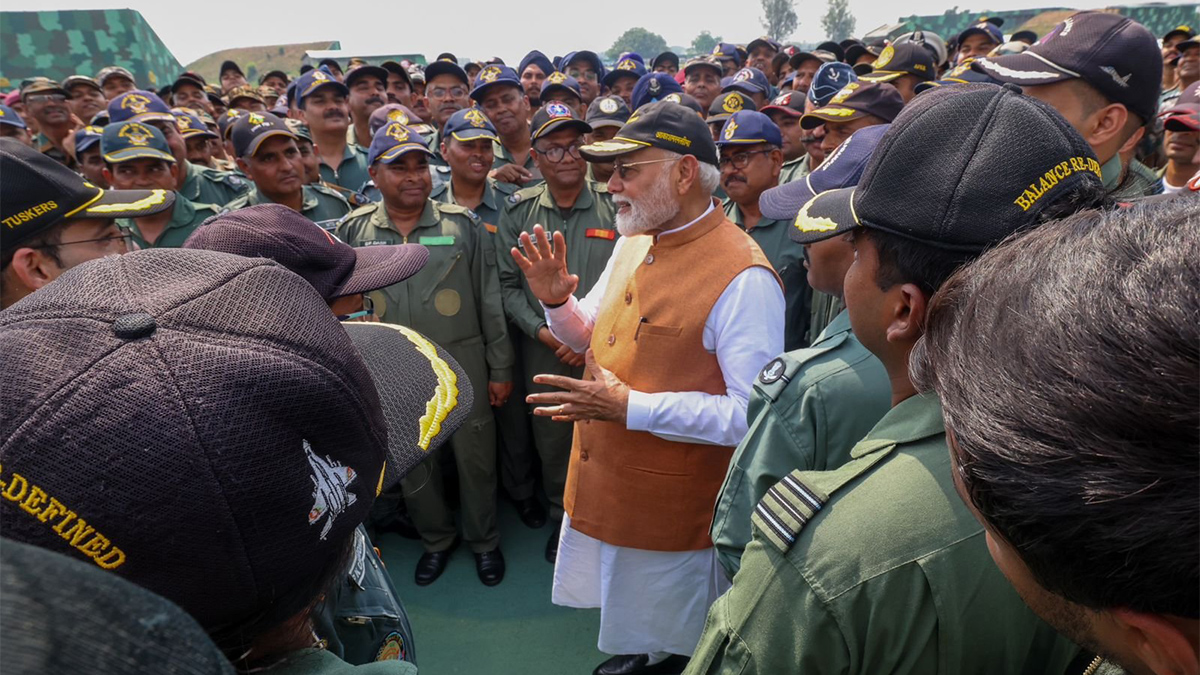
PM Modi’s visit was filled with symbolic messaging as he met soldiers from the Indian Air Force, the Indian Army and the Border Security Force at the Air Force Station, Adampur. He wore a cap that denoted both Trishul (trident) and Tandav (the famous dance of Shiva in angry form), and also a war cry besides being the insignia of the Western Air Command, whose Eighth Wing is based in Adampur.
The prime minister’s visit at the airbase Pakistan tried hard to hit saw a roar that would have rivalled the scream of missiles launched from the S-400 air defence system, against whose background PM Modi was photographed purposefully. Pakistan had claimed that it destroyed India’s S-400 air defence system.
To top it up, there were chants of ‘Bharat Mata Ki Jai’ (translating to victory to Mother India) to make the atmosphere electrifying for soldiers, who had turned up to listen to PM Modi, who said Operation Sindoor reminded the country’s enemies of the slogan that is India’s battle-cry.
Prime Minister Modi addresses Indian Armed Forces on Tuesday
Addressing the air warriors and soldiers with steely resolve, Prime Minister Modi reaffirmed the message he had delivered to the nation on Monday: India’s fight against terror has entered a new, unforgiving era. Going forward, he declared, three principles will guide the nation’s response.
Quick Reads
View All- India alone will decide the time, place and manner of its retaliation.
- There is no tolerance for nuclear blackmail, meaning the shadow of nuclear weapons will not shield those who sponsor or shelter terror.
- There will be no distinction — none — between terrorists, their masterminds or the states that enable them.
On Tuesday, Prime Minister Modi visited AFS Adampur to meet our brave air warriors and soldiers. “It was a very special experience to be with those who epitomise courage, determination and fearlessness,” the prime minister said in a statement on X.
Earlier this morning, I went to AFS Adampur and met our brave air warriors and soldiers. It was a very special experience to be with those who epitomise courage, determination and fearlessness. India is eternally grateful to our armed forces for everything they do for our nation. pic.twitter.com/RYwfBfTrV2
— Narendra Modi (@narendramodi) May 13, 2025
With the strikes in Balakot and Uri, Prime Minister Narendra Modi redefined the contours of India’s response to external threats. Following Operation Sindoor—India’s most intense military action since the Kargil War—Prime Minister Modi outlined a new counterterrorism strategy.
**Click here for India-Pakistan Ceasefire Live Updates**A doctrine redrawn: Modi’s strategic shift
Importantly, Prime Minister Modi maintained strategic ambiguity. Military operations were described not as concluded but merely paused, placing the onus on Islamabad’s future actions. “In the days ahead,” he said in his address to the nation on Monday, “Pakistan will be judged solely on its conduct and intentions.”
Framing it as a “ new normal,” India’s policy shift introduced a heightened level of assertiveness and lowered its threshold for retaliatory strikes in the event of future provocations.
“This marks the continuation of our evolving counter-terror policy,” the prime minister said. “From surgical strikes to air strikes, and now to Operation Sindoor, each phase reflects an escalated commitment and a new standard in our resolve.”
India’s new counter-terror playbook
Another standout moment was Prime Minister Modi’s explicit naming of terror networks such as Jaish-e-Mohammed and Lashkar-e-Taiba, and to link them with notorious international attacks in US and UK, the Indian Express reported. This situated India’s counterterrorism efforts within a globally recognised security framework shaped by post-9/11 principles.
He also spotlighted India’s military preparedness and superiority. “The world watched as Pakistan’s drones and missiles were neutralised mid-air by our robust defence systems. While they aimed for our borders, we reached deep within Pakistani territory. Our drones and missile systems hit strategic airbases—installations that Pakistan once paraded with pride—with pinpoint accuracy.”
“Our unity in the face of terrorism is our strongest weapon. While this may not be a time for conventional wars, it is certainly no time for terrorism. A zero-tolerance stance is the only path to a safer world,” he added.
In whatever scale it is measured — whether by domain experts, political opposition, scrutinising media, or common citizens — there is no doubt that India’s fight against terror underwent a paradigm shift once Prime Minister Modi assumed office.
The contrast between the UPA’s handling of the 2008 Mumbai attacks and the Modi government’s responses to Uri (2016), Pulwama (2019), and Pahalgam (2025) is stark. Where the Congress-led era was marked by caution and delay, Prime Minister Modi’s India has demonstrated speed, strength, and clarity of purpose.
Whether through surgical strikes, air assaults, or relentless international diplomacy, the Modi government has redefined India’s counter-terror doctrine. Under his leadership, India speaks from a position of strength, ensuring every hostile action is met with a firm and visible response.
Prime Minister Modi’s address to the nation on Monday
His actions are not mere rhetoric but concrete execution, unlike the UPA government under Prime Minister Manmohan Singh. The 26/11 Mumbai attacks, among the deadliest in India’s history, claimed 166 lives and shocked the nation.
The Singh government chose a restrained approach, opting for diplomatic channels despite clear evidence of Pakistani involvement. While the National Investigation Agency (NIA) was established, public sentiment reflected deep dissatisfaction. The absence of a visible or forceful response led to widespread perceptions of weakness and indecisiveness.
Uri 2016: Modi breaks the mould with surgical strikes
Under Prime Minister Modi, India’s response to terror entered a new era. When 19 Indian soldiers were martyred in the Uri attack, the government made it clear that business as usual was over.
Just 11 days later, India conducted surgical strikes across the Line of Control, targeting terrorist launchpads in Pakistan-occupied Kashmir. This bold move marked India’s first publicly acknowledged cross-border military operation in response to terrorism. It sent a strong signal to both Pakistan and the global community: India would retaliate to defend its sovereignty.
Pulwama 2019: Air power unleashed in Balakot
In February 2019, the Pulwama suicide bombing killed 40 CRPF personnel, sparking national outrage. Modi’s government responded with unprecedented force, authorising airstrikes deep inside Pakistan’s Balakot region.
For the first time since the 1971 war, Indian fighter jets crossed the LoC in an offensive operation, destroying a key Jaish-e-Mohammed training camp. The action underscored that India, under Modi, would not tolerate provocation without consequence.
A subsequent diplomatic offensive led to Jaish chief Masood Azhar being designated a global terrorist by the UN — a testament to the success of India’s twin military and diplomatic strategy.
Pahalgam 2025: Fury unleashed
On April 22, 2025, gunmen disguised in military uniforms launched a brutal attack on tourists in Baisaran Valley near Pahalgam, Jammu and Kashmir, killing 26 people. Witnesses reported that the attackers separated men from women and children, targeting those who could not recite the Islamic Kalima — a chilling act interpreted as selecting non-Muslims for execution. Victims included Indian and foreign nationals, both civilians and military personnel. The calculated cruelty of the attack became the catalyst for a seismic shift in India’s counter-terror doctrine.
In retaliation, the Indian Armed Forces launched Operation Sindoor, targeting terrorist camps in Bahawalpur and Muridke, among others. Air Marshal AK Bharti confirmed that precision-guided munitions were used to ensure maximum impact with minimal collateral damage. The operation was backed by comprehensive target system analysis signalling India’s advanced military capabilities and unwavering resolve.
The Indian Embassy in Washington clarified that no Pakistani civilian, economic, or military infrastructure was targeted during the initial phase of Operation Sindoor. However, when Pakistan retaliated by attacking Indian civilian and military sites, the Indian response was swift and overwhelming. Facing severe losses, Pakistan was forced to seek a truce — a stark reflection of the new deterrence India now wields.
A shift of no small significance
The shift from passive diplomacy to proactive deterrence marks a significant transformation in India’s national security posture under Prime Minister Modi. From Uri to Pahalgam, the doctrine has evolved from restraint to resolve, India’s security doctrine has evolved—from strategic restraint to decisive retaliation—redefining how the nation safeguards its sovereignty.

 "Pentagon no longer views China as top threat, offers 'more limited' support to US allies")
 "'Governor Carney sorely mistaken': Trump threatens 100% tariff on Canada over its potential China trade deal")
 "Bangladesh out of 2026 T20 World Cup, announces ICC; Scotland named replacement team")
 "Monster winter storm cancels nearly 10,000 US flights, leaves millions bracing for ice and outages")
 "Pentagon no longer views China as top threat, offers 'more limited' support to US allies")
 "'Governor Carney sorely mistaken': Trump threatens 100% tariff on Canada over its potential China trade deal")
 "Bangladesh out of 2026 T20 World Cup, announces ICC; Scotland named replacement team")
 "Monster winter storm cancels nearly 10,000 US flights, leaves millions bracing for ice and outages")