

 "Indian Mujahideen doesn't end with Yasin Bhatkal's arrest")
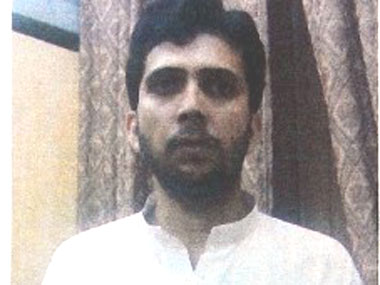
Four weeks after a Hellfire missile blew his body apart near Pakistan’s Miranshah on 21 May, 2010, the al Qaeda’s third-in-command spoke to his followers from the grave, through a posthumous online audio message. “I bring you the good tidings,” Sai’d al-Masri declared, “that last February’s India operation was against a Jewish locale in the west of the Indian capital [sic, throughout], in the area of the German bakeries — a fact that the enemy tried to hide — and close to 20 Jews were killed in the operation, a majority of them from their so-called statelet, Israel”. [caption id=“attachment_1069169” align=“alignleft” width=“380”]  Indian Mujahideen founder Yasin Bhatkal. AFP[/caption] “The person who carried out this operation was a heroic soldier from the ‘Soldiers of the Sacrifice Brigade’, which is one of the brigades of Qaedat al-Jihad [the al Qaeda’s correct name] in Kashmir, under the command of Commander Illyas Kashmiri, may Allah preserve him.” Last night, an Intelligence Bureau-led operation ended with the arrest of fugitive Indian Mujahideen commander Yasin Muhammad Ahmad Zarar Siddibapa, also known as Yasin Bhatkal, along with one of the men who is alleged to have helped him bomb Hyderabad’s Dilsukhnagar, Asadullah Akhtar ‘Haddi’. Intelligence Bureau agents, sources have told Firstpost, painstakingly tracked Yasin Bhatkal as he skipped across the India-Nepal border after successive bombings—finally telling police in Motihari just where to find him. This is a breakthrough for India’s beleaguered counter-terrorism effort—but also a grim reminder that the jihadist threat is metamorphosing. From the interrogations of men like 26/11 perpetrator David Headley, it’s long been known India’s jihadists are reaching out for support to the wider global movement. In 2008, Indian investigators dismantled much of the infrastructure of the Indian Mujahideen—a loose network drawn from the jihadist fringes of the proscribed Students Islamic Movement of India, financed by Indian organised crime networks and trained by the Lashkar-e-Taiba. The Indian Mujahideen had carried out an urban bombing campaign that claimed hundreds of lives after 2005; more than 70 of its operatives were eventually arrested in the 2005 sweep. There was a long list of men, though, who evaded police, and are still at large—among them Azamgarh’s Mirza Shadab Beg, Shahnawaz Alam, and Muhammad ‘Bada’ Sajid, Gujarat’s Alamzeb Afridi, Mahrashtra’s Zulfikar Fayyaz ‘Kagazi’ and Rahil Sheikh, and Asadullah Akhtar’s own alleged co-conspirator in the Hyderabad bombings, Uttar Pradesh resident Ariz Khan. Key leaders, more important, also escaped the police: operational commander Riyaz Shahbandri, his brother and top ideologue Iqbal Shahbandri, and the man who liaised between the network’s various cells, Abdul Subhan Qureshi. The ganglord who financed them all, Bihar’s Amir Raza Khan, is also still at large. Each of these men could be—and perhaps already is—the next Yasin Bhatkal. The question interrogators will be focusing on isn’t just his role in past bombings and the recruits he raised in places from Darbhanga to Hyderabad, but who financed the operations and guided them. Yasin Bhatkal isn’t believed to have personally travelled to Pakistan to meet with the Indian Mujahideen’s commanders, but his Skype and e-mail conversations will be of huge interest. The biggest question will be this: just what is the Indian Mujahideen leadership in Pakistan planning next? Headley called them the “Karachi Projects”: two distinct Indian Mujahideens, as it were, in competition. The Lashkar itself ran one, he said, using cadre recruited from the ranks of Islamist groups in India. The second, NIA documents reveal him to have said, was run by a retired Pakistani military officer called Abdur Rehman Hashim, also known by the code name “Pasha.” This second group of Indian jihadists, Headley told the NIA, was a “personal set-up of Pasha, and it is independent of the LET”. In the wake of 26/11, though, Pakistan came under intense pressure to scale back it’s intelligence services’ war-by-proxy against India—and the fugitive leadership turned to new friends. Major Hashim, according to Headley’s account, had served with the 6 Baloch Regiment until 2002, when he refused to lead his troops into combat against Taliban fleeing from the Tora Bora complex in Afghanistan — the last stronghold of al Qaeda chief Osama bin Laden in that country. For his actions, Major Hashim was demoted to captain, resigned from service, and joined the Lashkar as an instructor—training, among others, the men who attacked Prime Minister Manmohan Singh’s rally in Srinagar in 2004. Hashim, though, later fell out with the Lashkar, incensed, like many jihadists, by its refusal to take on the Pakistani state and western forces in Afghanistan. Following the 2007 siege of jihadists hold up inside Islamabad’s Lal Masjid in 2007, Headley was to recall, Major Hashim even contemplated assassinating Pakistan’s former President, General Pervez Musharraf. The Lal Masjid events, Headley recalled, sparked off an ideological war, leading to “splits in many of the outfits.” The Lashkar’s top military commander, Zaki-ur-Rahman Lakhvi, even faced a “serious problem in holding [on to] the LeT [cadre] and convincing them to fight for Kashmir and against India.” In spite of energetic efforts by Lakhvi and the ISI, Headley said, the “aggression and commitment shown to jihad by the several splinter groups influenced many committed fighters to leave Kashmir-centric outfits and join the Taliban.” “I understand this compelled the LeT to consider a spectacular strike in India,” Headley surmised. Headley himself turned to Muhammad Illyas Kashmiri, a former jihad volunteer with the Harkat-ul-Mujahideen who fought in Kashmir before forming the al-Qaeda affiliated Brigade 313, to fund his plans to execute a bombing in Copenhagen. Major Hashim was eventually arrested by Pakistani investigators in October, 2009 — but was never brought to trial. For years now, there’s been a steady string of al-Qaeda references to India. In April 2006, bin-Laden Osama himself spoke of a “Crusader-Zionist-Hindu war against the Muslims.” His deputy, Ayman al-Zawahiri, warned Pakistanis in September 2003 that General Pervez Musharraf was plotting to “hand you over to the Hindus and flee to enjoy his secret accounts.” In the wake of 26/11, al-Masri himself released a statement warning India of attacks if it struck against Pakistan. Maulana Aasim Umar, an al-Qaeda idelogue in Pakistan, earlier this year, released an appeal to Indian Muslims, asking why “there is no storm in your ocean”. “Is there not even a single mother in Uttar Pradesh”, Umar wrote, “who may sing those lullabies to children after listening to which they grow up to stage the battleground of Shamili instead of heading to bazaars, parks and playing fields? Have the successors of Shaykhul Hind discarded emigration and Jihad forever? Has the land of Bihar become so barren that it is unable to prepare even a single group of the like of the Mujahideen of Azeemabad?” “O’ those who have ruled India for eight hundred years”, he concluded, “O’ those who lit the flame of tawheed in the darkness of polytheism—how can you remain in your slumber when the Muslims of the world are awakening”? That’s just what the Indian Mujahideen hoped to do: to rekindle a long jihadist tradition. The Indian Mujahideen’s e-mail manifesto released after the Delhi bombings invoked precisely this political heritage: “we have carried out this attack in the memory of two most eminent Mujahids of India: Sayyed Ahmed Shaheed and Shah Ismail Shaheed, who had raised the glorious banner of Jihad against the disbelievers in this very city of Delhi. Ever since the fifteenth century and earlier, jihadists have emerged at various points of political crisis, seeing in Islam not just a faith but a language of political praxis. Like those past wars, the birth and rise of the Indian Mujahideen points to deep dysfunctions in our polity—dysfunctions which generated forces which are very far from spent. Yasin Bhatkal’s arrest doesn’t mean the story of India’s jihadist movement is anywhere near its end.
In Karachi, the Indian Mujahideen has been metamorphosing—forging ties with the broader jihadist movement. Yasin Bhatkal’s arrest is significant not just for what he can tell us about past attacks, but the future threats the network poses.
Advertisement
End of Article


 "Russian drones over Poland: Trump’s tepid reaction a wake-up call for Nato?")
 "As Russia pushes east, Ukraine faces mounting pressure to defend its heartland")
 "Why Mossad was not on board with Israel’s strike on Hamas in Qatar")
 "Turkey: Erdogan's police arrest opposition mayor Hasan Mutlu, dozens officials in corruption probe")
 "Russian drones over Poland: Trump’s tepid reaction a wake-up call for Nato?")
 "As Russia pushes east, Ukraine faces mounting pressure to defend its heartland")
 "Why Mossad was not on board with Israel’s strike on Hamas in Qatar")
 "Turkey: Erdogan's police arrest opposition mayor Hasan Mutlu, dozens officials in corruption probe")



](https://images.firstpost.com/wp-content/uploads/2013/08/yasin-bhatkal-afp1.jpg)