

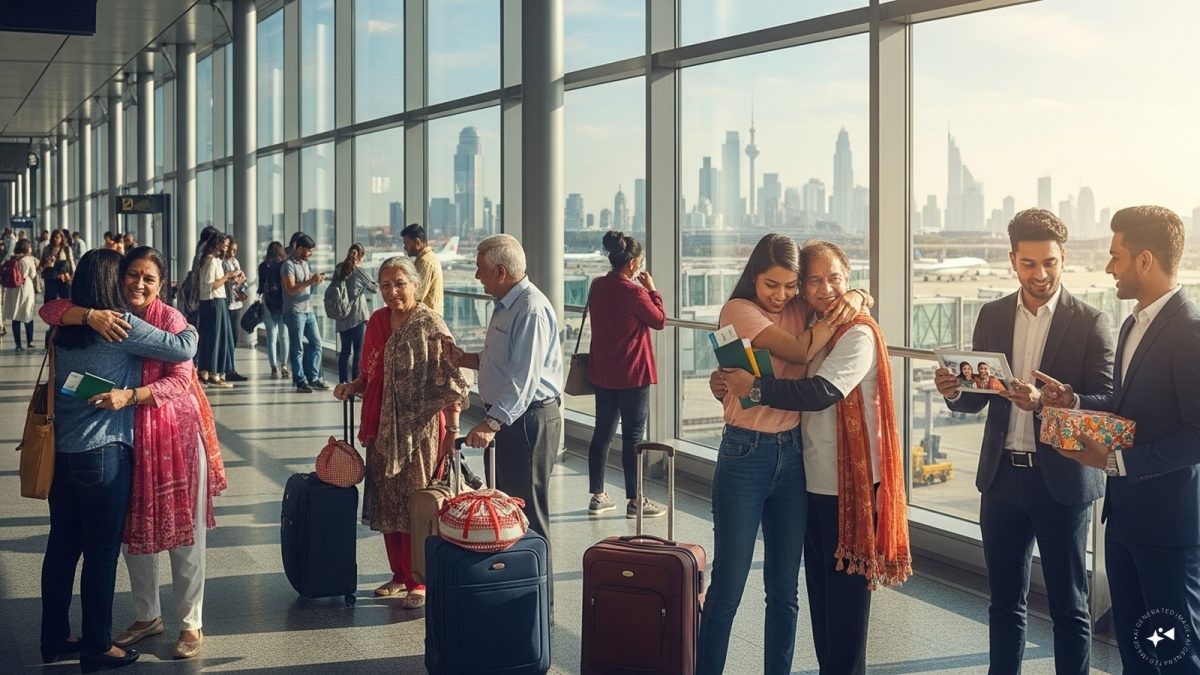
 "How Indian diaspora spread far and rose to shape the world")
India’s story was never meant to be confined within its geographic boundaries. For centuries, Indians have journeyed across oceans, chasing opportunity, braving hardship and carrying with them a piece of home wherever they went. This is the story of roots that stretched far and a diaspora that rose to shape the modern world—economically, culturally and politically.
Colonial expansion and the first waves of migration
The Indian diaspora, in large part, owes its early spread to the far-reaching ambitions of the British Empire. As the empire expanded from one country to another, the movement of Indians followed. A diaspora refers to the dispersion of people from their homeland, and for India, much of this was a legacy of colonial rule.
In various corners of the globe, Indians arrived for very different reasons. In countries such as Fiji and Mauritius, many were sent as contract labourers, often under challenging and exploitative conditions. In contrast, in destinations like Australia and Canada, migration was driven by the search for better opportunities. From the North Atlantic to the South Pacific, Indians established communities in almost every corner of the world.
Early acceptance and discrimination abroad
The reception Indians received abroad was far from uniform. In some places, such as New Zealand, they were welcomed and treated fairly. By the time India became independent in 1947, around 1,200 Indians lived in New Zealand and enjoyed what the government described as “complete equality.”
Elsewhere, the picture was starkly different. In Australia, for example, there were about 4,500 Indians in 1947. They enjoyed full citizenship rights, including the right to vote, but still faced legal discrimination. They did not have equal access to pensions or accommodation rights.
In the Caribbean, the situation varied further. Trinidad and British Guiana (now Guyana) each had Indian populations of around 1,70,000. While they were offered full citizenship, Hindu communities were barred from cremating their dead, a restriction that deeply impacted cultural and religious practices.
India steps in to protect its people
Just two months after Independence, India decided that its responsibility extended beyond its borders. The Constituent Assembly held multiple meetings to address the concerns of Indians abroad and devised action plans for specific cases. One month later, New Delhi quietly began to push for change.
Indian high commissions engaged directly with local authorities, highlighting discrimination in Commonwealth nations. By speaking up diplomatically and persistently, India began to see gradual improvements in the treatment of its overseas communities.
World’s largest diaspora today
Fast-forward almost eight decades, and the Indian diaspora is no longer just a product of colonial history—it is a global powerhouse. Today, the community of Indian origin numbers around 35 million people, making it the largest diaspora in the world.
Within this, more than 15 million are Non-Resident Indians (NRIs)—Indian citizens living outside India for reasons such as work or education. An individual is classified as an NRI if they reside outside India for at least 182 days in a financial year. NRIs retain their Indian passports, can vote in Indian elections, and are considered full Indian nationals.
Impact Shorts
More ShortsThe OCI connection
The second major category of the diaspora consists of Overseas Citizens of India (OCI), a status that replaced the earlier “Persons of Indian Origin” (PIO) category in 2015. OCIs are foreign citizens who are eligible for Indian citizenship on or after January 26, 1950, or are descendants of someone who qualifies. This category excludes nationals of certain countries such as Pakistan, Afghanistan and Bangladesh.
OCI status grants lifetime validity, lifelong visa-free travel to India, and the right to stay indefinitely without registration. However, OCIs cannot vote, hold government jobs, or be considered dual citizens. While NRIs carry an Indian passport, OCIs enjoy a set of privileges without full citizenship rights. Together, NRIs and OCIs form the backbone of the 35-million-strong global Indian diaspora.
From labourers to leaders
The contribution of the diaspora is visible in almost every sector. From global diplomacy to corporate boardrooms, Indians have risen to influential positions. Many lead the world’s biggest technology companies, while others head governments or shape policy in over 30 countries.
The roots of this journey go back to the “Girmitiya” system in the 19th century, when the British moved indentured labourers from India to East Pacific nations and Caribbean islands to work on plantations. The term “Girmitiya” came from “agreement,” which locals pronounced as “girmit.” Those who signed these contracts often settled permanently, laying the foundation for Indian communities abroad.
Generations later, Indian migration is no longer driven by compulsion or colonial schemes. Today’s movement is powered by ambition, skills and the determination to thrive.
US, Europe and beyond
The United States hosts the largest Indian population outside India, with over five million people—around 1.6 per cent of the country’s population. Indian Americans lead in education and income, with about 77 per cent holding a bachelor’s degree or higher and ranking as the highest earners among all Asian groups in the country.
In Europe’s largest economy, Germany, Indians also top the immigrant earning charts. They are known for excelling in STEM—science, technology, engineering and mathematics—fields, contributing significantly to both local economies and the global knowledge pool.
Boosting economies both abroad and at home
The impact of the Indian diaspora is not limited to the countries they live in. They also play a major role in boosting the Indian economy. Remittances—the money sent home by overseas Indians—are a prime example. In recent years, India has topped the global remittance charts, with inflows reaching a record $135 billion. Beyond direct financial contributions, Indians abroad attract foreign investment, foster international partnerships and keep cultural ties alive.
Challenges and ongoing issues
Despite these achievements, the diaspora continues to face challenges. Political conflicts around the world sometimes trap migrant Indian workers in dangerous situations. Migration laws in many Western countries have become stricter and racism persists. Reports of Hindu temples being vandalised or Indian workers being attacked—such as in Ireland—are still too common.
These issues are complex and have no quick solutions. Acknowledging this, the Indian government has steadily worked to enhance welfare mechanisms, digital grievance portals, legal aid and social protection for overseas Indians. From preventing fraud and land encroachment to organising large-scale evacuations in times of crisis, the support network has become stronger.
Government outreach and engagement
India has signed labour agreements with at least six countries easing the mobility of Indian-origin workers. Cultural and educational programs, especially for the younger generation, help maintain connections to their heritage.
Since 2014, Prime Minister Narendra Modi has made it a point to personally engage with the diaspora during his international visits. These interactions not only celebrate shared identity but also serve as a reminder of the government’s recognition of the diaspora’s importance.
Celebrating the global Indian
The Indian diaspora is no longer viewed as a “brain drain” but as a network of global ambassadors who represent the nation’s values, culture, and heritage. This recognition is formalised through the annual Pravasi Bharatiya Divas, first held in 2003 to mark the anniversary of Mahatma Gandhi’s return from South Africa in 1915. The event honours the contributions of overseas Indians to the growth of both India and the wider world, while also creating a platform to understand their challenges and harness their collective power.
A legacy of resilience
Ultimately, the story of the Indian diaspora is one of resilience and transformation. From the days of indentured labourers working on colonial plantations to today’s presidents, CEOs and innovators, Indians abroad have carried the essence of their homeland with them—in their values, culture and spirit.
As they continue to influence the world in remarkable ways, they also maintain a deep connection to India. No matter how far they travel, the bond to their roots remains unbroken. The Indian diaspora’s journey is not just about crossing borders—it is about rising beyond them shaping the world while staying forever linked to home.


 "Russian drones over Poland: Trump’s tepid reaction a wake-up call for Nato?")
 "As Russia pushes east, Ukraine faces mounting pressure to defend its heartland")
 "Why Mossad was not on board with Israel’s strike on Hamas in Qatar")
 "Turkey: Erdogan's police arrest opposition mayor Hasan Mutlu, dozens officials in corruption probe")
 "Russian drones over Poland: Trump’s tepid reaction a wake-up call for Nato?")
 "As Russia pushes east, Ukraine faces mounting pressure to defend its heartland")
 "Why Mossad was not on board with Israel’s strike on Hamas in Qatar")
 "Turkey: Erdogan's police arrest opposition mayor Hasan Mutlu, dozens officials in corruption probe")



