“How does governance work at the grassroots level in India?” To examine this question, we decided to pick one village anywhere in India, become a part of the community, see how individuals interact with various bodies of the government and examine its impact on their lives. I knew the answers to this question would be further complicated if the village didn’t identify as ‘India’, or simply didn’t care about that label — as is the case in large parts of the Northeast. In a region where ‘the outsider’ is a constant threat to a way of life, how do locals navigate a system where ‘outsiders’ are an explicit part of governance? It was to delve into these issues that I ended up living and working out of a village called Smit, in Meghalaya. This six-part series documents my time in Smit. [caption id=“attachment_7819151” align=“alignnone” width=“825”]
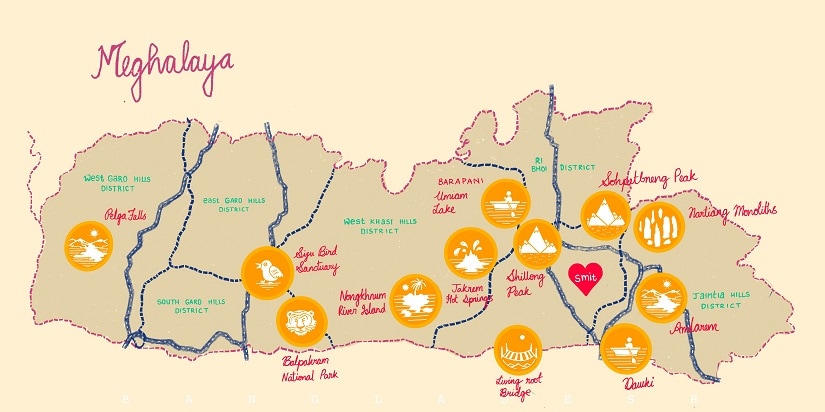 Smit, Meghalaya. Illustration courtesy Satwik Gade/Firstpost[/caption] 1. The Outsiders
2. Village Tour
3. Seng Khasi
4. Mei Tew
5. Kickboxing Classes Pynnehbor Mylliemngap doesn’t quite match any mental image you may have of a kickboxer: he’s short, with a baby face that belies his 21 years, and could easily pass for a high school student. But he’s been working in the village of Smit for over a year now, training children in kickboxing. It wasn’t easy to begin with, says Mylliemngap. A Khasi village is very well-organised and you need permissions for anything and everything you want to do in a public space. A village council headed by a sordar considers every request, and the executive collectively grants or rejects permission. Mylliemngap was lucky to get permission for his classes, and the council even allowed him to use the village community hall for his lessons. It’s a huge hall, with wooden flooring, and a big stage used for community events. It’s also dark and dingy — hardly the sort of place where you think dreams are built, although no one’s complaining. As soon as the kids start pouring in, they turn on all the lights in the hall and sweep the floor before beginning practise for the day. [caption id=“attachment_7829281” align=“alignnone” width=“825”]
Smit, Meghalaya. Illustration courtesy Satwik Gade/Firstpost[/caption] 1. The Outsiders
2. Village Tour
3. Seng Khasi
4. Mei Tew
5. Kickboxing Classes Pynnehbor Mylliemngap doesn’t quite match any mental image you may have of a kickboxer: he’s short, with a baby face that belies his 21 years, and could easily pass for a high school student. But he’s been working in the village of Smit for over a year now, training children in kickboxing. It wasn’t easy to begin with, says Mylliemngap. A Khasi village is very well-organised and you need permissions for anything and everything you want to do in a public space. A village council headed by a sordar considers every request, and the executive collectively grants or rejects permission. Mylliemngap was lucky to get permission for his classes, and the council even allowed him to use the village community hall for his lessons. It’s a huge hall, with wooden flooring, and a big stage used for community events. It’s also dark and dingy — hardly the sort of place where you think dreams are built, although no one’s complaining. As soon as the kids start pouring in, they turn on all the lights in the hall and sweep the floor before beginning practise for the day. [caption id=“attachment_7829281” align=“alignnone” width=“825”]
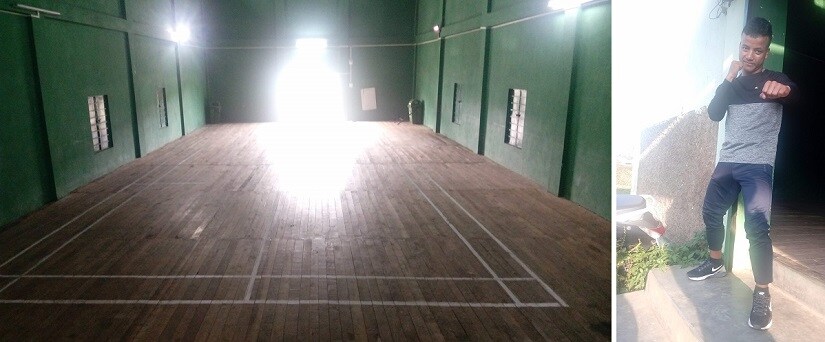 (Clockwise from above left) The hall where the kickboxing classes are held; Pynnehbor Mylliemngap; students train. All photos by Parul Abrol/Firstpost[/caption]
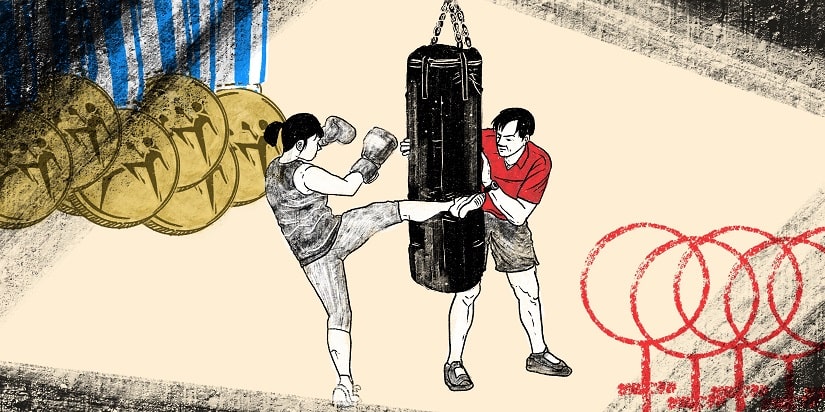 Mylliemngap’s training centre may be small, but his results are commendable. Illustration by Satwik Gade/Firstpost[/caption] Not all parents proved so recalcitrant. Sixteen-year-old Eban Kyntiew’s mother found out about Mylliemngap’s kickboxing classes and brought her daughter to join up. Eban’s family is not well-to-do; her father — an Army jawan — is mostly away. Eban’s mother has pushed the girls to make something of their lives: her older daughter Ker is the first from the family to finish school, and is currently enrolled at a reputed Shillong college. When Eban had to travel to Pune for a kick boxing championship, she was accompanied by her grandmother. Eban’s aim is to become a champion kick boxer. She has only set of appropriate sportswear for training, but that doesn’t daunt her. Every evening, she’s in the practice hall, right on time, in her only pair of black lowers. Another of Mylliemngap’s students is 18-year-old Phibarihun Mawlong. The Class 11 student comes from a slightly well-off family and was sent for kick boxing training by her brother, who learnt of the classes and thought they’d hold her in good stead. Well-built and dressed in proper gear, Phibarihun does look formidable — on course to meet her aim of being the “best fighter”. Everyone at the centre feels that they don’t get enough support from the state kickboxing association, so her aim is to help others train and participate in as many competitions. Mylliemngap’s training centre may be small, but his results are commendable. At the Pune kickboxing competition a few months ago, his students won five gold and eight silver medals. They’re fighting fit — and raring to go. In part 6, a conclusion.
In Meghalaya's Smit village, community kickboxing classes offer a chance to beat gender stereotypes
Parul Abrol
• December 29, 2019, 09:48:34 IST
Smit, in Meghalaya, fluctuates between its old and new values and systems, navigating the pull of modernity and tradition. Follow Parul Abrol as she follows Smit’s stories — a different world, within our own | Part 5 of 6
Advertisement
 "In Meghalaya's Smit village, community kickboxing classes offer a chance to beat gender stereotypes")

Mylliemngap started off as a wushu player, in 2006. His brother, a taekwondo expert, motivated Mylliemngap to take up the sport. Mylliemngap also joined the Meghalaya State Kickboxing Association. When there was no response to his classes initially, the sordar intervened and motivated the villagers to send their children for training. Now, Mylliemngap has 60 students who train six days a week. An early hurdle was money. Not everyone in the village has Rs 200 a month to spare on extracurricular activities. Add to it the expense of buying sportswear. So Mylliemngap allowed even those who couldn’t afford the fees to train, and many of his students wear their regular clothes to practise. A bigger problem would be getting girls to train at the centre. Meghalaya is a matrilineal society, but there is still prejudice enough about what girls should or should not be doing. Some of this is the effect of Christianity too — delineating ‘proper’ roles for men and women. But Mylliemngap did not lose hope. He counselled hesitant parents, told them how important it was for the girls to learn self-defence. Now, 15 of his 60 students are girls. [caption id=“attachment_7835101” align=“alignnone” width=“825”]
End of Article