“It is the victory of the country over child slavery. It is homage to our volunteers who were killed while rescuing children from different manufacturing plants,” Kailash Satyarthi told Firstpost, sharing his feelings after the news broke of him being awarded the Nobel Peace Prize jointly with Pakistan’s Malala Yousafzai. For the man who quit a bright career to take up the cudgels for India’s underprivileged children and endured several physical attacks in the relentless pursuit of his cause, it has been a long, difficult journey indeed. If the country is aware of the problems of child labour and child trafficking today, the credit for it must go to the never-say-die spirit of this fighter from Vidisha in Madhya Pradesh. [caption id=“attachment_1751613” align=“alignleft” width=“380”]
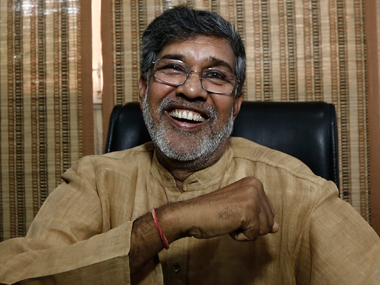
 Kailash Satyarthi. Reuters[/caption] Talking about the inspiration behind launching a movement against a social evil like child labour, the 60-year-old activist said, “When I was in Class V in a school of my hometown Vidisha, I used to see many children working at tea stalls and other places. They did not have access to education. I used to ask my teachers why they (child labourers) do not come to school, but never got a satisfactory answer.” “Once I spoke to the parents of the underprivileged children and asked them why they do not send their kids to school to study. Their reply left me devastated. One of them said: ‘Babuji humlog to kaam karne ke liye hi hain (We are bound to work)’. That day I decided that I will free India from this evil one day.” During his initial days of activism, Kailash organised the Global March Against Child Labor in the 1990s to rescue children abused worldwide in a form of modern slavery. Talking about the idea behind establishing Bachpan Bachao Andolan (BBA), he said, “I realised after meeting poor parents whose children work in several industries as bounded labourers that child slavery is a combination of several issues — low income of parents, lack of legislations and social inequality and many other things. Therefore, I decided to build a strong movement, which you see today in the form of Bachpan Bachao Andolan.” “I, along with my volunteers, was beaten up several times during our raid on different manufacturing firms. But I am born in the country of Mahatma Gandhi and know how to deal with situation in a non-violent manner. There were several challenges but I am an optimist who never surrendered before any unavoidable circumstance. I did not restrict my crusade in India only. I took it to 49 countries, including Pakistan and South Africa,” he added. When BBA was established in 1981, India did not have any legislation against child labour. Even United Nations adopted a notion for child rights in 1989, he said. “India still does not have strong laws on child trafficking. It has legislation on immoral trafficking and that is basically for adult trafficking for commercial sexual exploitation and so on,” he added. Kailash is considered to be the architect of two big civil society movements — Global March Against Child Labour (a worldwide coalition of NGOs, teachers’ unions and trade unions) and Global Campaign for Education. He successfully spearheaded a countrywide movement to make education a constitutional provision, which subsequently paved way for the rights of children for free and compulsory education in 2009 in India. He is credited for creating the first ever civil society — business coalition by establishing Rugmark (now known as Good Weave) in 1994. It was the first of its kind certification and social labelling mechanism for child labour free carpets in South Asia. Asked about child trafficking in the country, he said, “Unfortunately, the figures are increasing every year. It is not in hundred or thousand but in millions. Most of the trafficked children belong to West Bengal, Bihar and Jharkhand. They are brought to big cities like Delhi, Mumbai and Kolkata where they are made to work as bounded labours or forced in begging and other activities.” Asked if sharing the award with Pakistani girl Malala at a time when countries are engaged in a war-like situation at LoC would improve the relationship between two nations, he said, “I don’t know but I am hopeful. I will speak to her and invite her to our programmes. I am extremely inspired with her work.” Expressing her happiness over her husband’s achievements, Kailash’s wife Sumedha told Firstpost, “We had never imagined about getting a Noble Prize. This recognition has increased our responsibility many fold.” Sharing her experience of initial days of the movement, she said, “We were anxious when Kailash used to go for conducting raids. At that time, there was no cell phone facility. But we were also confident that the person who had gone to serve will never get hurt.” Asked where she did not stop her husband to proceed on a path with an uncertain future, she said, “I did not do that because both of us love children. Initial days were difficult as we did not have enough money and support.” Asked about her husband sharing award with Malala, Sumedha, who runs shelter home for homeless children, said, “There might be tension on the border but people of the two nations are friendly. When I visited Pakistan, I got a warm welcome there. I hope this award will bring India and Pakistan closer.”
Hope Nobel Peace Prize will bring India, Pak closer: Kailash Satyarthi
Tarique Anwar
• October 11, 2014, 13:05:29 IST
For the Nobel Peace Prize winner who quit a bright career to take up the cudgels for India’s underprivileged children and endured several physical attacks in the relentless pursuit of his cause, it has been a long, difficult journey indeed.
Advertisement
 "Hope Nobel Peace Prize will bring India, Pak closer: Kailash Satyarthi")
End of Article