

 "One wants Kanhaiya's tongue, another wants him dead: Free speech is fine, as long as it's applicable to everyone")
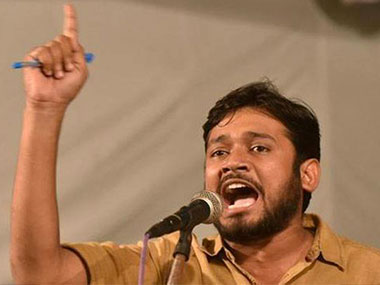
A BJP youth leader by the name of Kuldeep Varshnay offered Rs 5,00,000 as a reward for cutting off JNU students’ union leader Kanhaiya Kumar’s tongue. While this is deplorable, it needs to be noted that Varshnay is still free at the time of writing this piece while Kanhaiya was arrested following a cultural programme he had allegedly organised at the JNU campus on February 9. [caption id=“attachment_2659854” align=“alignleft” width=“380”] 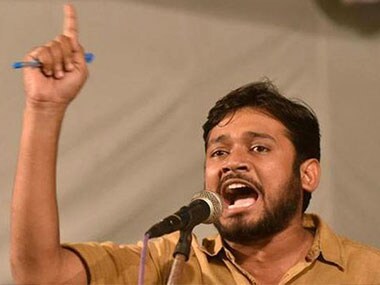 Representational image.[/caption] The BJP leader clearly incited (if not incentivised) people to commit violence and yet walked free, while Kanhaiya’s speech was criminalised immediately though it wasn’t an incitement to violence. Moreover, posters were put up in Delhi offering Rs 11 lakh as reward for Kanhaiya’s murder — only Adarsh Sharma has been arrested so far. This causes us to wonder if the laws that criminalise speech are the same for everyone or are they merely being used as a tool to protect the sentiments of the majority. For example, during the Delhi gang-rape protests in 2012, there were many comments and slogans that called for “death to the rapists”. Even last year, following agitations after the framing of the Juvenile Justice (Amendment) bill, there were calls for death penalties to be imposed on juveniles accused of rape. One couldn’t come by any article online without reading comments like “No trial, direct death for rapists”. One begins to wonder why these incitements to violence went unpunished. The law on freedom of speech is quite settled as far as India is concerned. All citizens have the right to freedom of speech and expression but the State may pass laws that impose reasonable restrictions on exercising the right. The interests of the sovereignty and integrity of India, security of the state, maintaining friendly relations with foreign nations, decency and/or morality, contempt of court, defamation and incitement to violence are all reasonable restrictions it may consider. In my view, these restrictions are sensible as they criminalise only those speeches which affect the exercise of free speech. This reasonableness also shields us from most forms of legislative overreach, which may infringe upon fundamental rights. For example, defamation, libel and slander have no place in a public debate as personal attacks result in heckling, can drown out voices and actually hurt free speech. Clearly, there can be laws that criminalise speech that affects the sovereignty of India. For example, writing a letter to the President of Pakistan asking him to invade India should ideally be a criminal offence. Decency and morality are questionable, but are needed to prevent public offence, and in fact, courts have been quite liberal in reading laws that criminalise obscene speech. Contempt of court is necessary for our judiciary to function effectively, it would be hard pressed to have a republic where people can openly advocate the disobedience of a court order and incitement to an offence is criminalised for obvious reasons. However, when it comes to the “public order” test, things begin to get dicey. That’s when we begin to see the true face of how these laws are applied and for whom they are applicable. In the wake of the Charlie Hebdo shootings in Paris last year, many newspapers, in India and abroad, self-censored themselves and refused to carry the offensive cartoons. Two papers in India, however, did — one was the Mint and the other was a little known Urdu paper Avadhnama edited by a lady called Shrin Dalvi. The editor of Mint was not arrested for carrying the cartoons, but Dalvi was. Her trial is underway and she is currently out on bail. She has received death threats and was forced to go into hiding fearing the safety of her children and family. Today, she lives without employment as there has been a social boycott of her by the Urdu Press. I have looked around and am yet to find any article that talks of people being arrested for threatening to kill her. The same can be said of Kamlesh Tiwari, a purported member of the Hindu Mahasabha, who released a press statement saying that the Prophet of Islam was the world’s first homosexual. Over one lakh Muslims rose up in protest demanding that he be put to death for his statement. They further went on to advocate a call for blasphemy laws in India, laws which they felt should carry the death penalty. What’s worrying is that most of the laws criminalising speech in India are bailable offences, which means you can’t be detained after being charged with hate speech. The Samajwadi Party government in Uttar Pradesh has detained Tiwari under the National Security Act, a law that provides for preventive dentition. He is, by any stretch of the term, a prisoner of conscience, but we don’t see a debate on free speech surrounding him. Contrast this with the uproar caused by the prosecution of MF Hussain for his paintings of Hindu gods and goddesses. Was it that we felt freedom of speech was threatened when Hussain was prosecuted, but we don’t feel so when Tiwari is detained without a trial or a charge? One could argue that it is so because the Hindu community is more liberal thanks to their higher economic and social status in India (as outlined by recent reports on the status of minorities) or one could argue it’s because as a society, we enjoy living in an echo chamber and don’t like it when the voices that are echoed are different from the ones we are shouting ourselves. There are very few laws that criminalise speech in India, except those that do so on grounds of “public order”, reflected in Article 19(2) of the Constitution. Most speech offences in India are ones which cause a break in public order and it’s important to realise that we are the people who are prone to disorder when we hear something we don’t like. Varshnay is able to get away for the same reason the Mullahs who called for the head of Tiwari and Shirin Dalvi are able to get away. It is not smart politics to initiate a prosecution against a person who says something that the majority agrees with, irrespective of the fact that, prima facie, offences can be made out from these statements. Calling for more free speech will mean getting around the idea that people like Tiwari will go around making their statements, free from prosecution. I am of the opinion that, no matter how distasteful, Tiwari has the right to make them, just like Kanhaiya has the right to make his speeches criticising the government and just like Hussain had the right to draw the paintings. It is the duty of the law and order administration of a civil society to ensure these people are safe while making these statements. A safe space for freedom of speech does not only mean a safe space for speech the majority can agree with. It means a safe space for all speech. We cannot criminalise speech just because the police have a tough time maintaining order following the way people react; that’s a copout, a copout the colonial administration that drafted these laws could afford, but a copout that is suicidal for any free-thinking democracy. In the seminal US Supreme Court decision of Abrams vs United States, Oliver Wendell Holmes Jr, in his dissent, argued why freedom of speech was necessary for a democratic society. “The ultimate good desired is better reached by free trade in ideas — the best test of truth is the power of the thought to get itself accepted in the competition of the market,” Holmes had written. This is often called the marketplace of ideas, and it’s time that free speech advocates began campaigning for laws protecting ideas that they themselves can’t get behind, for that’s the real defence of freedom of speech. A free market of ideas must be open to all ideas, no matter how distasteful they may be. The true test of a democracy’s character is a person who is able to say the most offensive and distasteful things while maintaining order while he does so. If as a people we want fewer laws criminalising speech, we need to start maintaining order in the manner we react to it.
The true test of a democracy’s character is a person who is able to say the most offensive and distasteful things while maintaining order while he does so
Advertisement
Follow Firstpost on Google. Get insightful explainers, sharp opinions, and in-depth latest news on everything from geopolitics and diplomacy to World News. Stay informed with the latest perspectives only on Firstpost.
End of Article

 "Ex-Pentagon official says Trump merits a Nobel for 'uniting India–Russia'")
 "Pressure mounts on ‘reckless’ Hegseth as war-crimes allegations and intel-mishandling claims roil Pentagon")
 "IndiGo flight cancellations LIVE: IndiGo says operations stabilising with 95% network restored; over 850 flights cancelled today")
 "India vs South Africa Highlights 3rd ODI at Visakhapatnam: Jaiswal ton; Kohli, Rohit 50s help IND win series")
 "Ex-Pentagon official says Trump merits a Nobel for 'uniting India–Russia'")
 "Pressure mounts on ‘reckless’ Hegseth as war-crimes allegations and intel-mishandling claims roil Pentagon")
 "IndiGo flight cancellations LIVE: IndiGo says operations stabilising with 95% network restored; over 850 flights cancelled today")
 "India vs South Africa Highlights 3rd ODI at Visakhapatnam: Jaiswal ton; Kohli, Rohit 50s help IND win series")



](https://images.firstpost.com/wp-content/uploads/2016/03/kanhaiya-kumar-380-@ibnlive2.jpg)