

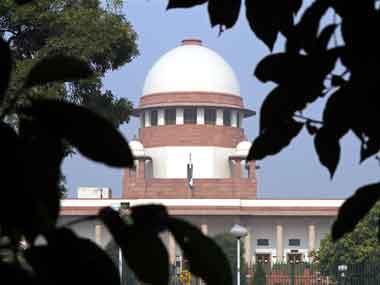
 "'Every facet of Right to Privacy is not fundamental': The most contentious statements made during hearing of the case")
The Right to Privacy debate in India is one of the most protracted and undoubtedly one which will have long term ramifications for the people. The verdict is likely to have a bearing on the relationship between Indian citizens and the State in the digital era and will also impact all future legislations on the Right to Privacy. The matter was heard by a nine-judge bench of the Supreme Court, which reserved its verdict on the issue on 2 August after voicing concern over possible misuse of personal information in public domain. The top court observed that the protection of the concept of privacy in the technological era was a “losing battle”. [caption id=“attachment_3962675” align=“alignleft” width=“380”] Representational image. Reuters[/caption] The Centre and the petitioners sparred in the top court over a number of days to determine whether the right to privacy is an absolute right or not. In the case of Aadhaar, while critics argued that Aadhaar violates privacy and helps spy on people, the government contended that an individual’s right to privacy is not an absolute right. Different, and mostly contentious, views emerged as the apex court heard the statements from both sides. ‘Privacy as Fundamental Right was deliberately avoided in Constitution’ Four non-BJP states had moved the Supreme Court seeking to intervene in the hearing on the Right to Privacy issue. Besides Karnataka and West Bengal, two Congress-led states of Punjab and Puducherry took a stand opposite to the Central government, which had said that the Right to Privacy is a common law right and not a Fundamental Right. During the hearing on arguments of these four states,
Attorney General KK Venugopal stated that privacy as a Fundamental Right was ‘deliberately avoided’ from Article 21. “Privacy, as a Fundamental Right, could have been mentioned in 21 but has been omitted. This was deliberate,” he said. He further said, “Claims to privacy that would destroy constitutional goals of social justice cannot be elevated to the status of a Fundamental Right.” One of the most controversial claims that the attorney general made during the hearing was that the right has more credibility in ‘developed countries that are socially, economically and politically developed’ while adding that in a developing country like India something as ‘amorphous’ as the right to privacy can never be a Fundamental Right. ‘Every facet of Right to Privacy is not fundamental’ Venugopal, in his arguments, told the Supreme Court that the
right to privacy was not a Fundamental Right . “There is no fundamental Right to Privacy and even if it is assumed as a Fundamental Right, it is multifaceted. Every facet can’t be considered a Fundamental Right,” Venugopal told the bench. He added that “information privacy” could not be a right to privacy and it could not ever be a Fundamental Right. Right to privacy could deny right to food? The counsel for the State argued that upholding a right to privacy could deny millions of poor people the right to food. The state offered the following choice — two square meals per day, or privacy, asserting that a poor person would pick the former. “On one hand, a few sensitive individuals are complaining about violation of privacy because Aadhaar required collection of biometrics and address details, on the other hand Aadhaar has ensured that food reached 270 million persons who live below the poverty line through social welfare schemes,” Venugopal had said, as
The Times of India reported. ‘Data is protected as property, not a Fundamental Right’ Furthering the argument that
privacy and data could be protected only as a statutory right, the government counsels argued that the protection of data was traceable to Article 300A of the Constitution. This is the provision granting property as a legal right to the people, not a Fundamental Right. The counsels argued that the State holds people’s data in a fiduciary capacity. This relationship was governed by common law rights and the right to property but not the Fundamental Rights. The Bench did not fully agree with this, asking how a person’s data could be mere property. ‘States can impose restrictions’ The Supreme Court sided with the Centre and said that
privacy is an "amorphous term" which is not absolute and cannot prevent the State from making laws imposing reasonable restrictions on citizens. The top court had further said that in order to recognise privacy as a right, it would first have to define it. However, this would be an uphill task as an element of privacy pervaded all Fundamental Rights enshrined in the Constitution.
The Centre and the petitioners sparred in the top court over a number of days to determine whether the right to privacy is an absolute right or not.
Advertisement
End of Article

 "‘I’d love to do it’: Trump refuses to rule out third term — despite constitutional limit")
 "What is the ‘Golden Fleet’ of navy ships that Trump wants to counter China with?")
 "‘Ramayan country’: Why Trinidad and Tobago wants to build a large Ram temple")
 "How China's rare earths choke changed America's trade deals")
 "‘I’d love to do it’: Trump refuses to rule out third term — despite constitutional limit")
 "What is the ‘Golden Fleet’ of navy ships that Trump wants to counter China with?")
 "‘Ramayan country’: Why Trinidad and Tobago wants to build a large Ram temple")
 "How China's rare earths choke changed America's trade deals")



