

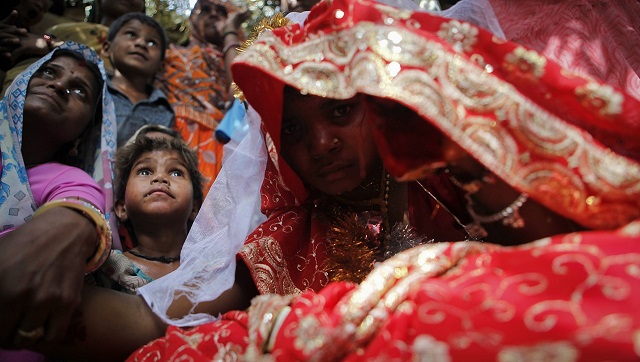
 "COVID-19 crisis risks reversing gains made against child marriage in India; legal revisions alone aren't solution")
Across 10 villages in Rajasthan’s Udaipur district, for two hours every day, open fields are converted into makeshift classrooms. Rows of young boys and girls, children of returnee migrant labourers, are seated two feet apart. Chart papers have been taped on the side walls to serve as a blackboard for the class. It has been nearly four months since government-run schools shut down and turned into quarantine centres. “Ever since the lockdown was announced, the children, particularly the girls, have been largely home-bound,” said Yogesh Vaishnav from Vikalp Sansthan, an NGO that has been running these open-air learning centres in its response to the COVID-19 pandemic. “With schools shut down and very poor access to technology [to avail of online classes], we fear that most of these girls will permanently drop out of the education system.” Coupled with the economic downturn, loss of livelihoods and reduced access to childcare protection and social support, the district has also been recording a steep increase in cases of violence against girls and women, as well as early and child marriages. Vaishnav is among the 41 signatories of a pan-India memorandum submitted last week to the task force constituted by the Union Ministry of Women and Child Development to examine and provide recommendations on issues including age of motherhood, maternal health and child mortality in India. The formation of the task force is in line with the statement made by Finance Minister Nirmala Sitharaman during the Budget Speech in February, where she recalled that women’s age of marriage was increased from 15 to 18 years in 1978 by amending the Sharda Act of 1929. Thus, as a potential solution to tackling poor maternal health outcomes and child mortality, the 10-member task force is examining whether to raise the legal age of marriage for females from 18 to 21 years. The report is expected to be submitted at the end of this month. While the government’s age-centred move is publicly being lauded as “empowering” and “progressive”, frontline workers, child rights activists and advocates (signatories of the memorandum) have advised strict caution against this move, particularly at a time when various state officials and activists have been reporting a spike in child marriages amid the lockdown. “How can this be a moment to add further to the burdens of families struggling for their very survival?” questions the memorandum. “Poverty, not early marriage, is the main cause for the ill-health of mothers and their children.” On 9 July, an additional submission was also put forward by members of the National Coalition Advocating for Adolescent Concerns (NCAAC), a group of civil society organisations, academics and activists in the country. In response, on Friday, the task force participated in an online exchange titled “Youth Voices” with 20 adolescent girls and young women leaders from various states to listen to their first-hand experiences. Despite legal interventions over the years, India has the largest number of child brides in the world, according to a 2019 report published by the United Nations International Children’s Fund (UNICEF); one-third of the global total. While the National Family Health Survey 4 data indicates a 20 percent decline in the prevalence of the practice in the past decade, the COVID-19 pandemic threatens to reverse the gains made over the years. And the revision of age at marriage, activists believe, could sound the death knell for the girls and young wives. [caption id=“attachment_8618191” align=“alignnone” width=“640”] 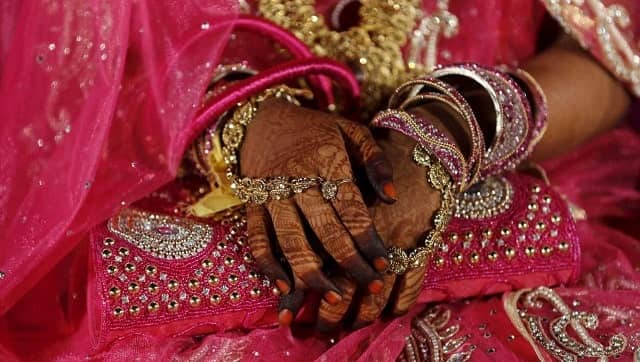 All images via REUTERS[/caption] The Prohibition of Child Marriage Act, 2006 (PCMA), which mandates the minimum age at marriage, for instance, was framed to replace the Child Marriage Restraint Act to forbid child or underage marriages, appoint Child Marriage Protection Officers to implement the law and penalise those that participate in the act including the adult party to such marriages. Yet, several field-based studies have pointed out the ways in which the Act is used punitively against girls who marry against parental wishes, rather than protecting girls from forced marriage. “While it is true that the law must be aspirational, it won’t mean too much on the ground considering very few child marriage cases actually get reported. Even when they do, most of the success that we have achieved is when we stop the wedding before it actually takes place,” said Nicole Rangel Menezes, co-founder of Leher, a child protection organisation working closely with women and girls in Bihar’s Madhubani district. “Those who marry off their children underage, traffic child brides are well under the radar of the law enforcement.” In fact, the use of PCMA by parents often leads to the girl being put in shelter homes, and the boy being imprisoned or sent to juvenile homes. The strict lockdown measures, closure of schools and the inability to access mobile phones, have made it additionally difficult for girls trying to prevent or escape a forced marriage. “The girls are unable to seek even informal support from their friends, neighbours and school teachers. The accused [a family member], then, is often the girl’s only access to justice,” said Sherin Bosco, co-founder of NGO Nakshatra that provides counselling and legal support to victims of sexual violence and trafficking across Tamil Nadu. “At such a time, any legal amendment has to be coupled with adequate psycho-social support and enabling measures to empower the children.” In fact, Bosco and her team have been receiving most of their tip-offs over the past few months over “missed calls”. “It is quite challenging for the children to call and lodge complaints, there is also an increased fear of getting caught,” said Bosco, adding that based on the “missed call”, the local team of counsellors find ways to provide support. Advocate Varsha Deshpande from the Dalit Mahila Vikas Mandal (DMVM) said the pandemic has mainly “exposed the existing institutional and policy gaps in state responses”. In Maharashtra’s drought affected Marathwada region, where DMVM works with migrant sugarcane cutters and brick kiln workers, child marriage has, for years, been a common practice. “When families migrate to the neighbouring states for work, they usually take their sons along for the farm work. The minor girls, who are left behind in the village with the older family members, are at such times, at a very high risk of sexual violence,” said Deshpande, adding, “Parents also get their daughters married in the fear that she will fall in love with someone of her own choice in their absence.” Given the lack of government-run hostels, safe access to schools and adequate child protection schemes, marriage then becomes the only way out to ensure their safety and security. The memorandum cites field-based evidence to suggest that child marriage is the consequence, and not the cause of girls dropping out of schools. “Rather than to raise the legal age of marriage, we must ensure that the right to free and compulsory education is extended beyond 14 years,” said Nishit Kumar from the Centre for Social and Behaviour Change Communication. Even national data shows that the reasons for high drop-out rates amongst girls are a combination of demand and supply side factors, primarily the availability, affordability and quality of schooling. While the Right to Education Act 2009 has led to a significant improvement in the enrolment of girls at primary and elementary levels, the drop-rate at the higher secondary levels remains alarming — from a net enrolment ratio of 91.58 (elementary) to 31.42 (higher secondary). This figure, reported by the National Institute for Educational Planning and Administration, falls by a further 15 percent for girls from Scheduled Tribe, Scheduled Caste and Muslim communities. Amid the current crisis, Kumar added, “To delay girls’ age of marriage, it will be far more important to improve overall access to education and also invest in better infrastructure. A legal revision alone cannot solve the problem.” Reetika Revathy Subramanian is a journalist and a PhD scholar at the University of Cambridge Centre for Gender Studies, UK. She writes on gender, informality and labour migration.
Despite legal interventions over the years, India has the largest number of child brides in the world, according to a 2019 report published by UNICEF; one-third of the global total.
Advertisement
End of Article


 "Charlie Kirk, shot dead in Utah, once said gun deaths are 'worth it' to save Second Amendment")
 "From governance to tourism, how Gen-Z protests have damaged Nepal")
 "Did Russia deliberately send drones into Poland’s airspace?")
 "Netanyahu ‘killed any hope’ for Israeli hostages: Qatar PM after Doha strike")
 "Charlie Kirk, shot dead in Utah, once said gun deaths are 'worth it' to save Second Amendment")
 "From governance to tourism, how Gen-Z protests have damaged Nepal")
 "Did Russia deliberately send drones into Poland’s airspace?")
 "Netanyahu ‘killed any hope’ for Israeli hostages: Qatar PM after Doha strike")



](https://images.firstpost.com/wp-content/uploads/2020/07/bride-min.jpg)