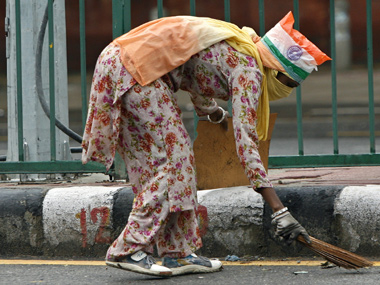
 "Clean India is a great goal. But can we change our internal plumbing?")
Let’s face it. The Swachh Bharat Abhiyaan has its work cut out for it. We Indians are litterbugs. And even when we do not want to be litterbugs the cities we live in force us to litter. You can walk for blocks clutching a greasy wrapper and not find a dustbin to discard it in. I remember once going into a mall merely to use its litter bin.
As Lord Meghnad Desai says in the Indian Express:
Well-off people do not clean up after themselves. That is the job of the lowest people whose karma, we believe, led them to be born to do menial jobs. No wonder India has a dirt problem.
Desai has a couple of suggestions. How about giving beggars uniforms, tools and cash incentives to clean our cities instead of begging? That’s not a bad idea if one has the guts to crack the begging mafia that exists in so many cities.
And he suggests harnessing the expertise of women and putting them on street committees because “the job of keeping the home clean is their responsibility. To supervise the cleaning servants is their job.” Lord Desai means well but rather blithely not only buys into gender stereotypes but perpetuates them. It’s bad enough keeping the house clean is regarded as women’s work. Now keeping the streets clean will also become their responsibility? ‘No good deed goes unpunished. '
In fact, the problem with our cleanliness (or lack thereof) is the assumption that cleanliness is always someone else’s job – mothers, maids, sweepers. It should be about all of us. Anyway, India is living proof of the fact that cleanliness does not necessarily begin at home. It actually ends at home. We can keep our homes spotless but have no qualms about emptying litter onto the street from our balconies. Or dumping our garbage in front of someone else’s house. Or our dogs’ poop, as Soutik Biswas observes on BBC.com.
Quick Reads
View AllIn the upstart suburb of Gurgaon, where I live, my educated, upwardly mobile, rich neighbours sent their pet dogs outside with their servants to defecate and refuse to clean up the mess. As long as their condominium is clean, it is all right.
While Anil Ambani picking up a broom might have symbolic value what a Swachh Bharat Abhiyaan ultimately has to inculcate is cleanliness as an ingrained habit not an October 2 virtue.
That faces huge hurdles in India not least of all because large swathes of the country live in squalor in urban slums with open drains and lack of water. The government wants to build toilets at the rate of one per second in order to end open defecation by 2019 according to The Economist.
Nitin Gadkari, Minister for Drinking Water and Sanitation says India needs to build around 11.11 crore individual household toilets, 1,14,315 community sanitary complexes, around 56,928 school toilets and 1,07,695 anganwadi toilets. But if all of them suddenly get toilets do we have enough water to meet their needs? Gadkari admits that there is no point constructing toilets without water. He says only 10,000 out of 300,000 toilets constructed to end open defecation were in use as toilets. Many of the others had been converted into godowns and even temples because of lack of water.
Dr. Bindeshwar Pathak, founder of the NGO Sulabh is optimistic. “You have to train some 50,000 people like me to go house to house to build toilets and follow up with then. You have to train motivators. Every mission needs missionaries. Islam, Christianity, Hinduism all have missionaries. Here in sanitation it’s lacking.”
He’s hopeful that with Narendra Modi putting his weight behind the project, it will be given the top priority. Governments are typically penny wise and pound foolish. When previous governments worked with Sulabh, they insisted on one-pit toilets as opposed to two-pit ones. They only wanted to spend Rs 500 on a toilet. In the two-pit toilet after one is full, the other is used, while the first converts to compost. The government thought one-pit was enough to inculcate toilet habits. Instead as soon as the pit was full people reverted back to the fields. “Also they went to people below the poverty line,” says Pathak. “Now those who have no house to live or proper food to eat what will they do with a toilet? Toilets need to go from top to bottom, not bottom to top.”
But while toilets are a matter of resources, littering and garbage is going to require a change in our mindset. And litter bins. Many proposals to create innovative trash bins in cities have run aground because they could be stolen for scrap. Building public gardens to prevent people from dumping rubbish have backfired with the fences of the garden becoming a place to hang washing and the little gardens becoming a large litter-bin until the plants, dusty and unwatered, give up the unequal fight.
In our part of the world communal is a bad word bringing up images of religious riots. We have to learn to reclaim the other meaning of communal – communal property one which we all have a stake in keeping clean.
Government bureaucrats are skeptical about the practicality of Modi’s grand plans for a Swachh Bharat by 2019 which wants to build 20 million toliets in the first year alone. The Economic Times says “A proposal prepared by the Ministry for Drinking Water and Sanitation indicates the project would need much more time, budgetary and manual resources to meet the deadline.”
With existing resources the project might be extended beyond 2022. Perhaps we won’t get a Clean India by 2019. But even a Clean-er India would a giant step in the right direction.

 "'Indian food, our pride': $200k settlement in Palak Paneer case a moral victory against racism in the west")
 "India’s air dominance in Operation Sindoor forced Pakistan to seek ceasefire, European report says")
 "How Pakistan’s support may have led Bangladesh towards a very costly mistake")
 "India vs New Zealand Live Score 3rd T20: Kishan, Abhishek tee off after Samson bowled on first ball")
 "'Indian food, our pride': $200k settlement in Palak Paneer case a moral victory against racism in the west")
 "India’s air dominance in Operation Sindoor forced Pakistan to seek ceasefire, European report says")
 "How Pakistan’s support may have led Bangladesh towards a very costly mistake")
 "India vs New Zealand Live Score 3rd T20: Kishan, Abhishek tee off after Samson bowled on first ball")