

 "Bastar development offensive: Healthcare, education thrive as tech-savvy Dantewada collector seeks to counter Maoist doctrine")
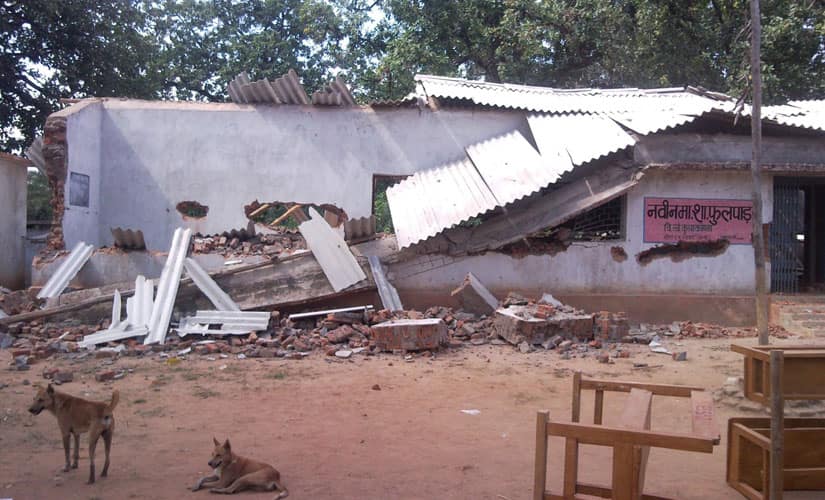
Editor’s Note: In April this year, Union home ministry removed 44 districts from the list of those affected by Left Wing Extremism (LWE), indicating a shrinking of the area of Maoist influence in the country. This is the result of a multi-pronged strategy that includes an offensive security and sustained development to wean away the locals from Maoist ideology. However, this is not the end of Maoist supremacy in the Red Corridor. The danger is very much lurking in the jungles, beaten, bruised and ready for retaliation. The bigger challenge for the administration is to enter the Maoist stronghold and carry out development right under the nose of the extremists. So, what exactly is the situation on the ground? Debobrat Ghose of Firstpost takes a trip through the Dandakaranya forests in the Maoist-hotbed of Bastar division of Chhattisgarh — one of the most badly affected regions by LWE and site of some of the deadliest attacks on the state by Maoists — to see the changes that have reached some villages, how willing are the villagers in embracing those changes, the immense risk state administration and security forces personnel undertake daily to effect those changes, all in the shadow of the Maoists who are far from finished. Dantewada collector Saurabh Kumar probably has one of the most unenviable jobs in the country. Looking after this vulnerable district in the Maoist heartland of Bastar division in Chhattisgarh, Kumar has a major challenge to establish the rule of the administration literally under the muzzle of guns while simultaneously carrying out different development projects so that the area can be integrated into the mainstream as soon as possible. Having taken over the charge of the district on 14 April 2016, this 2009-batch IAS officer has relentlessly worked to bring development to the district and to gradually wipe off the terror tag which is often associated with the district. “Development is well entrenched not only in Dantewada district but also in other districts in Bastar division. There is a decline in Maoists incidents. This is the way forward to tackle LWE and development will ultimately put an end to the Maoist menace in Bastar and elsewhere,” Kumar, district collector, Dantewada told Firstpost.[caption id=“attachment_4728251” align=“alignleft” width=“380”] 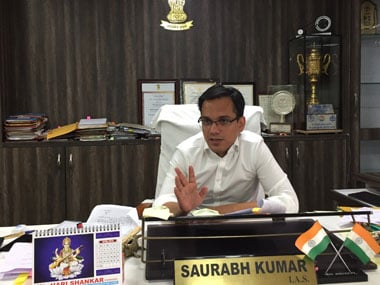 Dantewada district collector Saurabh Kumar. Firstpost/Debobrat Ghose [/caption] This is no mean achievement when the years of mindless Maoist violence are taken into account. On 6 April 2010, in a deadly attack, Maoists killed 76 CRPF personnel and one policeman in an ambush near Chintalnar village in Dantewada district, the biggest strike by extremists in recent history in terms of the number of casualties. Just a month later in an LTTE-style attack, a public transport bus was blown up by Maoists at Chingawaram on Dantewada-Sukma road that killed 35 passengers including security personnel. Dantewada is the same district where on 15 March 2007, Maoists attacked a police camp located at a school building in Rani Bodli village and killed 55 policemen. Prior to this attack on 17 July 2006, Maoist groups from Andhra Pradesh torched a relief camp of Salwa Judum at Errabore village and brutally killed 30 unarmed civilians and abducted 45. Later, they killed six of the abductees, who were surrendered Naxals. These are only the major incidents of violence and there are many small ones where many security personnel lost their lives. The attacks mostly happened while the personnel were deployed to guard road construction activity in the area. Not that innocent civilians are spared — too many of them have become helpless victims as well. The last attack was on 20 May this year — a week after Chhattisgarh Chief Minister Raman Singh began his ‘Vikas Yatra’ from Dantewada — in which Maoists blew up a vehicle on Kirandul-Cholnar road that killed seven policemen. Thanks to this mind-boggling number of fatalities on its soil, Dantewada has earned a notoriety as a district which has a major Naxal presence. The name itself has become spine-chilling. “We had never heard of killings as gruesome as in Dantewada. Though there’s a decline in Maoist incidents, it’s not over yet,” said an officer posted at Dantewada collectorate. Separated in 1998 from the erstwhile Bastar district, Dantewada again got bifurcated into Bijapur and Sukma districts respectively in 2007 and 2011. It is now one of the seven districts in the Bastar division. As per the government list of ‘115 aspirational districts’, Dantewada is also among the ‘most backward districts’ in the country. Despite the terror it evokes and the continued Maoist incidents, the district administration took upon the challenge of turning around the fortunes of Dantewada. Efforts began after 2003 when Raman Singh took over as chief minister of the BJP government by defeating the Congress led by Ajit Jogi. According to the people of Dantewada town, Singh had offered prayers at the temple of Danteshwari Mata — the supreme deity of the tribal population in Bastar – before starting his election campaign in 2003. He vowed to bring development to this Naxal-infested belt by putting an end to the menace. However, progress was slow and often got derailed due to Maoist insurgency, which had already struck deep roots in the district. The development in real terms began taking shape much later, about six years ago. After interacting with several villagers of Palnar, Geedam and many small hamlets, I found a common belief among many of them that the goddess has blessed Dantewada not only with rich mineral reserve but also with prosperity in the form of development, which they are enjoying at present.
“It’s Danteshwari Mata who has blessed our zila prashashan (district administration) with the wisdom to do good development work,” Somaru, a village elder told this correspondent at Balood village in Dantewada while pointing towards a newly constructed road. Gradually, I realised that it has taken a multi-level offensive to turn around the ground situation in Dantewada – to catapult it from one of the worst LWE affected and backward districts to a developing one. The security measures both by the central and state forces, including the adoption of an aggressive posturing against Naxals, have been buttressed by focussed approach on health and education by the administration with the right use of funds.


 "US ready to ‘impose costs’ on Russia if war in Ukraine drags on, says Hegseth")
 "US tells Hamas to stop violence against Gaza civilians and disarm 'without delay'")
 "China seizes 60,000 maps mislabelling Taiwan, omitting South China Sea islands")
 "Syria’s Sharaa pledges to honor Russia ties, seeks economic and military support in Kremlin visit")
 "US ready to ‘impose costs’ on Russia if war in Ukraine drags on, says Hegseth")
 "US tells Hamas to stop violence against Gaza civilians and disarm 'without delay'")
 "China seizes 60,000 maps mislabelling Taiwan, omitting South China Sea islands")
 "Syria’s Sharaa pledges to honor Russia ties, seeks economic and military support in Kremlin visit")



](https://images.firstpost.com/wp-content/uploads/2018/07/SaurabhKumar380Debo.jpg)
](https://images.firstpost.com/wp-content/uploads/2018/07/SchoolMaoists825Debo.jpg)