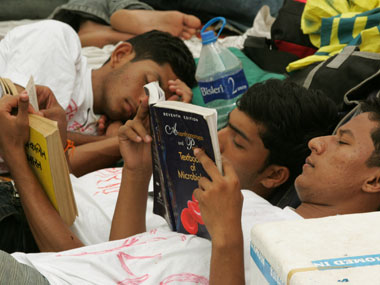
Chennai: As the scramble for the limited number of seats for engineering and medical seats in the self-financing colleges and deemed universities in Tamil Nadu begins ahead of the central and state board school leaving exams, a few hundred crores of rupees will change hands, mostly in black. In the process, it will also deny tens of thousands of deserving children their right to higher education. At the end of the admission season, it will be clear one more time that however meritorious you are, unless you get into national institutions such as the IIT, NIT or a handful of government or aided colleges, you have absolutely no chance of getting in without money. That too loads of it. A simple back-of-the-envelope calculation can explain the situation. In Tamil Nadu, there are about 500-and-odd engineering colleges out of which nearly 475 plus are self-financing colleges. Out of this about 100 have reasonable market value, some even quite high, in terms of employability. All of them charge from about Rs 1.5-3 lakh a year depending on the premium they command against the government prescribed fee of Rs 65,000. The self-financing colleges, on paper, are not free to run their institutions and money making enterprises at will. Each such college has to reserve 35 percent seats for students who get in through merit at Rs 35,000 per year and 65 percent, who are less meritorious, at Rs 65,000. But premium colleges charge all of them the same flat rate of Rs 1.5-3 lakh. In minority-run institutions, the prescribed ratio is 50:50. Some of the deemed universities (institutions with university status) run their own entrance examinations and select students, who also end up paying substantial amounts of money, even if one scores quite high in the exam. The highest fees are charged by about 40 elite colleges, which together have about 10,000-12,000 seats, netting roughly Rs. 300 crore in a year. Of course, there are engineering colleges which charge what the government prescribes, but most of them are the ones without proper infrastructure, faculty and reputation. Naturally, potential employees keep away from them. According to industry sources, only 75 engineering colleges out of the 500-and-odd in the state are considered good enough. In the case of medicine, the state has about 1,200 seats in self-financing medical colleges plus deemed universities for which a candidate has to pay an average of Rs 30 lakh plus the government prescribed annual fees of Rs 2.75 lakh per year. One of the institutions has an interesting Rs 1.5 crore package that takes one through post-graduation. But you have to book it at the time of your plus two. [caption id=“attachment_209477” align=“alignleft” width=“380” caption=“The summary of the situation is that except in government institutions or a handful of colleges affiliated to it, which adds up to about 25, students with merit have no other option but to pay. “]
 [/caption] The authorities say that there is no capitation fee or underhand deals, but routine sting operations by TV channels bring out capitation fee negotiations almost every year. This money is not receipted or accounted for and is all in black. This is at least another Rs 300 crore. Unlike the engineering seats without premium, which sometimes do not get filled up, all medical seats are up for grabs. Then there is BDS… The summary of the situation is that except in government institutions such as the Anna University or a handful of colleges affiliated to it, which adds up to about 25, students with merit have no other option but to pay. Or in other words, if you don’t have money, go to hell. The only option for students and parents is to seek education loans from banks, who do not relent without adequate collateral. In a large number of cases, the parents cannot find adequate collateral to secure the loans. The loans also might lead to a debt trap if the student fails to find a job immediately after passing out. The economic crisis of 2008 saw many students not finding jobs and struggling to pay back their loans. This is an example of what happens when governments withdraw from a crucial sector such as education and leave it to private players or public-private partnerships (PPPs). In both the cases, the bottomline is only profit. In the era of planners such as Montek Singh Ahluwalia and arm-chair World Bank advisers, PPP sounds reasonable, but the story is no different from sheer privatisation. It explains why a number of politicians or their cronies turn educationists, not just in Tamil Nadu, but also in other parts of the country. Or why some of the institutions tie up with big sounding names overseas. In neighbouring Kerala, which resisted the self-financing phenomenon for decades but gave up a few years ago, it has wreaked havoc with the education system. These days, an unemployed engineering graduate is a common sight in the state. The logic for the government was that such colleges help the state to retain the money that Kerala students otherwise would pay in Tamil Nadu and Karnataka. Interestingly, Tamil Nadu and Karnataka pioneered the system of self-financing colleges attracting a large number of students from every part of the country as well as from neighbouring countries. The argument that the governments offer for privatisation, or PPP, is enhancement of investment in education. But the Tamil Nadu example clearly shows that it doesn’t work too well. Instead what it does is deny education to deserving candidates, an irreversible inter-generational impact on poor families and a mafiaisation so to say of the education sector. The situation is similar to economic liberalisation without adequate governance structures leading to crony capitalism and plundering of national wealth. In this case, there are absolutely no checks and balances where people with intense profit motives, mostly politicians and their cronies or businessmen, are having a free run. The scramble for engineering seats in Tamil Nadu is largely because of the growing IT and BPO/KPO industries. Industry sources say that in a year, IT companies recruit about 1.1 lakh students from Indian campuses, most of them in South India. Another 2.5 lakh jobs are offered by the BPO/KPO industry. This is a good number for job-aspirants and hence the parents do not mind even selling their meagre possessions or take high-interest loans to send their children to good colleges. Of course, many do fail and do not make the cut. That is another story. “This is the result of a complete lack of education governance systems or administration of education systems,” says a former vice-chancellor in Tamil Nadu. “It is despicable that it is black money that drives, or circulates in, our institutions.” In a country like India, the government should ensure that certain sectors are run by them. “Education and health cannot be privatised in our country. Our people are too poor to access private services.” K Ramachandran, an education specialist, touches upon a central issue — the importance of students and merit. “Higher education can’t function without students. Do we care?” There is no other solution, but to increase government investment in education that will substantially increase the seats for meritorious students. More government institutions and transparent selections processes which require rapid scale-up and substantial investments are inevitable. Otherwise, we will continue to keep a sizable section of the population out of our socio-economic transformation. The opponents of unhindered neo-liberal policies do have a point: government withdrawal from the priority sector will throw our society out of balance. Education is just one example. But government intervention without a transparent governance structure oriented towards the delivery of high quality services can be as big a problem as privatised education. It’s a Catch-22 situation. (Editor’s note: Some of the numbers on fees and seats as estimations based on available information)
Study engineering? If you don’t have money, go to hell!
G Pramod Kumar
• February 10, 2012, 18:21:13 IST
As the scramble for the limited number of seats for engineering and medical seats in the self-financing colleges and deemed universities in Tamil Nadu begins, a few hundred crores of rupees will change hands, mostly in black.
Advertisement
 "Study engineering? If you don’t have money, go to hell!")
End of Article