

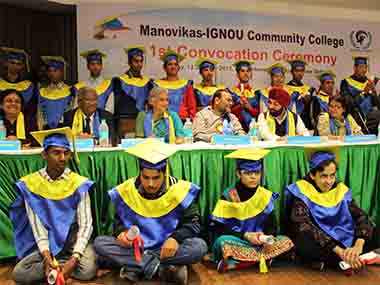
 "A college for the differently abled, arms them with a certificate, pride")
New Delhi: A shy Gaurav Dhawan would not have imagined that his life would turn out the way it has. At the age of eight, he was abandoned by his parents in one of the city’s many gurudwaras. His parents were poor and because he was, what they deemed, ‘mentally challenged’, they thought they would not be able to care for him. Today, he supports the very family that had deserted him. Twelve years ago Dhawan was taken to the Manovikas Charitable Society’s home by a well-wisher from the gurudwara. He stayed there, completed his schooling with their help and enrolled into Manovikas IGNOU Community College’s vocational training. “There were 7-8 students in my batch and we are all very good friends. I liked being part of the course very much,” said a beaming Dhawan on being asked what his experience at the community college was. [caption id=“attachment_587039” align=“alignleft” width=“380”] 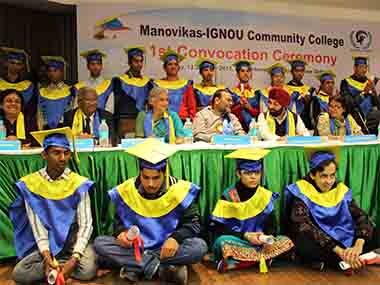 From left Mrs Poonam Natrajan Chairperson National Trust, Mr G Narayan Rao Chairman and Managing Director ALIMCO and NHFDC Padma Shri Dr Uma Tuli former Chief Commissio[/caption] In August 2011, with help from Manovikas’ placement cell he got a job at Haldiram’s as a salesperson and a box packer; and contributes to financially supporting the very family that abandoned him. On Sunday, the proud 20-year old received his certificate in Hospitality, topping his course and happy despite his circumstances. The college’s chairperson, Vikram Dutt, a formal civil servant with 42 years in the social sector, is of the opinion that the stigma of having a ‘different child’ is so much that most times parents themselves do not want to send their children for higher education. “We enroll about 20 students each batch – which lasts for six months – but we don’t get as many students as we hope we should. Most parents have the perception that if a child is slow or has delayed development they are ‘mentally retarded’ and there’s nothing that can be done to change it. They think they are good for nothings,” Dutt told Firstpost. “Many people ask me why I needed to have the convocation ceremony and have it at a place like the India International Center. I said we compete with the best so why shouldn’t we have a ceremony that befits it,” he added. Dr Vijaya Taing, a former lecturer of languages in Gwalior and a mother to a developmentally challenged daughter, Shwetha, agrees with Dutt. She said that for the lives of children with special needs it is vital that they do things that regular kids do, and parents have to stop thinking of them as a burden. Taing gave up her lecturer’s job in Gwalior soon after Shwetha finished playschool, so as to devote more time to her experiential education, homeschooling her throughout. She and her family moved base to Delhi, so that her daughter could avail facilities that were unavailable in Gwalior. She believes that while parents may go through many moments of self-doubt nurturing special kids, they must persist and be supportive. “It was tough, those years, but, I home tutored Shwetha. A formal education is not the only way or guarantee that the child will succeed. There needs to be environmental education, practical tasks that they should be taught, life skills, awareness of their surroundings and most of all confidence building. Sadly many parents don’t look at their child’s special needs in a positive light,” she said. At yesterday’s first convocation ceremony of the Manovikas IGNOU Community College held at the India International Centre, Dhawan and 30 other students were awarded certificates in Vocational Training from IGNOU in courses like hospitality, retail assistance, basic business, office attendants and computer training. The Manovikas IGNOU Community College, run by the charitable trust of the same name, provides vocational training to persons with intellectual disabilities, in courses recognized by Indira Gandhi National Open University.
At the age of eight, Gaurav Dhawan was abandoned by his parents in one of the city’s many gurudwaras. Today, he supports the very family that had deserted him.
Advertisement
End of Article


 "Russian drones over Poland: Trump’s tepid reaction a wake-up call for Nato?")
 "As Russia pushes east, Ukraine faces mounting pressure to defend its heartland")
 "Why Mossad was not on board with Israel’s strike on Hamas in Qatar")
 "Turkey: Erdogan's police arrest opposition mayor Hasan Mutlu, dozens officials in corruption probe")
 "Russian drones over Poland: Trump’s tepid reaction a wake-up call for Nato?")
 "As Russia pushes east, Ukraine faces mounting pressure to defend its heartland")
 "Why Mossad was not on board with Israel’s strike on Hamas in Qatar")
 "Turkey: Erdogan's police arrest opposition mayor Hasan Mutlu, dozens officials in corruption probe")



](https://images.firstpost.com/wp-content/uploads/2013/01/From-left-Mrs-Poonam-Natrajan-Chairperson-National-Trust-Mr-G-Narayan-Rao-Chairman-and-Managing-Director-ALIMCO-and-NHFDC-Padma-Shri-Dr-Uma-Tuli-former-Chief-Commissio.jpg)