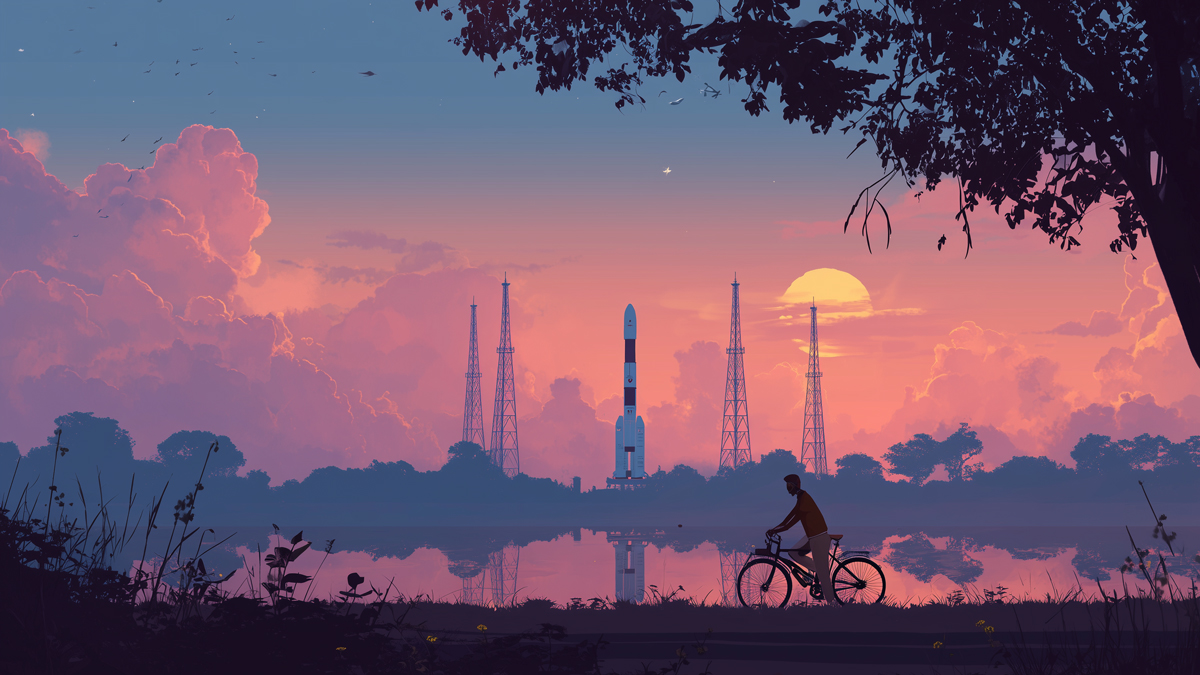
 "How India conquered space: From bicycles to the moon, mars & beyond")
In the middle of the 20th century, humanity looked to the heavens in a way it never had before. The first half of the century had been marked by two world wars, and the second half opened with a new kind of tension — the Cold War. Two superpowers, the United States and the Soviet Union, turned their rivalry into an arms race, a propaganda war and perhaps most ambitiously, a space race.
This wasn’t just about science. It was about prestige, influence and proving the superiority of one political system over another. Rockets launched with deafening roars, astronauts and cosmonauts became global icons, and the world followed every milestone — from the launch of Sputnik in 1957 to Neil Armstrong’s first steps on the Moon in 1969.
For most countries, these feats were the stuff of science fiction. The costs were astronomical. The technology, closely guarded. Space, it seemed, was the playground of the wealthy.
But in the 1960s, one newly independent nation refused to accept the role of passive observer. Still recovering from centuries of colonial exploitation, India dared to ask: why should space be the privilege of the rich? Could a country with limited resources, but limitless determination, reach for the stars?
Humble beginnings
India’s journey began in 1962 with the formation of the Indian National Committee for Space Research — Incospar. It was the brainchild of Dr Vikram Sarabhai, a visionary physicist who understood that space technology could leapfrog India’s developmental challenges. To him, satellites weren’t just tools for science — they could help forecast weather, guide agriculture, educate remote villages and improve communication across a vast, diverse land.
Quick Reads
View AllSarabhai’s choice for the country’s first launch site was unexpected: Thumba, a sleepy fishing village in Kerala. The location was perfect for studying the Earth’s magnetic field because it lay close to the magnetic equator. But there were no laboratories, no control rooms and certainly no launch towers.
So the team improvised. A church became their laboratory. The bishop’s house became their office. A nearby shed stored rocket parts. On November 21, 1963, in a scene that has since become iconic, parts of a small American-made Nike Apache rocket were transported to the launchpad on a bicycle.
That evening, the rocket roared into the sky, carrying a French payload to an altitude of 208 kilometres. It released a cloud of orange vapour to help scientists study upper atmospheric winds. It wasn’t a satellite. It wasn’t even Indian-built. But it was proof of concept — India could do this.
From Incospar to Isro
After that symbolic first launch, India’s ambitions grew. On the anniversary of independence in 1969, Incospar evolved into the Indian Space Research Organisation — Isro. The goal was now institutionalised: develop space technology for the benefit of India, while building the capacity for bigger scientific missions.
In 1975, Isro built and launched Aryabhatt, its first satellite. Although it hitched a ride on a Soviet rocket, the satellite was Indian through and through — designed, engineered and tested by Isro scientists. For a country just finding its feet in space technology, it was a proud moment.
The following years were a mix of breakthroughs and setbacks. Some launches failed. Some satellites underperformed. But each problem became a lesson. Isro scientists developed a habit of frugal, iterative improvement — doing more with less and never repeating the same mistake twice.
An Indian in space
The 1980s brought a new frontier: putting an Indian in orbit. In partnership with the Soviet Union, Isro embarked on a mission to send an Indian astronaut to space.
Out of about 50 test pilots from the Indian Air Force, Wing Commander Rakesh Sharma was chosen. His training was gruelling. He was tested for claustrophobia by being locked in a lit room for 72 hours, put through extreme endurance drills, placed on a strict diet and tasked with learning Russian in just three months so he could communicate during the mission.
On April 3, 1984, Sharma launched aboard Soyuz T-11 from the Baikonur Cosmodrome in present-day Kazakhstan. He spent nearly eight days aboard the Salyut 7 space station, conducting scientific experiments and representing a billion aspirations.
When then-prime minister Indira Gandhi asked him from space how India looked, Sharma’s reply was immediate: “Saare Jahaan Se Achcha” — “better than the entire world.” The words, drawn from a famous patriotic poem written during colonial rule, carried deep symbolism. It was a declaration that India’s future was not limited by its past.
Building the workhorses
If India wanted to be taken seriously in space, it needed its own launch capability. In the late 1980s, the Polar Satellite Launch Vehicle (PSLV) became Isro’s first reliable rocket, able to place satellites into polar orbits for remote sensing. The PSLV became known as Isro’s “workhorse,” delivering dozens of missions over decades with remarkable reliability.
Next came the Geosynchronous Satellite Launch Vehicle (GSLV) for heavier payloads and communication satellites. But to make the GSLV truly competitive, India needed cryogenic engines — which use super-cooled liquid hydrogen and oxygen to produce more thrust for less weight.
Here, geopolitics intervened. Attempts to buy the technology from Japan and Europe failed. A deal with Russia was blocked by US sanctions amid unfounded fears that India might use it for missile development.
Instead of giving up, India decided to develop the cryogenic engine in-house. It was a long, frustrating process marked by multiple failures. But by the early 2000s, Isro had its own functioning cryogenic stage — a breakthrough that would power its most ambitious missions.
Reaching the moon
In 2008, Isro launched Chandrayaan-1, India’s first lunar mission. The orbiter mapped the Moon from 100 kilometres above the surface and made a discovery that stunned the world: the presence of water molecules in lunar soil. This single finding reshaped scientific understanding of the Moon and demonstrated India’s capability in planetary science.
Leap to Mars
Five years later, India set its sights on Mars. The Mars Orbiter Mission, or Mangalyaan, was an audacious project. Many doubted it could be done in the time and budget Isro had — less than $74 million and under two years of preparation.
But in September 2014, India became the first Asian nation to reach Martian orbit and the first in the world to do so on its maiden attempt. The mission’s budget was less than that of the Hollywood film Gravity and yet it achieved what many wealthier nations had failed to do.
Landing on the moon’s south pole
In 2019, Isro attempted Chandrayaan-2, which included an orbiter, lander and rover. The orbiter worked perfectly, but the lander lost contact just before touchdown. It was a disappointment, but Isro immediately set to work on a follow-up.
In August 2023, Chandrayaan-3 landed successfully on the Moon’s south pole — a region never before reached by any nation. The mission cost just $75 million, showcasing India’s mastery of cost-effective engineering.
A new era of astronauts
In 2025, India marked another milestone in human spaceflight. Shubhanshu Shukla became the second Indian to go to space, travelling to the International Space Station aboard the private Axiom Space Mission 4. The 41-year gap since Rakesh Sharma’s flight made the moment even sweeter.
Shukla’s message from orbit echoed Sharma’s: “India still looks Saare Jahaan Se Achcha.” The continuity was deliberate — a reminder that while technology had advanced, the spirit driving India’s space journey was the same.
Business of space
India’s space economy today is valued at $8.4 billion — around 2 per cent of the global market. The target for 2033 is ambitious: capture 8 per cent of the market and grow the industry to $44 billion.
Five years ago, India had fewer than 50 space startups. Today, there are over 200, working on everything from satellite constellations to reusable rockets. This boom is driven by four main forces: strong government support, rapid technological innovation, Isro’s research-led culture and private sector energy.
The road ahead
The next decade promises even bigger leaps. The Gaganyaan mission, scheduled for 2027, will send three Indian astronauts into orbit on an indigenous spacecraft. By 2035, India aims to establish its own space station — the Bharatiya Antariksh Station. And by 2040, it plans to put an Indian on the Moon.
From Aryabhatt to Chandrayaan-3, from Mangalyaan to Gaganyaan, India’s journey has been defined by frugality, innovation and persistence. It has challenged the assumption that space exploration is only for the rich. It has shown that what you truly need isn’t unlimited budgets — it’s unlimited ambition.
As Isro and India’s growing private space sector push forward, the message is clear: when you have fire in your belly, even the sky is not the limit.

 "Trump finds new raid target? Report says US actively seeking regime change in Cuba by 2026-end")
 "Trump meets Zelenskyy in Davos, says 'a ways to go' on ending Ukraine war")
 "Power shift in Hanoi: Vietnam party list hints PM and president losing clout")
 "Can Trump’s Board of Peace replace the United Nations?")
 "Trump finds new raid target? Report says US actively seeking regime change in Cuba by 2026-end")
 "Trump meets Zelenskyy in Davos, says 'a ways to go' on ending Ukraine war")
 "Power shift in Hanoi: Vietnam party list hints PM and president losing clout")
 "Can Trump’s Board of Peace replace the United Nations?")