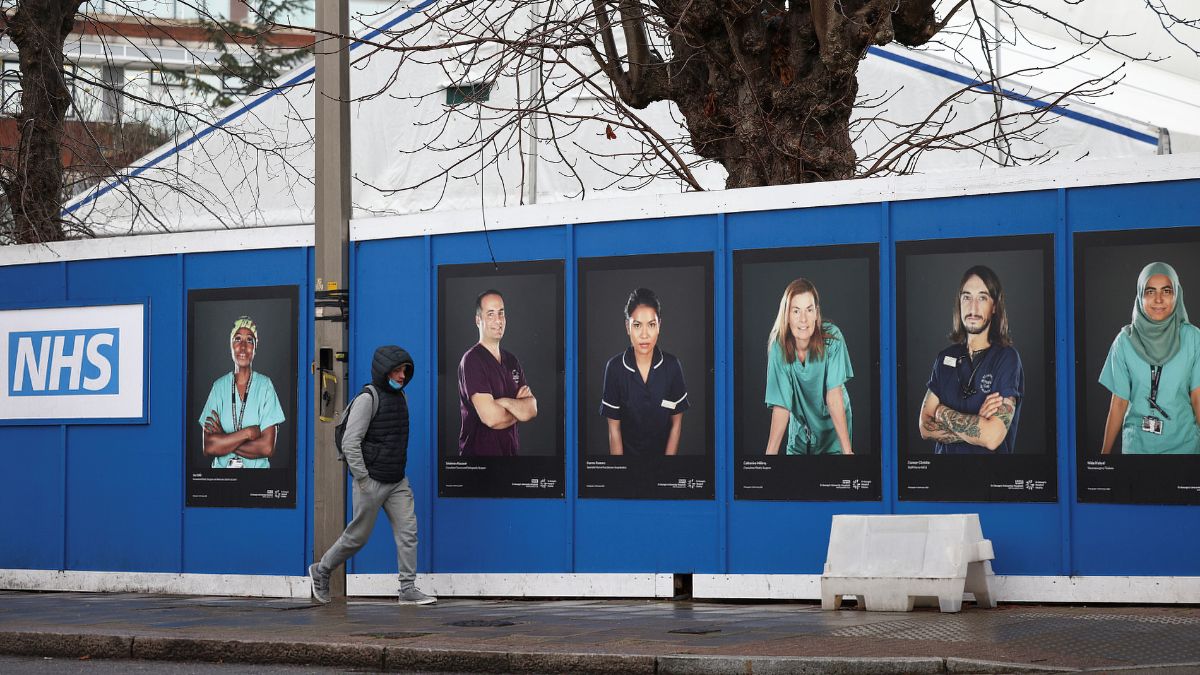
 "A person walks past images of National Health Service (NHS) workers displayed on hoardings outside a temporary field hospital at St George's Hospital in London, UK, January 8, 2022. File Image/Reuters")
Wealthy nations are increasingly relying on medical professionals trained outside their borders.
Across North America, Western Europe, Australia, and other members of the Organisation for Economic Co-operation and Development (OECD), foreign-born and foreign-educated doctors are becoming indispensable to sustaining national health systems.
Their migration, however, often deepens shortages in countries that invested in their training and already face critical gaps in medical staffing.
Recent data shows that nearly a quarter of all doctors practising in OECD countries were born abroad, and close to a fifth completed their education elsewhere.
And now high-income nations are not merely attracting foreign doctors — they are increasingly structuring immigration and workforce policy around them.
At the same time, developing countries, especially in Africa and Asia, are witnessing a continuous departure of trained medical professionals they struggle to replace.
How much the West depends on imported medical talent
The share of foreign-trained and foreign-born doctors across OECD member states is substantial and continues to grow.
United States: International medical graduates (IMGs) form roughly 25 per cent of the physician workforce. Of the nation’s 987,000 doctors, more than 262,000 are immigrants. India alone accounts for nearly 6 per cent of US doctors, making it the largest source country.
Europe (WHO Region): Between 2014 and 2023, the number of foreign-trained doctors increased by 58 per cent. In 2023, 60 per cent of new entrants to the medical labour market had completed their education abroad.
Australia, Ireland, New Zealand: These countries continue to have some of the highest proportions of foreign-trained doctors globally. The share reaches around 40 per cent in nations such as Ireland and New Zealand.
Israel: Israel, meanwhile, sees nearly 60 per cent of its doctors trained overseas.
Collectively, these figures expose the structural dependence of Western health systems on physicians who trained elsewhere — frequently in lower- or middle-income countries.
Canada launches ambitious initiative to retain foreign doctors
Canada has become one of the clearest examples of how affluent nations are attempting to stabilise their health-care systems by prioritising foreign-trained physicians.
Confronted with long wait times, inadequate primary care access and chronic staffing shortages, the federal government has announced new measures designed to keep international doctors already practising in Canada from leaving.
Canadian Immigration Minister Lena Diab unveiled a major policy change aimed at opening permanent residency routes for these physicians.
Her announcement confirmed that 5,000 additional federal admission spots will be set aside for provinces and territories to nominate licensed doctors who hold job offers.
This expansion does not replace existing immigration quotas but adds to them, signalling how urgently Canada seeks to reinforce its medical workforce.
“Many of these doctors are already treating patients in our communities. We cannot afford to lose them,” stated Diab.
From early 2026, a dedicated category will be created under the Express Entry immigration system for doctors who have accumulated at least one year of Canadian work experience within the previous three years.
This category will include practitioners working in primary care as well as medical, surgical, clinical, and laboratory specialties.
The government says physicians nominated through the programme will see their work permits processed in 14 days, allowing them to remain active during the period that their permanent residency forms are being handled.
A federal statement outlining the move said, “We’re giving these doctors a clear pathway to permanent residence in Canada to fill critical health workforce gaps, while helping support reliable care and a stable health system for Canadians.”
The government has connected this initiative to troubling gaps in access to care. Nearly 17 per cent of adults and 11 per cent of children and adolescents have reported not having a regular primary care provider.
These shortages have contributed to a reliance on internationally trained professionals, yet a significant portion of those already in the country remain underutilised.
The Canadian Medical Association (CMA) welcomed the policy update. Its president, Dr. Margot Burnell, stressed the scale of the issue, stating, “Currently, more than 13,000 internationally trained physicians in Canada are not working in their field.”
OECD data highlights Canada’s dependence on foreign-trained talent. The organisation’s International Migration Outlook for 2025 recorded 3,900 India-trained doctors in Canada based on earlier figures from 2021.
Broader estimates suggest that the total number of doctors of Indian origin present in the country may sit between 8,000 and 10,000.
UK braces for exodus of international docs
While Canada attempts to hold on to foreign-trained staff, the United Kingdom is grappling with a rising number of departures. The country’s health service is one of the most dependent in the world on overseas medical talent.
About 42 per cent of the National Health Service’s (NHS) doctors were educated outside the UK, making international recruitment central to the system’s functioning.
Yet a major new report from the General Medical Council (GMC) shows troubling signs. In 2024, 4,880 foreign-trained doctors exited the NHS workforce, up sharply from 3,869 the year before — a rise of 26%.
This shift has deepened concerns that the UK could face serious staffing holes if departures continue at this pace.
GMC chief executive Charlie Massey highlighted the seriousness of the situation, stating,
“Doctors represent a mobile workforce, whose skills are in high demand around the world.”
“If we see even a small percentage increase in them leaving, our health services will end up with huge holes that they’ll struggle to fill.”
Massey’s warning comes amid a broader climate of tension within the NHS. Health leaders have raised concerns about frontline staff encountering discrimination and hostility.
Several NHS trust executives have informed national bodies that the widespread presence of St George’s flags has created what some employees describe as “no-go zones,” affecting their ability to visit homes for patient care.
A poll conducted by NHS Providers showed that 45 per cent of senior managers were extremely worried about discrimination directed towards staff, while 33 per cent were moderately concerned.
UK Health Secretary Wes Streeting recently noted that the system is severely oversubscribed with two-thirds of the 30,000 applicants for 10,000 available training positions are international medical graduates.
The UK continues to rely heavily on recruitment from abroad despite global warnings. The World Health Organisation issued a “red list” in 2020 that identifies Nigeria, Ghana, Zimbabwe, and 34 other African countries as facing workforce vulnerabilities, advising wealthier nations not to actively recruit from them.
Yet, according to the UK’s Nursing and Midwifery Council, more than 7,000 Nigerian nurses relocated to the UK between 2021 and 2022, highlighting how demand continues to supersede ethical considerations.
Those foreign-trained doctors moving from the UK are preferring Australia as a potential destination for their new workplace.
Australia’s heavy dependence on foreign docs
Although Australia faces a severe shortage of medical staff, many internationally trained doctors residing there are unable to practise due to regulation and red tape.
Projections suggest that Australia will require an additional 13,000 doctors by 2026 to meet growing healthcare demand.
International medical graduates already make up 32 per cent of the nation’s medical workforce and constitute more than half of rural doctors, a level of dependence that shapes healthcare access in large parts of the country.
Despite this, foreign-trained doctors regularly encounter long delays, unclear assessment requirements, multiple exams that duplicate earlier evaluations, and heavy financial burdens. Some spend years in temporary jobs outside medicine while awaiting approval from regulatory bodies.
The federal parliament addressed these barriers more than a decade ago. In 2012, the House of Representatives Standing Committee on Health and Ageing published the Lost in the Labyrinth report, identifying chronic problems and making 45 recommendations for reform.
While there have been improvements in certain areas — such as workplace-based assessments and additional training programmes — implementation has remained inconsistent.
Access to support differs substantially depending on location, with doctors in remote areas often facing isolation and discrimination.
With inputs from agencies