

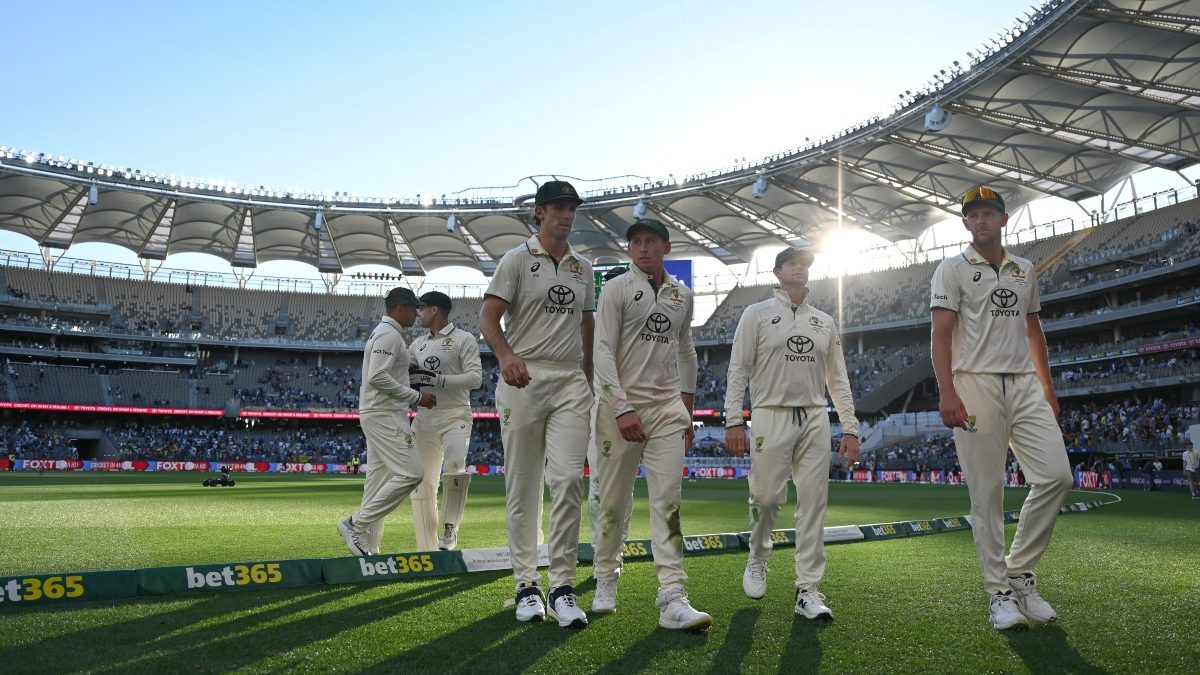
 "Border-Gavaskar Trophy: Why the Australian cricket team is struggling to win at home against India")
The last time Australia lost three Tests in a row was towards the end of 1988, when the all-conquering West Indies humbled them in the first three games of a five-match showdown in Brisbane, Perth and Melbourne. Under Allan Border, Australia were still a team in transition while West Indies, with Viv Richards at the helm, were both fearsome and experienced with Malcolm Marshall spearheading their pace attack.
Some 36 years later, Pat Cummins is in danger of becoming the first Australian skipper since Border to surrender three Tests at home in a row. Outwitted by debutant paceman Shamar Joseph and West Indies in the day-night Test in Brisbane in January and humbled by Jasprit Bumrah’s genius in Perth some ten days back, Australia will bank on a return to one of their favourite hunting grounds to arrest a mini slide in the second Test against India, who will welcome back skipper Rohit Sharma.
Having won each of the preceding seven day-night Tests at the Adelaide Oval, the Aussies are quietly confident of making their way back into this five-match series. They might use bundling India out for 36 in the corresponding fixture four years back as inspiration, but they will also be mindful that ten days is a lot closer than four years and therefore for now at least, the bragging rights rest with their opponents.
IND vs AUS | How has Team India performed in pink-ball Tests and at Adelaide Oval?
It’s been an interesting last few days in Australia, with reactions to their 295-run drubbing in Perth ranging from the extreme to the outrageous. Perhaps in various quarters outside the team, India were seen as pushovers after their 0-3 submission to New Zealand in their own backyard. To be schooled at one of their most successful grounds – the hosts had won all four prior Tests at the Optus Stadium – must be a bitter pill to swallow and to no one’s surprise, the doomsday experts have been at it on various media platforms since the Perth debacle.
The Jasprit Bumrah factor and Josh Hazlewood’s ‘rift’ remark
The two big talking points have been the hold Bumrah has had on the Aussies, and an off-hand remark by Josh Hazlewood that has been conveniently interpreted as a rift in the team, with the batters on one side and the bowlers on the other. That conspiracy theory has gained traction after it was announced five days after the Perth Test ended that Hazlewood was ruled out of the second Test with a side strain.
First, to Hazlewood. At the end of day three in Perth, with Australia on 12 for three after being set a humongous 534 for victory, he was asked about the approach the following day and what Australia could do to turn things around. “Well, you’d probably have to ask one of the batters that question probably,” he said, with a smile. “I’m sort of relaxing and trying to get a bit of physio and a bit of treatment. I’m probably looking mostly towards the next Test and what plans we can do against these batters. I guess the batters – just sticking to what they do, their preparation.
Impact Shorts
More Shorts“They’ll have a hit in the morning and talk around plans of how they can negate what happened in the first innings and move forward and improve on that.”
IND vs AUS | Here's what the Adelaide Oval pitch looks like days before start of 2nd Test
Hazlewood had taken four for 29 to halt India’s first innings at 150, after which he and fellow quick Mitchell Starc negotiated 110 balls in putting on 25 for the last wicket, the highest partnership in a disappointing total of 104. His subsequent comments therefore came in handy for an Australian media looking for scapegoats to further the ‘all’s-not-well-in-the-team’ narrative, which has persisted despite repeated entreaties from various players, including Cummins, Marnus Labuschagne and Travis Head , among others, that the team is united as ever.
Alex Carey, the wicketkeeper from South Australia who will be playing in front of his family and friends from Friday, also was a little taken aback by the extreme reaction to what in effect is a single, isolated defeat. “It’s quite a big reaction externally for one Test loss,” he observed on Tuesday. “Internally, we don’t feel that. We didn’t play the way we would have liked to have played, but we know over four, five Test matches, if we keep rocking up and playing our style of cricket, we will have the success.”
For that, Australia will have to evict Bumrah from their minds , which he has occupied rent-free. Each one of the Australians who have met the media in the last many days have invariably been reminded of the mayhem the Indian quick has triggered; it’s almost as if even if the batters don’t want to think of Bumrah, they simply have no choice.
Head went to the extent of saying Bumrah would probably go down ‘as one of the greatest fast bowlers to play the game’. “We’re finding that at the moment, how challenging he can be and it’s nice to play against that,” said the Player of the Match in the last two Adelaide Tests, who has a terrific record against India. “It’s going to be nice to look back at your career and tell the grandkids that you faced him.” Strike one already to Bumrah, you say?
IND vs AUS | How Jasprit Bumrah's Team India pulled off a stunning turnaround in Perth
Australia’s more tangible problem, beyond the concocted divide in the team and the genuine Bumrah threat, is the inability of Labuschagne and Steve Smith to put their hands up. Since the retirement of David Warner, the Aussies have struggled for momentum at the top of the order. Hardly has a mention of Warner been made by any of the players, who must know the impact the bruising left-hander had against the new ball.
Steve Smith and Marnus Labuschagne crucial to Australia’s chances
Smith, who has returned to No. 4 after a failed four-Test experiment as opener following Warner’s retirement, has gone without a hundred for 23 innings, during which period he has made only four half-centuries. Labuschagne’s numbers are equally damning – a solitary century and seven fifties in his last 41 Test innings. These two have been the backbone of the Australian batting for nearly half a decade now and when both go cold at the same time, the void is, as can be understood, extremely difficult to fill.
Within a matter of two weeks, Australia are being painted as the hunted when, before Perth, they were anointed the hunters. But no Australian team ever rolls over and surrenders without a fight. True, Perth was an unqualified disaster and particularly alarming was Australia’s flatness in the field the longer Yashasvi Jaiswal and KL Rahul built on India’s 46-run first-innings edge.
But when things go wrong, they can go horribly so. In a way, Australia must be relieved that all disciplines let them down in the same game because that means there is only one way left for them – upwards. No matter what the perception outside is, India know the perils of reading too much into the past or looking too far ahead.
“We have taken a lot of confidence from that (victory in the first Test). But yeah, Perth is back in Perth,” Rahul cautioned. “It’s a different place, different conditions. The pink ball is going to be different.”
The series score line might read 1-0 in India’s favour, but both teams start on nought in Adelaide. That alone should preclude Australia being taken for granted.

 "Russian drones over Poland: Trump’s tepid reaction a wake-up call for Nato?")
 "As Russia pushes east, Ukraine faces mounting pressure to defend its heartland")
 "Why Mossad was not on board with Israel’s strike on Hamas in Qatar")
 "Turkey: Erdogan's police arrest opposition mayor Hasan Mutlu, dozens officials in corruption probe")
 "Russian drones over Poland: Trump’s tepid reaction a wake-up call for Nato?")
 "As Russia pushes east, Ukraine faces mounting pressure to defend its heartland")
 "Why Mossad was not on board with Israel’s strike on Hamas in Qatar")
 "Turkey: Erdogan's police arrest opposition mayor Hasan Mutlu, dozens officials in corruption probe")



