

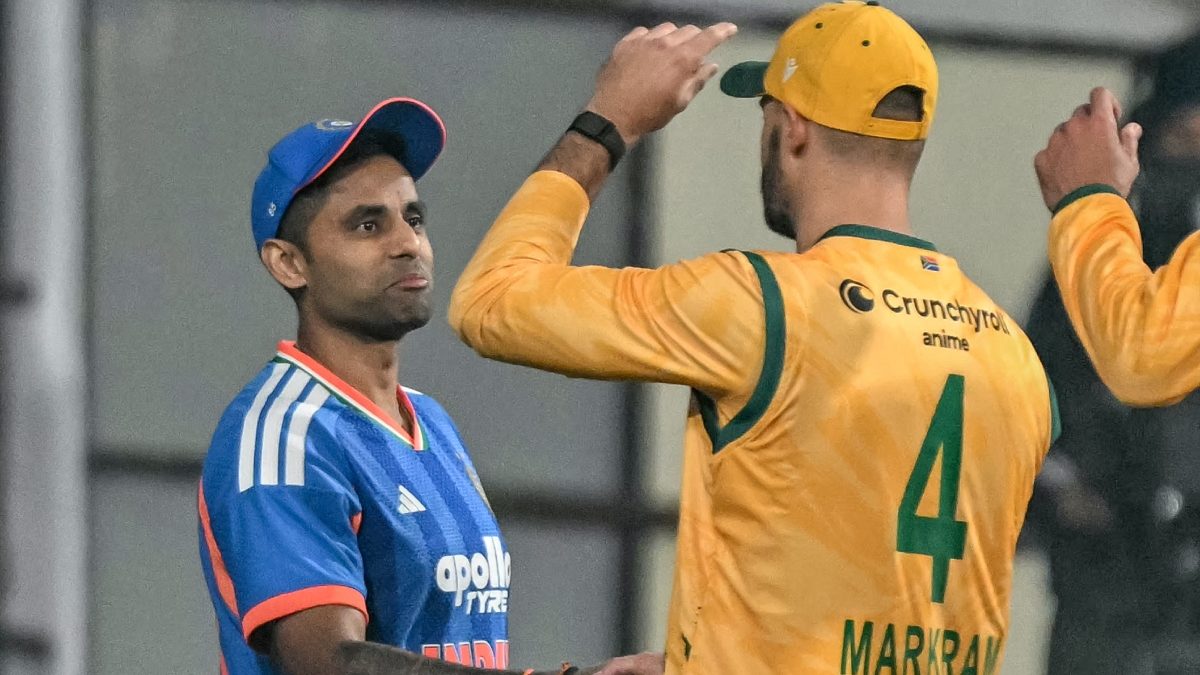
 "India's evening of mistakes in Mullanpur: South Africa bring high-flying T20 world champions to ground")
December 11, New Chandigarh. 20 overs into the second T20I. South Africa have put 213 on the board. There is dew around. The pitch is conducive to stroke-making. India have an irresistible batting unit. Capable of throwing caution to the wind, and capable of deflating bowling attacks. Plenty in attendance too. These fans have seen their team hunt leather for almost two hours, but they know that if any side can chase this down, it is India.
The hosts begin like they have a score to settle too. Abhishek Sharma flexes his muscles early against Lungi Ngidi. The third ball of the over, in the slot and pitching outside off, is creamed over cover. The fourth ball is worked away for a single and that brings Shubman Gill on strike.
Gill, though, does not show the sort of conviction that has become synonymous with Abhishek lately. He nibbles at a back of a length delivery, gets squared up and nicks through to wide slip. A golden duck for India’s vice-captain, which, on most days, would be problematic but tonight, feels a little more significant. Not just because of how many India have to chase, but also because that misstep acts as a prelude for the rest of the night.
Axar Patel’s bizarre promotion
Axar Patel, surprisingly, walks in at 3. He has never batted at this spot before in his T20I career. In fact, before tonight, the only time he had ever batted in the top four was more than a year ago – against Pakistan in New York at the T20 World Cup.
Quick Reads
View AllThere is no doubting Axar’s ability. Quite often, he has been India’s crisis man. And there is a running joke that he either steps forward or is pushed forward whenever things threaten to turn pear-shaped. But was Axar batting at number three really the right ploy, especially with Suryakumar Yadav and Tilak Varma in the shed, and with Sanju Samson on the bench?
That, in a nutshell, might end up being the takeaway from this second T20I. Because India, after losing a few early wickets, got caught in the quicksand. The more Axar tried to plough and wriggle out of it, the more he and India got stuck. He was eventually dismissed for a run-a-ball 21, with the required run-rate inching towards 12.
Axar’s innings, in isolation, was detrimental enough. But the knock-on effects it had, caused India more issues. His promotion meant that Suryakumar had to shunt down to number four. Tilak then had to shift down further. He did not seem to mind it and waged a lone and arduous battle against the Proteas.
Too much flexibility?
But most of Tilak’s high-profile acts in Indian colours, perhaps barring the Asia Cup final, have come when he has batted at three. Funnily enough, it was against this very side and when Suryakumar was starting out as captain that Tilak famously asked his skipper if he could bat at that position, in an away series. Tilak repaid the faith Suryakumar had shown in him with back-to-back hundreds.
Tilak’s demotion meant those below him had to bat lower too. Hardik Pandya, star of the show in Cuttack, huffed and puffed, ultimately finishing with a sub-100 strike rate, despite batting for more than 20 balls.
Jitesh Sharma flickered initially before fizzling out. Shivam Dube, who did not fare badly with the ball, came in to bat at number eight. Being an all-rounder, Dube can be a lot of things. But a number eight batter, tasked with hitting straightaway, that too against pace, is perhaps something he is not.
In T20s, batting orders, often, are a little overrated. Flexibility and adaptability are regular buzzwords. India’s current head coach Gautam Gambhir has reminded everyone as much whenever he has gotten a chance to do so. And it is practically more feasible to shuffle the pack and indulge in something funky when there is lesser at stake.
But that also begs the question around how much flexibility is too much flexibility. Not solely because of how that particular experiment, on any given day, has panned out, but also because of how it creates bugs and glitches in systems that were otherwise working perfectly.
Mullanpur conditions test India
India could not adapt well enough to conditions either, with South Africa definitively out-bowling India. They had the luxury of watching for 20 overs before getting into their work, but their propensity to hit the pitch hard helped them extract handsome rewards.
Abhishek, Gill and Suryakumar all perished to back of a length deliveries that did just enough off the surface. Even towards the end of South Africa’s bowling innings, they prioritized bowling the ball into the deck, as opposed to India, who tried to nail their yorkers, missed and subsequently travelled the distance. That neither of Arshdeep Singh or Jasprit Bumrah were able to hit the blockhole consistently (owing to the dew) should have been evidence enough to switch to an alternate play. India did not. And India paid the price.
The other aspect India might not be happy with is how they crumbled inside the powerplay in their run-chase. Ordinarily, with a T20 World Cup on the horizon, this was an evening for India to reiterate their favourites tag, and to reaffirm why they are the best outfit on the planet in this format. Especially in front of a partisan crowd and with dew a huge factor.
Instead, it turned into an evening where India, for the first time in a while, seemed a little rattled. A touch unsure of how to transfer the pressure onto the opposition. And a tad lacking in matching the opposition skill-for-skill. All while South Africa grew in confidence, vanquished the ghosts of Cuttack, and shrunk India’s air of dominance.
Again, though, India would rather lose a game to South Africa now than, say, in the Super Eight or in the semi-final/final of the T20 World Cup. From that perspective, it is probably not the worst outcome in the world that they have actually faced defeat.
And in a few months’ time, this game could be looked at as one where India came face to face with the chinks that exist in their armour and went about removing them, one at a time. After all, nothing in sport prepares teams better than a game they did not win.
But for that narrative to run true, India need to turn up in Dharamsala on Sunday. Just like their fans thought they could on Thursday in New Chandigarh, and just like the team, stung by a defeat in the format for only the third time this year, will feel they ought to.

 "What the dramatic US seizure of Venezuela-linked oil tanker tells us")
 "Should Ukraine concede territory to Russia? Zelenskyy wants Ukrainians to vote in referendum")
 "Who is Kilmar Ábrego García, the man ‘mistakenly’ deported by US, now freed?")
 "Trump's new tax guidance could let companies save billions more")
 "What the dramatic US seizure of Venezuela-linked oil tanker tells us")
 "Should Ukraine concede territory to Russia? Zelenskyy wants Ukrainians to vote in referendum")
 "Who is Kilmar Ábrego García, the man ‘mistakenly’ deported by US, now freed?")
 "Trump's new tax guidance could let companies save billions more")



