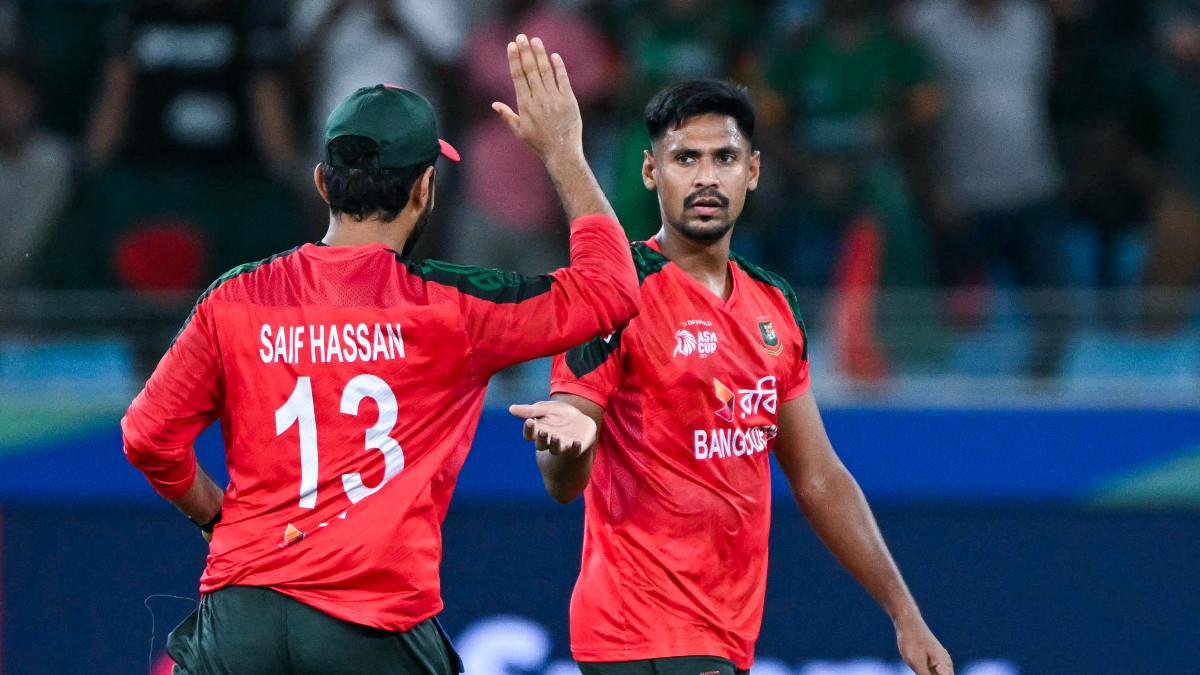
 "Bangladesh pacer Mustafizur Rahman had been acquired by Kolkata Knight Riders for Rs 9.2 crore in the IPL 2026 auction, only to be released less than a month later on the BCCI's advice. AFP")
Kolkata Knight Riders acquiring Bangladeshi pacer Mustafizur Rahman for Rs 9.2 crore last month had led to a massive uproar on social media as well as among the general public and has put the spotlight on India’s cricketing relations with Bangladesh.
Diplomatic ties between New Delhi and Dhaka, after all, have been on the decline ever since Sheikh Hasina was deposed as the Prime Minister in August 2024. Provocative statements from top leaders such as Chief Advisor Muhammad Yunus, focusing primarily on cutting northeastern India off from the rest of the country, have only worsened the situation between the two neighbours.
With the assassination of student leader Osman Hadi as well the mob lynchings of Dipu Chandra Das and Khokhon Das, individuals belonging to the minority Hindu community, relations between the two South Asian neighbours appear to have hit rock bottom since Bangladesh was liberated from Pakistan in December 1971.
In such a scenario, it was understandable for the BCCI to ask three-time champions KKR to release Mustafizur regardless of his stature as one of Bangladesh’s greatest cricketers who had made quite the impact in the Indian Premier League since his debut in 2016.
But how does the decision to remove Mustafizur from KKR’s squad following protests affect cricketing relations between India and Bangladesh?
Will the BCCI start treating Bangladesh Cricket Board the same way they treat Pakistan Cricket Board – severing bilateral ties but ensuring the two nations face each other in global and continental events?
Quick Reads
View AllBCB asks for venue change in T20 World Cup
The Mustafizur decision, for starters has led to the BCB considering approaching the International Cricket Council for a venue change in the upcoming T20 World Cup – which will be co-hosted by India and Sri Lanka. The Bangla Tigers will be playing three of their four Group C fixtures at Kolkata’s Eden Gardens and will be facing Nepal at Mumbai’s Wankhede Stadium.
With Pakistan playing all of their fixtures in Sri Lanka, including the semi-finals and final should they qualify, it appears BCB also intends for their team to shift their base to the island nation. However, a final decision by the ICC, currently led by ex-BCCI secretary Jay Shah, is yet to be made.
On the longer run, however, it could affect India’s tour of Bangladesh that is scheduled to take place in September this year , as announced by the BCB on Friday. The Men in Blue were supposed to tour Bangladesh in August for a white-ball series right before the Asia Cup, only for it to get called off.
The BCCI had mentioned scheduling hassles as the reason behind decision at the time, but it was quite evident that diplomatic tensions between the two countries had a strong influence on the eventual outcome.
Will Bangladesh go down the Pakistan route?
And if things do not improve in Bangladesh after the general elections in February, the Indian board could very well abandon the tour altogether instead of postponing it for the next year. And such a move could also affect the perception of Bangladesh as a cricketing destination.
Bangladesh is by no means at par with Pakistan as far as security issues are concerned, although Australia did withdraw from a Test tour in late 2015 as well as from the U-19 World Cup that took place in the country shortly after.
Whether Bangladesh also becomes a no-go zone in the cricketing context like Pakistan was from 2009 until recently is something that remains to be seen, and the BCCI might just end up playing a major role in influencing global opinion in that regard.