

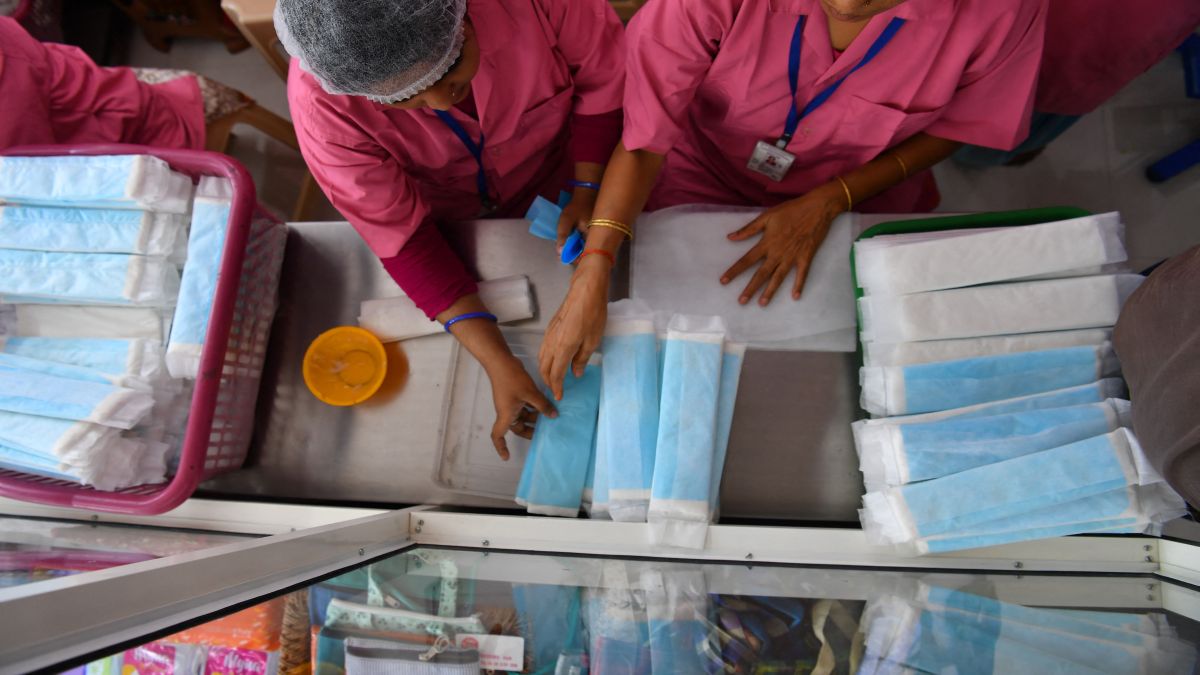
 "Seeing Red: How sanitary pads, menstrual waste add to India’s environmental burden")
Picture this: you are having your menstrual cycle, and you reach out for your trusted sanitary pad. Once you are done with it, you wrap it up in paper, and throw it in the dustbin and forget all about it.
However, that sanitary pad has a long life ahead: it reaches landfills across the country and continue to exist there, as they aren’t made of biodegradable materials. And hence, they not only become one of nature’s polluters, affecting animal health but also lead to resource depletion.
On World Menstrual Hygiene Day — celebrated annually on 28 May — we take a closer look at the environmental impact of sanitary pads and how we could tackle this problem.
Trash that pad
Menstrual health products namely sanitary pads and tampons have been a boon for India, saving millions of women from infections as well as from the task of washing and drying menstrual cloth or using leaves.
However, this has come with a cost — an environmental cost. According to Menstrual Hygiene Alliance of India, the country generates a whopping 12 billion disposable sanitary napkins every year, the majority of which are non-biodegradable in nature, typically made from polypropylene and superabsorbent polymer powder (sodium polyacrylate).
Experts observe that each of these sanitary pads disposed are equivalent of four plastic bags, and it takes 250-800 years to decompose. What’s worse is that some may never decompose at all.
Impact Shorts
More ShortsThis is because commonly available sanitary pads in the market are primarily made of plastic or plastic derivatives. The absorbent core of a sanitary pad is made of wood pulp, the ‘absorbing gel’ is made of super absorbent polymers, the ‘wings’ have non-biodegradable adhesives to keep them in place, and other materials such as polypropylene and polyethylene are also added.
Also, many users of sanitary pads don’t dispose them off in the right way, which leads them to being found in landfills as well as in local water bodies. This, in turn, pollutes the water bodies as well as the flora and fauna that exist in it.
Some experts also note that discarded sanitary pads can affect the soil — that’s because when these pads do break down they eventually become microplastics. And these microplastics then find their way to our soil system and even oceans.
Handling of sanitary waste
In India, one of the biggest problem with sanitary waste is its disposal. In India, according to the Solid Waste Management (SWM) Rules, 2016, soiled sanitary pads are considered household waste.
It has been observed that incinerators are the preferred way to discard sanitary pads. This, itself, presents a problem, as there is a shortage of such facilities in the country. Down To Earth reports that cities like Pune and Bengaluru and states like Goa have installed small-scale sanitary waste incinerators in schools and colleges. In 2022, the Delhi government announced the installation of sanitary napkin incinerators with smoke control units in toilet blocks for girls in 550 Municipal Corporation of Delhi schools.
However, this could be dangerous to humans as well as the environment. When sanitary pads are burnt, experts note that they release extremely hazardous carcinogenic gases, including dioxin furans. Dioxin and furans are toxic, persistent (do not readily break down in the environment), and bio-accumulative (able to move up the food chain) in nature.
Arundati Muralidharan, co-founder of Menstrual Health Action India, in an Economic Times report also noted that many of these incinerators lack proper maintenance and fail to incinerate the plastic in the pads efficiently. Furthermore, the absence of ventilation systems poses health risks due to the fumes emitted.
Going green in red
Experts believe that while disposable sanitary pads have been a boon for Indian women, it’s time to look beyond just this option when it comes to menstrual products. In the past few years, the country has seen a gradual movement towards switching to sustainable and eco-friendly menstrual hygiene products. Menstruators are shifting to using biodegradable sanitary napkins, reusable cloth napkins, menstrual underwear, and menstrual cups.
Biodegradable sanitary napkins can decompose in six to 12 months. Reusable cloth pads and menstrual underwear can be reused for a year or two. Menstrual cups are made of medical-grade silicon and are reusable for five to 10 years.
In fact, a report by Action Research and Training for Health (ARTH) titled ‘Why India needs to move beyond sanitary pads’ showed that when a menstruator uses menstrual cups, she will generate 600 grammes of non-biodegradable waste. Silicone menstrual cups are non-biodegradable but do not break down into microplastics and can be recycled.
Speaking on the same, Dr Soumya Swaminathan, former chief scientist of the World Health Organisation (WHO), said: “This reduces the generation of total non-biodegradable waste by 99 per cent and is an example of a win-win intervention that is good for the environment and good for health and hygiene. Menstrual cups are practical, hygienic, and cost-effective. More and more women need to know about them and myths around their use need to be busted.”
And adoption to such green options is growing. A Business Insider report from 2022 said that Sirona Hygiene brought in 20,000-30,000 new consumers for its menstrual cups, every month.
Deep Bajaj, founder and CEO of Sirona Hygiene in the report said that the sustainable category is picking up pace and is growing at the rate of 100 per cent year-on-year. He further added that while there was no specific data available on this nascent market, it could be worth around Rs 100 crore overall already.
Besides a shift to greener options, experts also note that a long-term scientific solution should be found to discard sanitary pads in a safe and eco-friendly manner.
And if nothing else, one can opt for the free bleeding method — where menstruating persons choose not to use any kind of menstruating product at all.
With inputs from agencies


 "Russian drones over Poland: Trump’s tepid reaction a wake-up call for Nato?")
 "As Russia pushes east, Ukraine faces mounting pressure to defend its heartland")
 "Why Mossad was not on board with Israel’s strike on Hamas in Qatar")
 "Turkey: Erdogan's police arrest opposition mayor Hasan Mutlu, dozens officials in corruption probe")
 "Russian drones over Poland: Trump’s tepid reaction a wake-up call for Nato?")
 "As Russia pushes east, Ukraine faces mounting pressure to defend its heartland")
 "Why Mossad was not on board with Israel’s strike on Hamas in Qatar")
 "Turkey: Erdogan's police arrest opposition mayor Hasan Mutlu, dozens officials in corruption probe")



