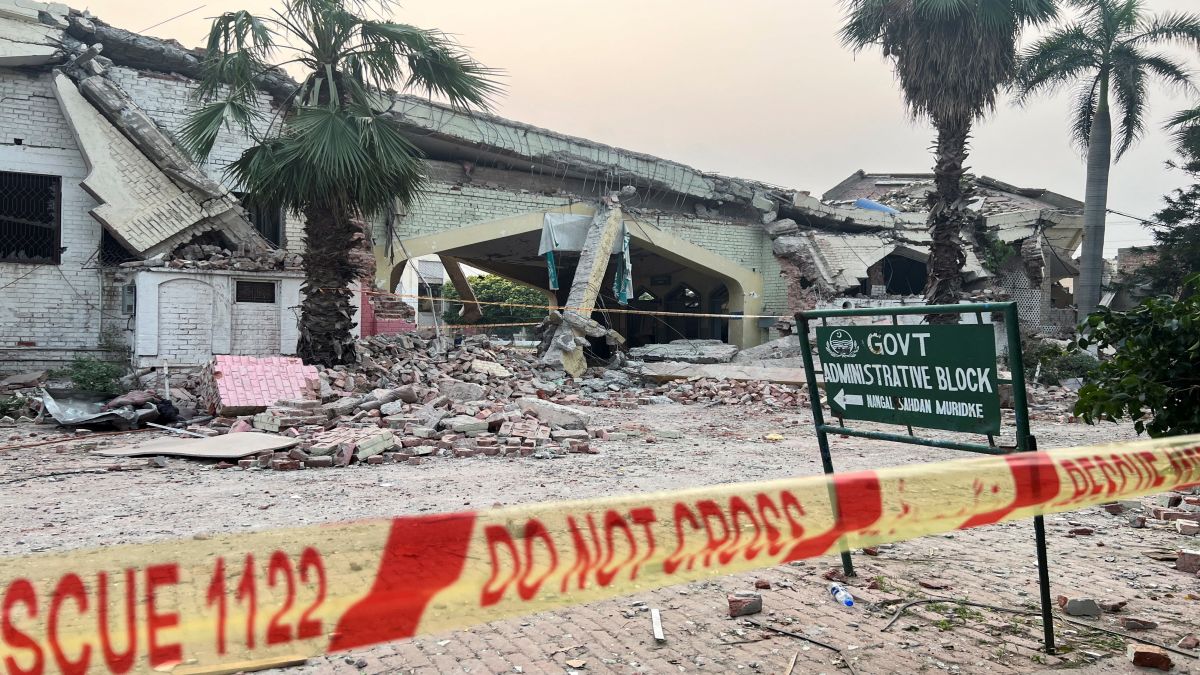
 "A damaged portion of the terror camp in Pakistan's Muridke near Lahore during Operation Sindoor. File image/Reuters")
Will India and Pakistan clash again in 2026?
A US think-tank has claimed that there is a ‘moderate likelihood’ of renewed conflict between the two nations. The report says this will likely be caused by increased “terrorist activity”.
The two countries earlier this year engaged in a four-day battle in May. This came after India launched Operation Sindoor in response to April’s Pahalgam terror attack, in which 26 civilians, mostly tourists, were killed.
The report comes as India’s defence council recently cleared a Rs 79,000 crore package for the Indian Armed Forces.
But what does the report say? Will the year 2026 witness another India–Pakistan conflict?
Let’s take a closer look:
The report and its methodology
First, let’s take a brief look at the report and its methodology.Entitled Conflicts to Watch in 2026, it was compiled by the Center for Preventive Action (CPA) of the Council on Foreign Relations (CFR) think-tank. The CPA first used social media platforms to poll respondents about which conflicts to include in the survey. It then whittled this down to 30 using in-house experts.
In November 2025, the CPA sent the survey to around 15,000 US government officials, foreign policy experts, and academics, of whom approximately 620 responded. They were asked to rate the likelihood of each conflict and the impact on US interests.
The survey then ranked the conflicts according to their likelihoods, placing them in Tiers I, II and III.
What does it say?
The report says that clashes between India and Pakistan could develop into a flashpoint in 2026.
It points to the prospect of an “armed conflict” between India and Pakistan due to “heightened terrorist activity”. The possible conflict was ranked as part of the report’s Tier II contingencies alongside:
Increased terrorist attacks and expanded territorial control by Al-Shabaab and ISIS
Houthi attacks on Israel and continued Israeli military strikes in Lebanon
Growing sectarian violence and a resurgence of ISIS in Syria, exacerbated by Israeli and Turkish military interventions
It said such a conflict between the two nations would have a “moderate impact” on the Trump administration’s interests. The idea behind the report is to help US officials and lawmakers understand the potential conflicts that could arise around the world and how best to put policies in place to mitigate them.
It is important to note that the report does not predict conflict but assesses the likelihood of it based on expert opinion.
Interestingly, the report also appears to echo the Trump administration’s narrative that it had “sought to end” the conflict between India and Pakistan.
“The second Trump administration has sought to end many ongoing conflicts, such as those in the Democratic Republic of Congo, the Gaza Strip, and Ukraine, as well as between India and Pakistan and Cambodia and Thailand,” the report states.
What happened between India and Pakistan earlier this year
Tensions between India and Pakistan flared sharply earlier this year following a deadly terror attack in Jammu and Kashmir’s Pahalgam, in which 26 civilians — most of them tourists — were killed. New Delhi blamed Pakistan-based terror groups for the assault, calling it one of the deadliest attacks on civilians in recent years.
In response, India launched Operation Sindoor on the intervening nights of May 7 and 8, carrying out precision strikes on what it described as terrorist infrastructure across the border. Indian officials said nearly two dozen terror camps were hit and more than 100 militants were eliminated, some of them deep inside Pakistani territory. Several air bases including the vital Nur Khan in Rawalpindi and logistical facilities were also targeted, marking one of the most expansive Indian military actions in recent years.
Pakistan responded by attempting drone and missile strikes against Indian military and civilian targets. These were intercepted by Indian air defence systems, and New Delhi said there were no casualties or major damage. The exchange marked one of the most serious military confrontations between the two nuclear-armed neighbours since the Balakot airstrikes in 2019.
Hostilities subsided only after Pakistan’s Director General of Military Operations reached out to his Indian counterpart, leading to a cessation of fire. Indian officials later made it clear that the decision to halt operations was taken independently and not under external pressure.
Prime Minister Narendra Modi subsequently warned that India would no longer tolerate “nuclear blackmail” or cross-border terrorism, signalling a shift towards firmer military responses to future attacks. The episode reinforced India’s belief that limited, calibrated military action could be undertaken without triggering full-scale escalation.
In the aftermath, the Trump administration claimed it had helped defuse the crisis, with the US President saying that trade pressure had been used to bring both sides to the table. India, however, rejected these claims outright, reiterating that there had been no third-party mediation and that all decisions were taken bilaterally between the two militaries.
Pakistan–Afghanistan clash on the horizon?
The CFR report also flags a “moderate likelihood” of an armed confrontation between Pakistan and Afghanistan in 2026, driven by rising militant violence along their shared border. At the heart of the tension is the Tehreek-e-Taliban Pakistan (TTP), which Islamabad accuses the Taliban-led Afghan government of sheltering and enabling.
Since the Taliban returned to power in Kabul in 2021, attacks by the TTP inside Pakistan have increased sharply. Pakistani authorities say militant leaders operate from Afghan territory and plan cross-border strikes with relative impunity — a charge the Taliban consistently denies.
Tensions escalated further in October when Pakistan carried out airstrikes inside Afghanistan, reportedly targeting TTP leader Noor Wali Mehsud and other senior figures. Kabul condemned the strikes as a violation of its sovereignty, while Islamabad described them as necessary counter-terror operations.
Since then, sporadic cross-border firing and heightened troop deployments have continued along the Durand Line.
Wiith inputs from agencies