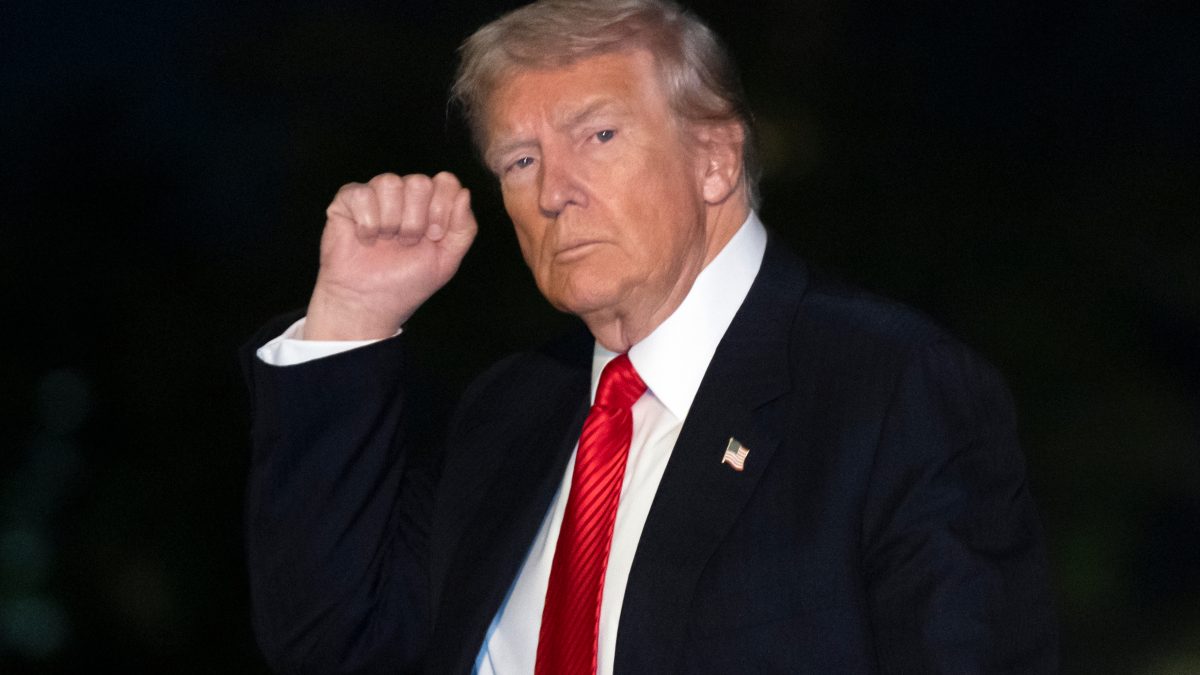
 "President Donald Trump gestures while walking across the South Lawn of the White House. File image/AP")
A ruling by the Supreme Court striking down President Donald Trump’s use of the 1977 International Emergency Economic Powers Act, or IEEPA, to impose broad global tariffs would eliminate a favourite cudgel to punish countries that draw his ire on non-trade political matters.
The court, whose 6-3 conservative majority includes three justices nominated by Trump in his first term, takes up the challenge on Wednesday, which was launched by small business groups and several states . It’s not clear how quickly the top court would release an opinion.
Trump is the first president to invoke this statute — which has often been used to apply punitive economic sanctions on adversaries — to impose tariffs.
The law gives the president the power to deal with “an unusual and extraordinary threat” to US national security, foreign policy or economy. Typically, it has been used to impose sanctions on adversaries or freeze assets, including after the September 11, 2001, attacks on the United States.
In this case, Trump deemed a $1.2-trillion US goods trade deficit in 2024 a national emergency — even though the United States has run trade deficits every year since 1975.
Trump has complained, in sometimes stark and violent language, of other countries taking advantage of the US in trade. The case before the court is of such importance to him that he mused about attending the oral arguments (but chose not to).
Several laws allows for tariffs
US Treasury Secretary Scott Bessent said he expects the Supreme Court to uphold the IEEPA-based tariffs. But if the top court strikes down the tariffs, Bessent said in an interview, the administration will simply switch to other tariff authorities.
Those include Section 122 of the Trade Act of 1974, which allows broad 15 per cent tariffs for 150 days to calm trade imbalances.
Bessent said Trump also can invoke Section 338 of the Tariff Act of 1930, a statute that allows tariffs up to 50 per cent on countries that discriminate against US commerce.
Trump is already using other authorities for certain tariffs.
He is busy piling up tariffs under Section 232 of the Trade Expansion Act of 1962 involving national security concerns to protect strategic sectors, including autos, copper, semiconductors, pharmaceuticals, robotics and aircraft.
As well, Section 301 of the Trade Act of 1974 allows for applying tariffs as part of unfair trade practices investigations.
“You should assume that they’re here to stay,” Bessent said of Trump’s tariffs.
For countries that have negotiated tariff-lowering trade deals with Trump, “you should honour your agreement,” Bessent added. “Those of you who got a good deal should stick with it.”
Major questions doctrine could arise
Challengers to Trump tariffs have argued the US Constitution grants Congress, not the president, the authority to issue taxes and tariffs, and that any delegation of that authority must be both explicit and limited.
Earlier this year, two lower courts and seven of 11 judges on the US Court of Appeals for the Federal Circuit essentially agreed. The Federal Circuit, in its unsigned opinion, wrote that “it is far from plain” that the IEEPA law’s language regarding regulating importation “includes the power to impose the tariffs at issue in this case.”
But James Taranto, a federal judge appointed by president Barack Obama, authored a dissent, joined by three other judges.
“We do not see IEEPA as anything but an eyes-open congressional choice to confer on the president broad authority to choose tools to restrict importation”, amid a national emergency, Taranto wrote.
They have argued that a legal principle called the major questions doctrine should doom Trump’s tariffs. The doctrine requires executive branch actions of “vast economic and political significance” to be clearly authorised by Congress.
The Supreme Court cited the major questions doctrine repeatedly in cases during Joe Biden’s administration to thwart some of his agenda items, including his plan to cancel $430 billion in student debt. The court found clear congressional authorisation was lacking in those cases.
Addiction to tariffs?
In April, Trump placed tariffs on goods imported from individual countries to address US trade deficits with them.
These followed separate tariffs he announced in February as economic leverage on China, Canada and Mexico to curb the trafficking of the often-abused painkiller fentanyl and illicit drugs into the United States.
Trump administration officials have touted his tariffs as pushing major trading partners such as Japan and the European Union to negotiate major concessions that will help to reduce the US trade deficit, arguing those concessions will survive any Supreme Court ruling.
Since April, the administration has announced deals, or frameworks towards a deal, with several countries.
Instead of major concessions, Trump’s administration has had to settle for extensions of a delicate truce under which American and Chinese tariffs were reduced to keep the rare earths flowing.
The parameters of the trade relationship with Washington’s North American partners have yet to be settled. Trump has repeatedly railed against the update to the North American Free Trade Agreement that he hailed and signed off on during his first presidential term.
Some investors have said financial markets, which have grown accustomed to the Trump tariff status quo, could be thrown into turmoil if the Supreme Court strikes down the IEEPA tariffs.
A major reason for concern, particularly in the Treasury debt market, is the risk of having to refund more than $100 billion in IEEPA tariff collections and forgoing hundreds of billions of dollars of revenue annually.
The IEEPA tariffs collected so far this year make up the biggest portion of a $118 billion increase in net customs receipts in the 2025 fiscal year that ended on September 30.
That helped offset rising health-care, Social Security, interest and military outlays, helping shrink the US deficit slightly to $1.715 trillion.
“It’s a significant political economy risk that we get addicted to tariff revenue,” said Ernie Tedeschi, a senior fellow at the Yale University Budget Lab, adding that it makes it harder for any future presidential administration to lower the duties.