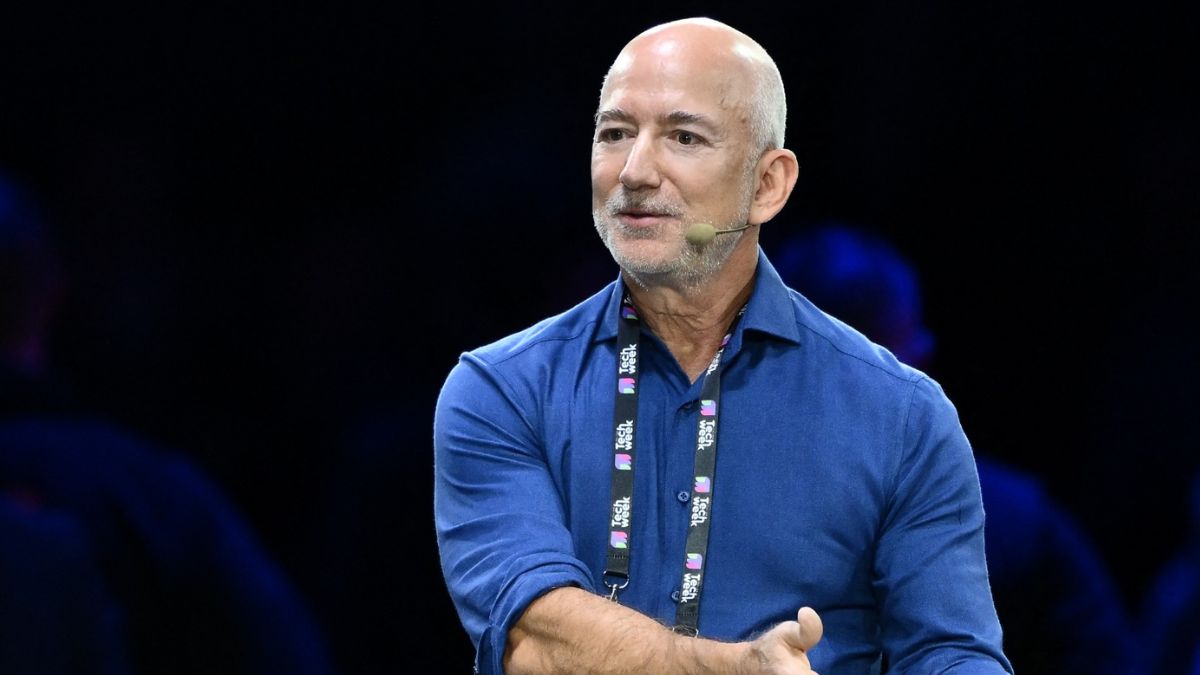
 "Why Jeff Bezos, one of the world’s richest men, is not saving The Washington Post")
In 2013, Jeff Bezos was universally praised for buying The Washington Post.
Bezos, who had bought perhaps the most prestigious newspaper in the world from its long-time owners, the Graham family, for $250 million (Rs. 22,560 crore), had vowed to be a good steward of the brand.
Bezos, during the first staff meeting, vowed that a ‘golden age’ for the newspaper was nigh. However, now, a little more than a decade later, The Washington Post is seeing one of its worst retrenchments in history.
Now, the world’s fourth richest man, who has an estimated net worth of $250 billion (Rs. 23.55 lakh crore), is being pilloried in public for what many see as the destruction of an American institution.
But why is Bezos not saving the iconic newspaper?
Bullish early years
Many were bullish after Bezos took over _The Washington Post._ After all, Bezos was one of the world’s wealthiest men and, as such, had near-limitless resources. Many thought Bezos, an entrepreneur and innovator at heart, would be just the man who could power the newspaper into a glorious new age – at least with his pocketbook.
For a while, that seemed to be the case. The 2016 presidential election witnessed Trump coming to power. The Washington Post was among the several news outlets that reaped the rewards of the first Donald Trump presidency. In January 2017, it adopted the slogan “Democracy Dies in Darkness”, which began appearing on its website and then in print shortly afterwards.
The newspaper was praised by many for its investigative journalism during the Trump years and standing up to the administration. In 2019, even as the Trump administration sought to let Mohammed bin Salman, the de facto ruler of its ally Saudi Arabia, off the hook in the Jamal Khashoggi murder, Bezos travelled to Istanbul and spoke at a memorial for Khashoggi. Bezos also offered support to Khashoggi’s fiancée, Hatice Cengiz, saying, “You are not alone.”
“In the beginning, he was wonderful,” Sally Quinn, the veteran Post contributor and wife of famed WaPo executive editor Ben Bradlee, told The New Yorker. “He was smart and funny and kind and interested. He was joyful. He was a person of integrity and conscience. He really meant it when he said this was a sacred trust, to buy the Post. And now I don’t know who this person is.”
Bezos begins to bail
However, the good times would not last. In 2025, by the time Trump had returned to the presidency – which many in the US, including several top Republicans, had thought impossible after the January 2021 insurrection at the US Capitol – the newspaper was drowning.
According to NDTV, The Washington Post has lost half a million subscribers since 2020. Audience and digital readership numbers, which had surged to tens of millions of monthly active users in January 2021 amid the Trump presidency and the pandemic news cycle, had fallen sharply by 2023, according to internal and media reports.
The newspaper is thought to have lost hundreds of millions of dollars over the past few years, according to multiple media reports citing people familiar with its finances. While the Post, like many other outlets, was awash in a sea of red ink, its competitors, The New York Times and The Wall Street Journal, were flourishing.
However, the _Post_ had something that the other outlets did not – the backing of the world’s richest man. As many have pointed out, while the Post lost around $77 million (Rs. 694.8 crore) in 2023, this is just a fraction of his net worth. Indeed, Bezos paid $500 million (Rs. 4,512 crore) for a 417-foot superyacht. It was a point Bezos would make himself in 2024: “The advantage I bring to the Post is when they need financial resources, I’m available. I’m like that. I’m the doting parent in that regard.”
But the warning signs were already there in the lead-up to the 2024 election. In July 2024, in the aftermath of the Trump assassination attempt, Bezos wrote on X, “Our former President showed tremendous grace and courage under literal fire tonight. So thankful for his safety and so sad for the victims and their families.” Many saw this message, his first on the platform since June 2023, as a sign of a possible rapprochement with Trump, a man who previously mocked him as ‘Jeff Bozo’, ahead of the election.
Squashing Kamala endorsement, currying favour with Trumps
Then, in October 2024, The Washington Post editorial board was set to deliver a historic endorsement of Vice President Kamala Harris. However, just days before it was set to go to print, the endorsement was unceremoniously squashed by senior leadership. This was the first time in almost four decades that the newspaper did not endorse a nominee.
David Maraniss, who resigned from the newspaper in 2024 in the aftermath of the development, told The New Yorker, “He bought the Post thinking that it would give him some gravitas and grace that he couldn’t get just from billions of dollars, and then the world changed.” Maraniss, who had been with the paper for nearly 50 years, added, “Now I don’t think he gives us—I don’t think he gives a flying f%^&.”
Since Trump has returned to power, Bezos has been more than happy to openly curry favour with the administration. Indeed, Bezos, much like his fellow billionaires, had dinner with the Trumps shortly before the inauguration and even attended the inauguration ball.
Bezos, who owns Amazon, has commissioned a documentary profiling First Lady Melania Trump for $40 million (Rs. 360.96 crore) and spent another $35 million (Rs. 315.84 crore) on promoting it. Critics have described the documentary as a vanity project for the Trumps and, at worst, a way to financially benefit the family through Bezos-backed projects.
Nor has Bezos spoken up in favour of WaPo reporter Hannah Natanson, who was subjected to an FBI search in which her phones, laptops, and other devices were seized, even as the newspaper denounced the “highly unusual and aggressive” move by the Trump administration.
What leadership is saying, the response
Bezos and The Washington Post CEO Will Lewis have remained conspicuously silent.
The Washington Post executive editor Matt Murray has termed the development a “broad strategic reset”. He added, “We have grappled with financial challenges for some time. They have affected us in multiple rounds of cost cuts and buyouts, along with other periodic constraints…”
He said the newspaper would now “concentrate on areas that demonstrate authority, distinctiveness, and impact” in areas such as politics and national security.
However, others are far more critical.
“This ranks among the darkest days in the history of one of the world’s greatest news organisations,” Marty Baron, the heralded ex-editor-in-chief of the newspaper, wrote. He said the newspaper’s issues “were made infinitely worse by ill-conceived decisions that came from the very top — from a gutless order to kill a presidential endorsement 11 days before the 2024 election to a remake of the editorial page that now stands out only for its moral infirmity.”
“We are witnessing a murder at The Washington Post,” added long-time ex-Post reporter Ashley Parker. “This massacre will be the enduring legacy of Jeff Bezos and Will Lewis and the leadership who stood by.”
Still others are far more blunt about what is occurring.
Glenn Kessler, a long-time fact-checker at the Post, said, “Bezos is not attempting to save The Washington Post. He’s trying to endure Trump.”
With inputs from agencies

 "India, Israel elevate ties to special strategic partnership; PM Modi calls it ‘reflection of aspirations of both nations’")
 "India vs Zimbabwe LIVE Score, T20 World Cup 2026: Abhishek-Kishan stand goes past fifty, India in complete control")
 "Who is Borge Brende, World Economic Forum chief who quit over Epstein files?")
 "US-Iran tension: Third round of nuclear talks begin in Geneva — can it avoid war?")
 "India, Israel elevate ties to special strategic partnership; PM Modi calls it ‘reflection of aspirations of both nations’")
 "India vs Zimbabwe LIVE Score, T20 World Cup 2026: Abhishek-Kishan stand goes past fifty, India in complete control")
 "Who is Borge Brende, World Economic Forum chief who quit over Epstein files?")
 "US-Iran tension: Third round of nuclear talks begin in Geneva — can it avoid war?")