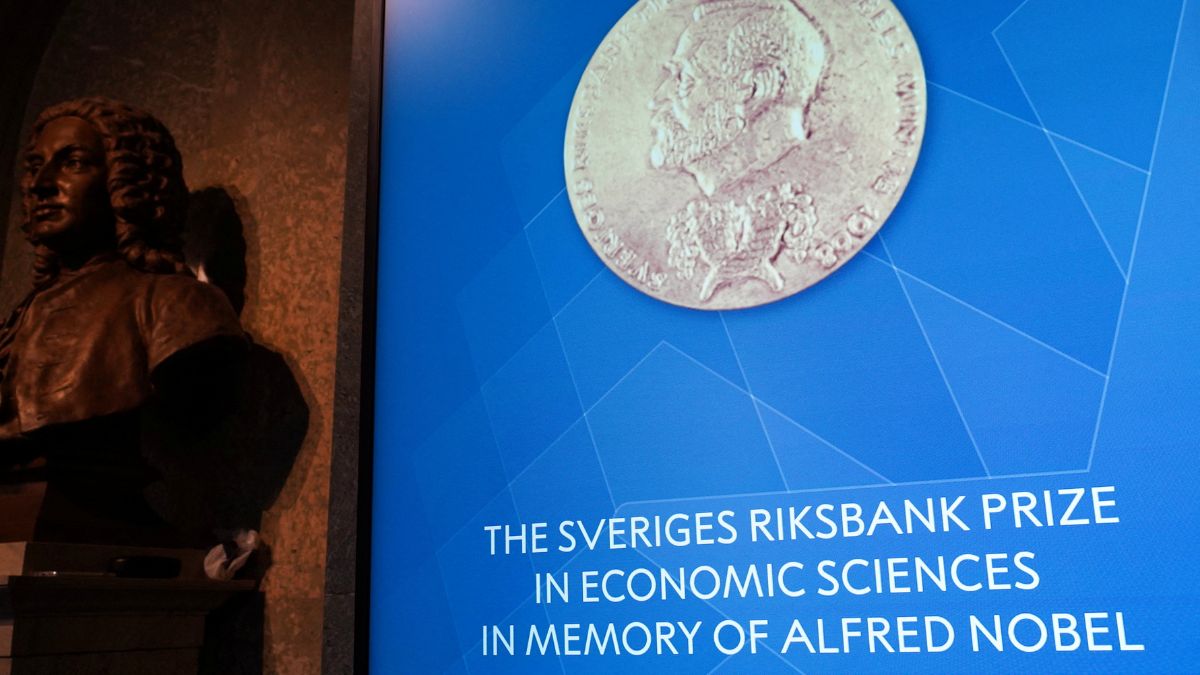
 "Of all the 93 laureates awarded since 1969, only three have been women. Reuters")
The Norwegian Nobel Committee will announce the Nobel Prize in Economics on Monday, closing the season. Experts in areas such as credit, the role of government, and wealth inequality are seen as potential contenders this year.
The prize, which was awarded to American economist Claudia Goldin last year, will be announced at 11:45 am CEST (3:15 PM IST).
Claudia Goldin was honoured for her “having advanced our understanding of women’s labour market outcomes.” Only three women have won since the economics award began in 1969: Goldin in 2023, Elinor Ostrom from the US in 2009, and French-American Esther Duflo in 2019.
Speaking to AFP, Mikael Carlsson, professor of economics at Uppsala University in Sweden, said, “The general trend in society to attach greater importance to parity and diversity has broadened the research process.”
“However, this is not the criteria taken into account when assessing whether a scientific contribution is worthy of a Nobel Prize,” he added.
Carlsson predicts that Japan’s Nobuhiro Kiyotaki and Britain’s John H Moore may be awarded for their research on how minor disturbances impact economic cycles, or American economist Susan Athey for her work on market design.
But what measures should you keep in mind when predicting a Nobel Prize winner?
According to Magnus Henrekson of the Research Institute of Industrial Economics in Stockholm, a good starting point would be to examine the research interests of the committee responsible for selecting the candidates.
The committee’s chairman specialises in development economics, but Henrekson noted that it is unlikely this field will be recognised again so soon, as it was recently awarded a prize.
He said, “I don’t think it’s likely that the same field will win the prize two years running.”
Who will win the Prize?
French economist Philippe Aghion, along with Americans George Loewenstein, Kenneth Rogoff, and Carmen Reinhart, are often mentioned as strong contenders for the Nobel Prize.
Another leading name this year is Turkish-American Daron Acemoglu, a professor at MIT, known for his best-selling books, including Why Nations Fail: The Origins of Power, Prosperity, and Poverty. Acemoglu could be paired with Russian-American economist Andrei Shleifer.
While predicting the winner is always challenging, the online statistics platform Statista suggested that by analysing previous laureates and the current focus of economic research, it is possible to identify likely future recipients, even if not necessarily in 2024.
Statista believes Acemoglu might be recognised for his “work on the long-run development of institutions which facilitate or hinder economic growth.”
Other potential candidates include macroeconomists such as Olivier Blanchard from France, and Americans Larry Summers and Gregory Mankiw.
Economists focused on wealth inequality, such as France’s Thomas Piketty and Gabriel Zucman, along with French-American Emmanuel Saez, are also frequently mentioned as possible recipients.
Canadian-American Janet Currie, an expert in anti-poverty policies, is a top contender according to analytics firm Clarivate, which tracks potential Nobel laureates based on citation analysis.
British-Indian economist Partha Dasgupta is another possible winner, noted for “integrating nature and its resources in the human economy.”
Paolo Mauro, a former International Monetary Fund member, has also been suggested for his “empirical studies of the effects of corruption on investment and economic growth.”
‘A false Nobel’
The Nobel Prize in Economics stands apart from the original five awards established in the will of Swedish inventor Alfred Nobel, who passed away in 1896. It was introduced in 1968 through a donation from Sweden’s central bank, earning it the nickname “a false Nobel” from critics.
However, like the other science prizes, the winner is selected by the Royal Swedish Academy of Sciences, following the same rigorous process.
This prize will conclude the 2024 Nobel season, which has already recognised advances in artificial intelligence for the physics and chemistry awards, and honoured the Japanese organisation Nihon Hidankyo with the Peace Prize for its work against nuclear weapons.
Nobel Peace Prize
Notably, the Nobel Committee has previously recognised efforts to eliminate nuclear weapons. In 2017, the International Campaign to Abolish Nuclear Weapons (ICAN) received the Peace Prize, while in 1995, Joseph Rotblat and the Pugwash Conferences on Science and World Affairs were honoured for “their efforts to diminish the part played by nuclear arms in international politics and, in the longer run, to eliminate such arms.”
This year’s award was announced amid ongoing and devastating conflicts in West Asia, Ukraine, and Sudan.
Nihon Hidankyo was established in 1956 by survivors of the atomic bombings and victims of nuclear weapons tests in the Pacific, advocating for government support to address health issues due to these events.
Nobel Prize in Literature
Meanwhile, in literature, South Korean author Han Kang claimed the prize, becoming the only female laureate this year, while the Nobel in medicine was awarded for breakthroughs in understanding gene regulation.
Han Kang received her first major international award nine years after the publication of her most famous novel “The Vegetarian”, following its eventual translation into English.
Han, 53, is the 18th woman to be awarded the Literature Prize. She was born in Gwangju and lived there until she was 10, when her father, Han Seung-won, relocated the family to the capital, Seoul. Although a private person, the soft-spoken Han has become a prominent figure in South Korea’s literary landscape, where she has published novels, short-story collections, and children’s books.
Despite being translated into numerous languages, The Vegetarian had sold fewer than a million copies in South Korea before the announcement by the Swedish Academy on Thursday. This limited success was due to a relatively low interest in literature among South Koreans and a struggling publishing industry. However, following the announcement, her fellow countrymen quickly sought to make up for lost time, flooding bookstores for her novels, poetry, and short stories.
The Nobel Prizes include a diploma, a gold medal, and a cash award of one million dollars. The formal award ceremonies will take place in Stockholm and Oslo on December 10, the anniversary of Alfred Nobel’s death.
The Nobel season concludes today with the announcement of the winner of the Economics Prize, officially known as the Bank of Sweden Prize in Economic Sciences in Memory of Alfred Nobel.
With inputs from AFP, Reuters