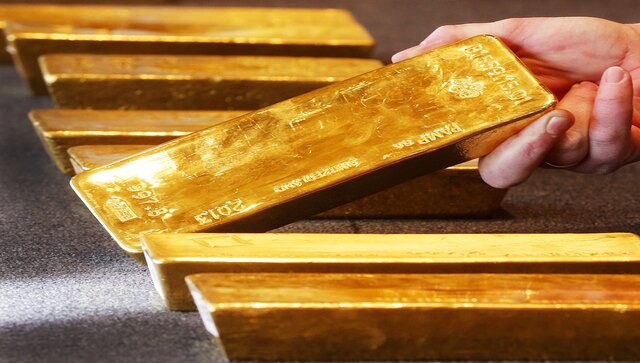
 "Which country has the most gold reserves? What’s India’s rank?")
Gold has been a key component of the financial reserves of countries for years. Amid rising economic uncertainties, central banks of several nations, including India, have been keeping the shiny metal as reserves due to its safety and stability as a store of value.
The miner’s lobby World Gold Council (WGC) recently released its estimates of the gold reserves held by countries as of the third quarter of 2023. Let’s take a closer look at which country has the most gold reserves and where India stands.
Countries with the largest gold reserves
The United States has the most gold reserves with 8,133.46 tonnes, Forbes reported citing the latest WGC data. The metal makes up for nearly 78 per cent of the country’s total foreign reserves.
With 3,352.65 tonnes of gold, Germany has the second largest reserve, followed by Italy (2,451.84 tonnes) and France (2,436.88 tonnes).
Russia is in the fifth place with 2,332.74 tonnes of gold reserves. China is in the sixth spot with 2,191.53 tonnes of gold. Switzerland and Japan have the eighth and ninth largest gold holdings in the world, respectively.
India stands at the ninth rank with 800.78 tonnes of gold in its official reserves. With 612.45 tonnes of the metal, the Netherlands has the tenth-largest gold reserve.
Quick Reads
View AllTurkey, Taiwan, Uzbekistan, Portugal, Poland, Saudi Arabia, the United Kingdom, Kazakhstan, Lebanon and Spain are other countries that maintain gold reserves.
Has India increased its gold holdings?
Yes, India’s gold reserves have surged. The Reserve Bank of India (RBI) bought nine tonnes of gold in the September quarter last year, as per a Mint report.
India’s central bank has been increasing its gold holdings since 2017, adding 248.9 tonnes till 2023. As per WGC data, India held 794.6 tonnes of gold in its official reserves as of March last year.
An RBI report last April showed gold reserves have grown by over 40 per cent since it restarted buying the shiny metal more than five years ago, as per Economic Times (ET).
As of 29 September 2023, India had total forex reserves of $586.9 billion, out of which gold comprised 7.44 per cent or $43.7 billion in value, RBI’s Weekly Statistical Supplement on 6 October revealed.
Besides RBI, the central banks of other countries have also been purchasing gold to keep as official reserves. The Monetary Authority of Singapore (MAS), the People’s Bank of China (PBoC) and the Central Bank of the Republic of Turkey have been buying gold amid the depreciation of the US dollar and negative interest rates, as well as to diversify their foreign exchange reserves, as per Indian Express.
Meanwhile, Indian families’ love for gold continues. As per WGC’s report published last June, Indian households are estimated to have about 21,000 tonnes of gold, which makes them the world’s largest holders of the precious metal.
Somasundaram PR, the managing director of WGC India, said a study conducted two years ago projected household gold stocks to be approximately 21,000-23,000 tonnes, which is likely to have now jumped to 24,000-25,000 tonnes, News18 reported.
ALSO READ: Why is gold near its all-time high? Should you buy?
Why do countries have gold reserves?
Gold has traditionally played a role in supporting the value of the currency of a country.
During the late 1800s and a substantial part of the 1900s, countries adopted the gold standard wherein the yellow metal was used to back the value of their paper money by creating a fixed exchange rate between their currency and a certain amount of gold, as per a Forbes report.
Each unit of currency had an equivalent value in gold, enabling people to swap their paper money for actual gold at that fixed rate. While the practice was abandoned in the 1970s, several countries continue to have gold holdings.
Once again, central banks are preferring gold as a safe-haven asset amid rising economic uncertainty. They now have over 35,000 metric tonnes of the yellow metal, about a fifth of all the gold ever mined, as per Reuters Plus.
The metal is seen as a reliable and stable store of value, especially in times of financial turbulence.
Central banks maintain gold holdings to diversify their total reserves. The tangible asset helps alleviate the risks connected with fluctuations in the value of other assets, reported Forbes.
Gold serves as a hedge against inflation. Its value typically rises during economic turmoils or geopolitical tensions.
“As gold carries no credit or counterparty risks, it serves as a source of trust in a country, and in all economic environments, making it one of the most crucial reserve assets worldwide, alongside government bonds,” according to Reuters Plus.
Gold’s allure is enhanced by its inverse relationship with the US dollar. When the value of the dollar falls, gold usually increases in value. It helps central banks to safeguard their reserves during market volatility.
Gold reserves can also increase the creditworthiness of a country and “influence its standing in the global economic system”, as per Forbes.
With inputs from agencies


 "Jaishankar meets Sergio Gor ahead of US visit, says discussed 'many dimensions of our partnership'")
 "As Trump shakes up Nato, Europe aims to go self-sufficient in weapon production")
 "EU to list Iran’s Revolutionary Guards as terrorist group alongside al-Qaeda and Hamas")
 "With new security pact, India and EU eye win-win defence ties as US, China rival in arms race")
 "Jaishankar meets Sergio Gor ahead of US visit, says discussed 'many dimensions of our partnership'")
 "As Trump shakes up Nato, Europe aims to go self-sufficient in weapon production")
 "EU to list Iran’s Revolutionary Guards as terrorist group alongside al-Qaeda and Hamas")
 "With new security pact, India and EU eye win-win defence ties as US, China rival in arms race")