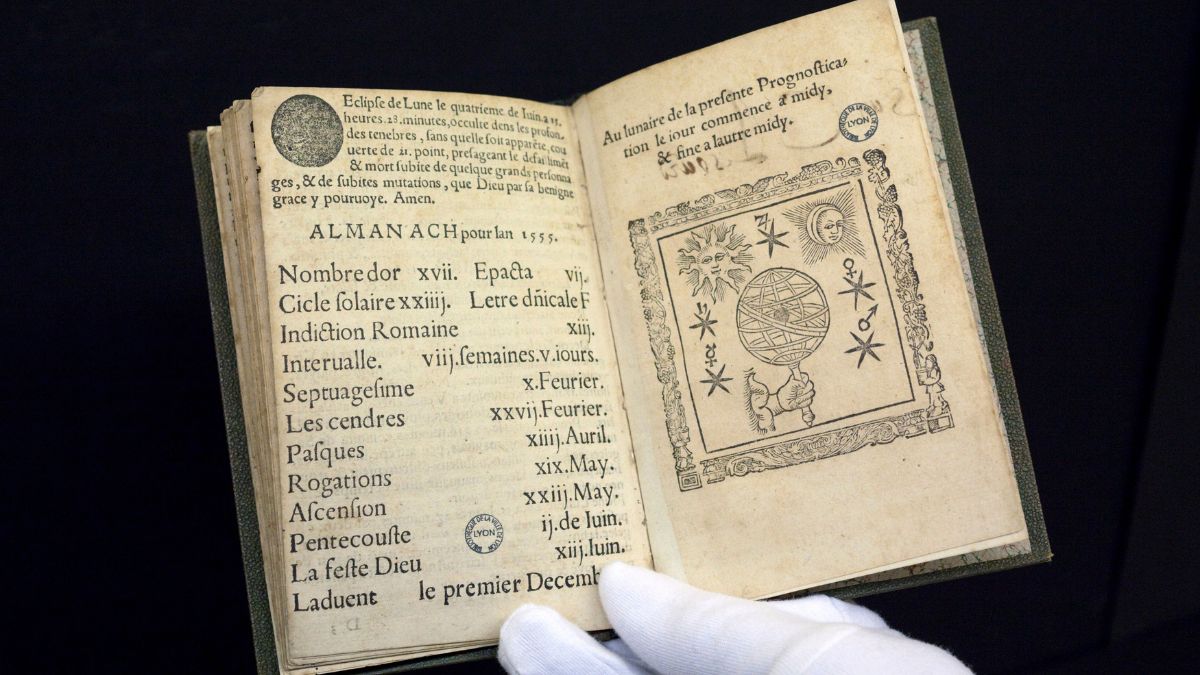
 "A 16th-century edition of predictions by Nostradamus, the first book to be digitised by Google from a collection of 500,000 at the Municipal Library of Lyon, is displayed by a librarian in this January 15, 2010 picture. File Image/Reuters")
Year 2026 has begun.
And the writings of Michel de Nostredame — better known to history as Nostradamus — are once again being revisited by readers seeking meaning in uncertainty.
The 16th-century French astrologer and physician has long occupied a unique place in popular culture, credited by supporters with anticipating some of the most consequential moments of modern history, even as critics argue that his verses are too ambiguous to be predictive.
Nostradamus’ work has resurfaced at a time when global instability is hard to ignore. The ongoing conflict between Russia and Ukraine, renewed concerns over pandemics, rivalries in Asia and Europe, and climate-related disasters have all contributed to renewed public interest in historical prophecies.
While Nostradamus never wrote explicitly about the year 2026, contemporary interpreters have focused on specific numbered quatrains — particularly those marked “26” — to argue that they symbolically correspond to events expected during this year.
Who was Nostradamus?
Born in 1503, Michel de Nostredame lived through an era marked by plague, religious upheaval and political violence. Trained as a physician, he treated victims of epidemic disease at a time when medical knowledge was limited.
His life was deeply shaped by personal loss, including the deaths of his wife and young children, reportedly from illness presumed to be plague.
According to historical assessments, this trauma played a major role in shaping the bleak tone that permeates much of his work.
Nostradamus is best remembered for Les Prophéties, first published in 1555. The book consists of 942 short, poetic quatrains written in a mix of French, Latin and Provençal.
These verses describe wars, assassinations, natural disasters, social unrest and disease using symbolic language rather than clear chronology.
While many of the interpretations attributed to Nostradamus emerged centuries after his death, his name has become synonymous with long-range prophecy.
Supporters have credited him with predicting Adolf Hitler’s rise to power, the Great Fire of London, the September 11 attacks, the Covid-19 pandemic, and even the deaths of major global figures such as Queen Elizabeth II and Pope Francis.
Others also link his writings to Japan’s powerful earthquake on New Year’s Day 2024.
Critics, however, argue that these associations are the result of retroactive interpretation rather than precise foresight. Nonetheless, during moments of global crisis, Nostradamus’ verses often return to public discourse.
Did Nostradamus’ predictions for 2025 come true?
Before examining claims linked to 2026, followers of Nostradamus have assessed how interpretations connected to 2025 unfolded.
Among the predictions attributed to that year were the end of the Russia-Ukraine war, a catastrophic asteroid collision with Earth, major environmental upheaval in South America, and the emergence of what some described as an “aquatic empire.”
In reality, the conflict in Ukraine has continued. While reports suggest that Russian President Vladimir Putin has been considering peace initiatives involving the United States, no ceasefire has been achieved so far.
On the asteroid front, Nasa data indicates that by December 2025, 191 near-Earth objects had passed relatively close to the planet without causing global destruction.
Environmental developments in the Amazon region partially aligned with interpretations of Nostradamus’ warnings. After a prolonged drought, intense rainfall in February and March led to destructive flooding along the Ene River, severely impacting Indigenous Asháninka communities.
While no literal “aquatic empire” has emerged, some commentators have drawn parallels with the rise of artificial intelligence infrastructure, particularly data centres that rely heavily on water for cooling and humidification, raising environmental concerns.
So, what has Nostradamus supposedly predicted for 2026?
The “thunderbolt” prophecy
One of the most frequently cited quatrains linked to 2026 appears in Century I, verse 26: “The great man will be struck down in the day by a thunderbolt.”
Interpreters have long debated the meaning of this line, with many suggesting it refers to the sudden downfall of a powerful individual.
Rather than reading the verse literally, analysts often view the “thunderbolt” as a metaphor for abrupt political disruption. This has led to interpretations involving the assassination of a prominent male figure or a coup capable of destabilising an established political order.
The lack of specific names or locations has allowed the verse to be applied broadly across different geopolitical contexts.
Nostradamus’ original texts do not offer timelines or identities, and the association with 2026 arises solely from the quatrain’s numbering.
Ticino and the symbolism of “overflowing blood”
Another verse often associated with 2026 appears in Quatrain II:26: “Because of the favour that the city will show, the Ticino will overflow with blood.”
Ticino is an Italian-speaking canton located in southern Switzerland, known for its alpine landscapes, lakes and long-standing neutrality.
The mention of Ticino has drawn particular attention because Switzerland has historically remained outside major European conflicts. Analysts suggest that the reference may symbolise the spread of instability into regions traditionally considered insulated from war.
Some interpretations focus on military casualties, epidemic outbreaks or political consequences rather than literal violence.
An alternative reading has also emerged in recent years. As of 2025, Ticino introduced expanded options for preserving umbilical cord blood stem cells, both for private family use and for solidarity donation.
In this context, some commentators argue that “blood” need not signify death, but rather biomedical developments.
Seven months of war
Another verse frequently linked to 2026 warns of prolonged conflict: “Seven months great war, people dead through evil / Rouen, Evreux the King will not fail.”
The explicit reference to a defined duration has made this one of the most cited quatrains among Nostradamus followers.
Rouen and Évreux are cities in France, leading some analysts to associate the verse with European conflict. Others argue that these place names reflect Nostradamus’ own historical context and should be interpreted symbolically rather than literally.
The mention of leadership that “will not fail” has been read as an allusion to rulers or heads of state refusing to compromise, prolonging conflict despite mounting casualties.
Given the current geopolitical climate, with Europe already impacted by the war in Ukraine, the verse has been interpreted as a warning about escalation rather than a forecast of a new, distinct war.
Naval conflict and the “seven ships”
In Quatrain VII:26, he writes, “Foists and galleys around seven ships, a mortal war will be let loose.” Foists were lightweight sailing vessels, while galleys were oar-powered warships, terms rooted in the maritime realities of the 16th century.
Modern interpreters often associate this verse with naval conflict, particularly in regions marked by territorial disputes.
Attention has focused on the South China Sea, where China, Taiwan, Vietnam, Malaysia, Brunei, Indonesia and the Philippines maintain overlapping claims.
These seven entities are frequently cited as the possible modern equivalent of the “seven ships” described in the quatrain.
China’s expansive claims and ongoing tensions in the region have kept the South China Sea at the centre of global strategic concerns.
While Nostradamus could not have envisioned modern naval technology, proponents argue that the imagery of clustered vessels engaged in deadly conflict aligns with contemporary maritime standoffs.
The “swarm of bees”
Among the more enigmatic verses linked to 2026 is the line: “The great swarm of bees will arise … by night the ambush …” This imagery has generated a wide range of interpretations, particularly in the digital age.
Some analysts connect the “bees” to collective political movements rather than literal insects. According to a report in New York Post, the colour black — commonly associated with swarming insects as well as fascist movements — has led to interpretations suggesting the rise or consolidation of totalitarian regimes.
Others view the verse as a metaphor for coordinated attacks, potentially referencing cyber warfare, drone technology or biological threats.
The phrase “by night the ambush” has been widely interpreted as indicating surprise or stealth, reinforcing concerns about unconventional or asymmetric threats that may be difficult to anticipate or counter.
“A man of light”
Despite his reputation as a harbinger of doom, Nostradamus’ writings are not entirely devoid of hope.
Some interpreters note that sequences associated with 2026 conclude with the emergence of a figure described as a “man of light,” believed to guide humanity through turmoil toward recovery.
For believers, this suggests that Nostradamus viewed destruction and renewal as intertwined processes, with periods of crisis giving way to transformation.
This interpretation has provided reassurance to readers who see his work not merely as a catalogue of disasters, but as a broader reflection on historical cycles.
Also Watch:
With inputs from agencies