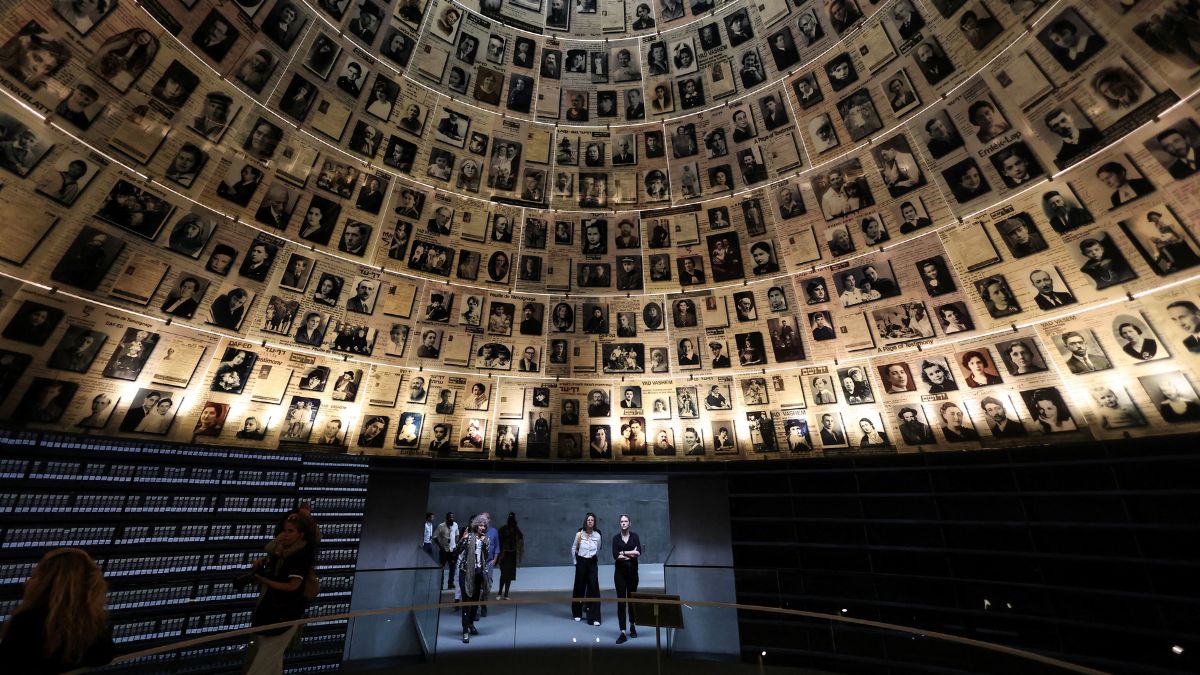
 "Visitors tour an exhibition, ahead of Israel's national Holocaust memorial day at Yad Vashem, the World Holocaust Remembrance Center, in Jerusalem, April 23, 2025. File Image/Reuters")
Indian Prime Minister Narendra Modi is visiting Israel this week on a two-day trip. The visit includes a scheduled stop at Yad Vashem, Israel’s national memorial to the victims of the Holocaust.
Modi’s Israel trip began on Wednesday with a high-profile address to the Knesset, where he received a standing ovation from lawmakers following a half-hour speech that reaffirmed India’s strategic commitment to Israel.
In his speech, the PM said, “Let us ensure that the friendship between India and Israel remains a source of strength in an uncertain world,” while also highlighting long-term cooperation in security, trade, investment, infrastructure development, artificial intelligence, and quantum technology.
As part of the official itinerary, Modi is also meeting Israeli President Isaac Herzog, with the Israeli Prime Minister’s Office stating that multiple agreements covering economic, security, and political cooperation are expected to be signed.
The visit to Yad Vashem forms a central element of the trip. This marks Modi’s second visit to the Holocaust memorial, following his earlier trip in 2017.
What is Yad Vashem?
Yad Vashem is Israel’s official state institution dedicated to commemorating the victims of the Holocaust, known in Hebrew as the Shoah.
Established in 1953 through legislation passed by the Knesset, the memorial complex stands on the western slopes of Mount Herzl in Jerusalem, an area also known as the Mount of Remembrance.
The site sits around 804 metres above sea level and is located adjacent to the Jerusalem Forest.
The name “Yad Vashem” is drawn from the Book of Isaiah (56:5), which speaks of granting a “memorial and a name” to those whose lives were erased.
This biblical reference captures the institution’s core purpose: restoring identity to millions of individuals who were systematically murdered by Nazi Germany and its collaborators during the Second World War.
The mission of Yad Vashem is built around four pillars: commemoration, documentation, research, and education.
It seeks to preserve the memory of the six million Jewish victims of the Holocaust, record survivor testimonies, honour Jewish resistance fighters and non-Jews who helped Jews at great personal risk, and conduct academic research into genocide with the aim of preventing similar atrocities in the future.
The institution’s stated vision is “to lead the documentation, research, education and commemoration of the Holocaust, and to convey the chronicles of this singular Jewish and human event to every person in Israel, to the Jewish people, and to every significant and relevant audience worldwide.”
Covering roughly 45 acres, the Yad Vashem campus comprises research institutions with public memorial spaces.
Facilities dedicated to scholarship include the International Research Institute for Holocaust Research, an extensive archive, a specialised library, a publishing house, and the International School for Holocaust Studies.
Alongside these are public-facing museums and remembrance sites that allow visitors to engage directly with historical evidence, personal stories, and symbolic spaces of mourning.
The memorial receives approximately one million visitors annually, making it the second most visited site in Israel after the Western Wall.
Entry to the complex is free of charge. Among those who visit each year are students, researchers, tourists, and political leaders from across the world.
At the heart of the complex stands the Holocaust History Museum, a striking triangular prism structure designed by renowned architect Moshe Safdie.
The building cuts through the mountainside and opens onto a viewing platform overlooking Jerusalem, symbolically representing the passage from destruction and darkness to renewal and life.
The museum houses original artefacts, archival material, and curated exhibits that trace the Holocaust from its ideological roots to its devastating human consequences.
One of the most emotionally powerful spaces within Yad Vashem is the Hall of Names. This circular chamber contains more than 4.8 million Pages of Testimony, each recording the personal details of individual victims.
Another deeply moving site is the Children’s Memorial, an underground cavern dedicated to the memory of 1.5 million Jewish children murdered during the Holocaust.
In near-total darkness, the names of the children are read aloud while just five candles are reflected infinitely by mirrors, creating the illusion of countless points of light.
The campus also includes the Museum of Holocaust Art, exhibition pavilions, the Hall of Remembrance, a synagogue, outdoor sculptures, and commemorative landscapes such as the Valley of the Communities, which memorialises thousands of destroyed Jewish towns and villages across Europe.
A central focus of Modi’s visit is the Book of Names, a massive installation containing the printed names of millions of Holocaust victims on rigid pages.
Another key area is the Garden of the Righteous Among the Nations, which honours non-Jews who risked their lives, without financial or evangelical motives, to save Jews during the Holocaust.
Individuals such as Oskar Schindler are among those recognised in this section. The recognition programme reflects one of Yad Vashem’s founding goals: acknowledging moral courage in the face of systematic evil.
Visitors to the complex can also access millions of pages of survivor testimonies, photographs, audio recordings, and video archives, providing researchers and the general public with a vast repository of historical evidence and personal narratives.
Who else has visited Yad Vashem?
Over the decades, Yad Vashem has become a regular stop for heads of state, royalty, and senior political figures seeking to pay respects to the victims of the Holocaust.
The site has hosted more than 40 world leaders during major international remembrance events, including the 2020 World Holocaust Forum.
Notable visitors have included US Presidents Joe Biden, Barack Obama, and George W Bush; German Chancellor Friedrich Merz; Russian President Vladimir Putin; Ukrainian President Volodymyr Zelenskyy; Italian President Sergio Mattarella; Britain’s Prince Charles; Dutch King Willem-Alexander; and UAE Foreign Minister Abdullah bin Zayed Al Nahyan.
From India, Modi visited Yad Vashem in 2017 and is returning in 2026, while former External Affairs Minister SM Krishna visited in 2012.
Modi’s current visit comes at a time when Israel’s global standing has been affected by the war in Gaza. Against this backdrop, his public statements in the Knesset emphasised continuity in partnership.
Have there been any controversies including Yad Vashem?
Despite its role as a cornerstone of Holocaust remembrance, Yad Vashem has not been immune to political and historical disputes.
In 2020, during the World Holocaust Forum, the institution faced widespread criticism for screening videos that were accused of downplaying the roles of the United States and the United Kingdom in the Second World War while failing to address the Molotov-Ribbentrop Pact between Nazi Germany and the Soviet Union.
The controversy led Yad Vashem to acknowledge “historical inaccuracies” in the presentation and issue an apology amid concerns that the narrative had aligned too closely with Russian diplomatic sensitivities.
The institution has also drawn long-standing criticism for not formally recognising the Armenian Genocide. This position has been widely interpreted as being influenced by Israel’s diplomatic considerations, particularly its historically sensitive relationship with Turkey.
In 2009, Yad Vashem reportedly dismissed a docent who compared the Holocaust to the Nakba, the displacement of Palestinians in 1948.
With inputs from agencies