 "What is PTSD, the condition Salman Rushdie is coping with after the knife attack?")
Author Salman Rushdie has revealed he is suffering from Post-Traumatic Stress Disorder (PTSD) in the aftermath of his stabbing last year. In an interview ahead of the publication of his new novel Victory City, Rushdie admitted to finding it ‘very difficult to write’ since the 12 August incident at a conference in Chautauqua in upstate New York. “There is such a thing as PTSD you know,” the 75-year-old told the New Yorker editor David Remnick. Victory City, which purports to be a translation of a historical epic originally written in Sanskrit, is Rushdie’s 15th novel. It was written before the attack. The award-winning novelist, a naturalized American who has lived in New York for 20 years, lost sight in one eye and the use of one hand, his agent said in October. Let’s take a closer look at PTSD and how Rushdie is doing: What is PTSD? According to the Mayo Clinic website, PTSD is defined as a mental health condition triggered by a terrifying event.
Someone can experience PTSD by either experiencing such an incident or even witnessing it.
Its symptoms vary from flashbacks to nightmares, severe anxiety, and uncontrollable thoughts about the event. According to the website, most people who experience such events have temporary problems with adjusting and coping – which can be alleviated through self-care and the passage of time. However, if symptoms worsen or last months or even years and interfere with day-to-day life, a person may have PTSD. Getting effective treatment after PTSD symptoms develop can be critical to reduce symptoms and improving function, as per the website. Symptoms Those suffering PTSD can display the following symptoms:
- Intrusion
- Avoidance
- Alterations in cognition and mood
- Alterations in arousal and reactivity
Anyone can suffer from PTSD According to psychiatry.org, PTSD was previously called ‘shell shock’ in World War I and ‘combat fatigue’ in World War II.
However, PTSD isn’t just limited to those who have experienced the horrors of war.
People who have experienced natural disasters, serious accidents, terrorist acts, rape/sexual assault, historical trauma, intimate partner violence and bullying, can also suffer from PTSD. According to the website, PTSD can occur ‘in all people, of any ethnicity, nationality or culture, and at any age.’ PTSD can be treated through a variety of methods including cognitive behavioural therapy, medication, acupuncture, yoga, and animal-assisted therapy, as per the website. How is Rushdie doing? Rushdie said the attack had left him mentally scarred. “I’ve found it very, very difficult to write. I sit down to write, and nothing happens. I write, but it’s a combination of blankness and junk, stuff that I write and that I delete the next day. I’m not out of that forest yet, really,” he added. Rushdie told journalist David Remnick that “big injuries are healed” but he was not able to type very well because of a lack of feeling in some fingertips. “I’ve been better. But, considering what happened, I’m not so bad,” said the Indian-born author, describing himself as “lucky.” “I’ve simply never allowed myself to use the phrase ‘writer’s block.’ Everybody has a moment when there’s nothing in your head. And you think, Oh, well, there’s never going to be anything. One of the things about being seventy-five and having written twenty-one books is that you know that, if you keep at it, something will come,” Rushdie said, as per The New Yorker.
Rushdie also said he has had nightmares.
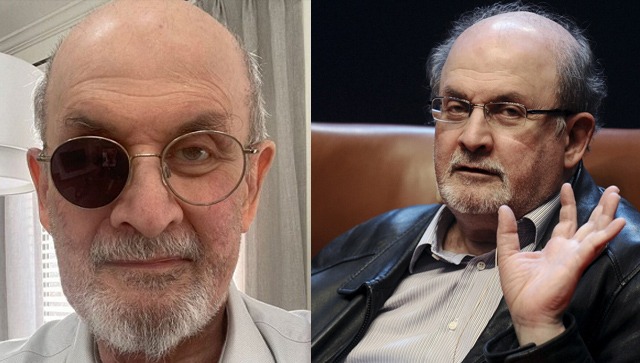
“Those seem to be diminishing. I’m fine. I’m able to get up and walk around. When I say I’m fine, I mean, there’s bits of my body that need constant check-ups. It was a colossal attack.” Rushdie lived in hiding for years after Iran’s first supreme leader Ayatollah Ruhollah Khomeini ordered his killing for what he deemed the blasphemous nature of “The Satanic Verses,” published in 1988. The attack shocked the West but was welcomed by extremists in Muslim countries such as Iran and Pakistan. Words ‘the only victors’ Rushdie was asked whether he thought it had been a mistake to let his guard down in recent decades. “I’m asking myself that question, and I don’t know the answer to it,” he said. “Three-quarters of my life as a writer has happened since the fatwa. In a way, you can’t regret your life.” Hadi Matar, a 24-year-old from New Jersey with roots in Lebanon, was arrested immediately after the attack and pleaded not guilty to assault charges. “I blame him,” said Rushdie, simply. Rushdie’s Victory City is an “epic tale” of a 14th Century woman who defies a patriarchal world to rule a city hits US shelves on Tuesday. The much-anticipated work tells the tale of young orphan Pampa Kampana who is endowed by a goddess with magical powers and founds the city, in modern-day India, of Bisnaga, which translates as Victory City. While not personally promoting the book, Rushdie has begun communicating via social media, most often to share press reviews of his new novel. On Monday, he posted on Twitter a photo of himself with one eye covered by a darkened lens on his glasses, with the caption, “The photo in @NewYorker is dramatic and powerful but this, more personally, is what I actually look like.” An icon of free speech since he was subjected to the fatwa that forced him into hiding, Rushdie is still an outspoken defender of the power of words. His new work follows a heroine on a mission to “give women equal agency in a patriarchal world,” according to publisher Penguin Random House’s summary. The book tells the tale of Pampa Kampana’s creation of a city and of its downfall. A ‘triumph’ “Over the next 250 years, Pampa Kampana’s life becomes deeply interwoven with Bisnaga’s, from its literal sowing from a bag of magic seeds to its tragic ruination in the most human of ways: the hubris of those in power,” the publisher’s summary added. The novel concludes with the statement: “Words are the only victors.” US author Colum McCann wrote in _The New York Times t_hat his friend Rushdie was saying “something quite profound” in his new novel. “In the face of danger, even in the face of death, he manages to say that storytelling is one currency we all have,” said McCann. The Atlantic magazine called it a “triumph — not because it exists, but because it is utterly enchanting.” Born in Mumbai in 1947, Rushdie published his first novel “Grimus” in 1975, and gained worldwide fame six years later with “Midnight’s Children,” which won him the Booker Prize. With inputs from agencies Read all the Latest News , Trending News , Cricket News , Bollywood News , India News and Entertainment News here. Follow us on Facebook , Twitter and Instagram .