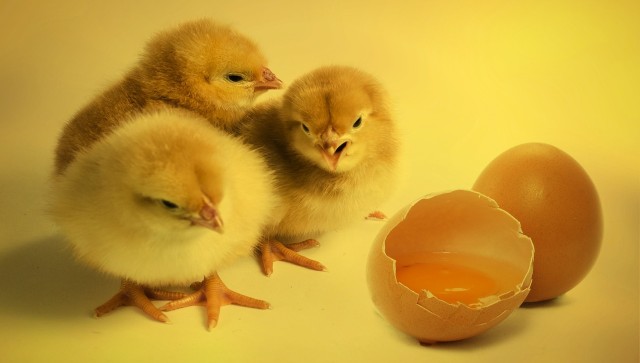
 "What came first, egg or chicken? How scientists solved the big mystery")
Which came first, the chicken or the egg? Over the years, this conundrum has perplexed not just young brains but also intellectuals. However, according to a new study by the University of Bristol published in the Journal Nature Ecology and Evolution, it might be a smart idea to bet on the chicken, because it suggests that the first reptiles and birds may have borne their offspring. Along with researchers from Nanjing University, scientists dispute the existing view that hard-shelled eggs were the key to the success of amniotes – animals whose foetuses develop inside an amnion (membrane or sack) inside the egg. Let’s take a closer look. Also read: Worry Side Up: Why the cost of eggs has doubled in the US Chicken might be the winner In terms of evolution, the chicken’s distant dinosaur predecessors were laying eggs millions of years before the first chicks appeared. It was believed that this would finally put an end to the age-old debate over which came first, the egg or the chicken. However, the earliest reptilian ancestors of the chicken, who lived millions of years before dinosaurs formed, may not have laid eggs, contrary to what was previously believed, according to the study. The development of the embryo or foetus occurs within an amnion, a protective membrane inside the egg, and scientists have long believed that the ability to lay eggs with hard shells was vital to the early evolutionary success of the amniotes, a group of vertebrates, more than 300 million years ago, according to Dailymail. As per the study, which looked at 51 fossil species and 29 current species that might be classified as oviparous (meaning they lay hard or soft-shelled eggs), or viviparous (meaning they give birth to live young), the contrary is true. The study demonstrates that all the major Amniota taxa, including Mammalia (mammals), Lepidosauria (lizards and other reptiles), and Archosauria (dinosaurs, crocodiles, and, well, birds), appeared to be viviparous and displayed evidence of long-term embryo retention. “The amniotic egg is very different from the anamniotic egg of extant amphibians, which lacks an eggshell and extraembryonic membranes. The amniotic egg consists of a suite of fetal membranes, including the amnion, chorion and allantois, as well as an external shell that can be either strongly mineralised (as in rigid-shelled eggs) or weakly mineralized (as in parchment-shelled eggs),” the study said, as per NDTV. Also read: No land to bury dead chickens in Japan: How deadly is the current bird flu outbreak? Extended embryo retention (EER) – the primitive reproductive mode Extended embryo retention (EER) describes the situation in which the young are kept by their mothers for varied lengths of time, depending on whether or not the circumstances are favourable for survival. Long considered one of the greatest evolutionary breakthroughs, hard-shelled eggs appear to have been replaced by longer embryo preservation, according to this new study. The first tetrapods that developed limbs from fishy fins were largely aquatic in their behaviour before the amniotes. As with contemporary amphibians like frogs and salamanders, they needed to dwell in or close to water to eat and reproduce, according to co-author Michael Benton from the University of Bristol’s School of Earth Sciences. Amniotes were able to escape the water when they first arose, some 320 million years ago, because they evolved waterproof skins and other qualities that allowed them to regulate water loss, according to him.
“But the amniotic egg was the key. It was said to be a “private pond” in which the developing reptile was protected from drying out in the warm climates and enabled the Amniota to move away from the waterside and dominate terrestrial ecosystems,” he said.
“This standard view has been challenged. Biologists had noticed many lizards and snakes display flexible reproductive strategies across oviparity and viviparity. Sometimes, closely related species show both behaviours, and it turns out that live-bearing lizards can flip back to laying eggs much more easily than had been assumed,” said Baoyu Jiang, leader of the project and a professor at Nanjing University, in a press statement. Today, EER, in which the mother retains the developing young inside their body, is extremely prevalent among vertebrates. In lizards and snakes, it is likewise highly pervasive and diverse. At various phases of life, these animals can release the young, either inside an egg or as tiny wrigglers. while moms are able to release their young while the weather is warm and there is ample food supply, EER may be advantageous. Benton draws the conclusion that the current study “consigns the classic ‘reptile egg’ model of the textbooks to the wastebasket,” along with other recent studies. This may indicate that EER, rather than a hard-egged shell, originated in amniotes to shield their growing embryo. With inputs from agencies Read all the Latest News , Trending News , Cricket News , Bollywood News , India News and Entertainment News here. Follow us on Facebook , Twitter and Instagram .