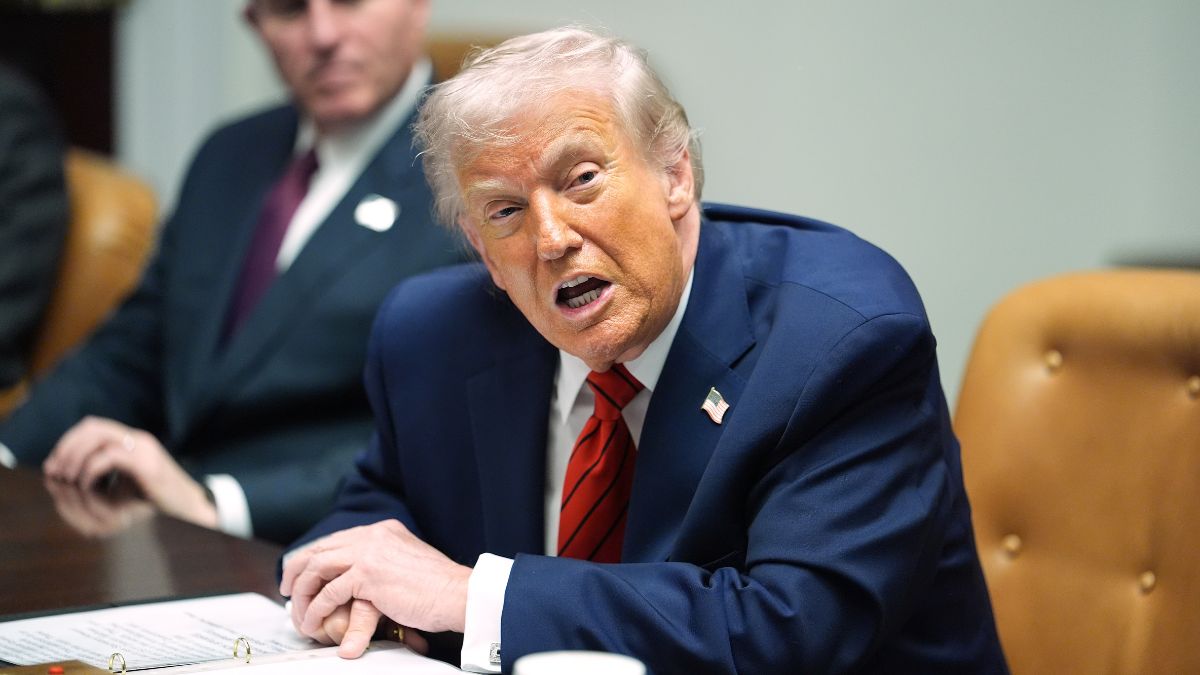
 "Sitting next to founder and CEO of Dell, Michael Dell, left, US President Donald Trump speaks during a roundtable discussion with business leaders in the Roosevelt Room of the White House, December 10, 2025, in Washington, DC, US. File Image/AP")
The United States has formally unveiled a major overhaul of its immigration pathway through the Trump Gold Card — a high-priced route to permanent residency.
Announced by US President Donald Trump, the scheme is being positioned as a reengineered successor to long-standing investor visas and as a tool to give American businesses faster access to highly skilled workers they have struggled to retain under existing frameworks.
The programme, months in the making, arrives against the backdrop of a sweeping clampdown on other forms of immigration, far-reaching deportation campaigns and new fee requirements for work visas.
With the online portal now accepting applications, prospective candidates must pay the US Department of Homeland Security a processing charge of $15,000 — collected through the Trumpcard.gov platform — followed by a mandatory $1 million remittance to the federal government.
The administration has described these payments as a “contribution” or “gift,” depending on the section of the website viewed, but both terms function as the programme’s essential qualifier for permanent residency.
Once this process begins, applicants undergo a background investigation overseen by federal authorities. Successful individuals then receive US permanent resident status — a functionally equivalent green card with the procedural advantages built into the new framework.
Trump himself characterised the product unequivocally, telling reporters, “Basically it’s a Green Card, but much better. Much more powerful, a much stronger path. A path is a big deal. Have to be great people.”
According to official information released through the site, the programme extends to immediate family members under age 21 and spouses, whose eligibility is tied to the primary applicant.
The application form requires personal details ranging from birth country to address, citizenship status, and household members.
The platform currently calculates a slightly higher processing amount of $15,375, reflecting a surcharge applied at checkout. Credit card users are notified that an extra 2.5 per cent fee is added if that payment method is selected.
Once documents and payments are submitted, the US Department of Homeland Security (DHS) and US Citizenship and Immigration Services (USCIS) begin thorough background checks on the applicant and dependents.
How the Trump Gold Card may benefit US companies
The Gold Card is not only designed for individual investors. A major component of the program is tailored for US companies looking to keep high-value employees in the country without navigating lengthy or unpredictable visa processes.
Firms can participate by contributing $2 million for each employee they want to sponsor through a corporate Gold Card.
In addition to this upfront cost, businesses are subject to recurring and conditional fees. These include a 1 per cent yearly maintenance payment — calculated as $20,000 — and a 5 per cent transfer fee of $100,000 whenever a company wants to reassign the sponsored card from one employee to another.
The government’s FAQ also notes that corporations may acquire multiple cards, but each card is tied to one worker at a time.
Trump promoted this corporate element aggressively, posting online that “Our Great American Companies can finally keep their invaluable Talent.”
He argued that companies lose graduates from US universities each year because those students lack a secure immigration pathway, leaving employers unable to offer long-term roles.
The US president also said business executives repeatedly told him about losing outstanding recruits due to the difficulty of extending their stay after graduation.
He singled Apple’s chief executive Tim Cook, saying that Cook had frequently urged the administration to reform the system, noting, “Nobody talked to me more about it.” Apple representatives did not publicly respond to inquiries about the president’s comment.
US Commerce Secretary Howard Lutnick explained the vetting fee and the rationale behind the new corporate system, asserting that the approval review would “make sure these people absolutely qualify to be in America.”
He contended that the goal was to ensure that companies were no longer constrained by the unpredictability of the existing immigration processes, especially when hiring foreign-born graduates from elite US institutions.
Trump also referred to international students from leading US universities as potential beneficiaries.
He cited several countries — China, India and France — as home to many graduates who could qualify for the program, saying, “The companies are going to be very happy.”
How the Trump Gold Card is an immigration tool to raise revenue
Lutnick told Reuters that “I would expect over time that we’d sell, you know, thousands of these cards and raise, you know, billions, billions of dollars.”
Trump argued that proceeds would accumulate into a government account, stating that the money would allow the administration to fund initiatives that could be beneficial for the country.
Trump also highlighted that the model mirrored what he considered successful tariff policy — directly generating income for the US Treasury. This framing reflects the administration’s broader approach of merging economic nationalism with a commercialised immigration mechanism.
The Commerce Department, the Department of State and the Department of Homeland Security have jointly implemented the programme. According to Trump, Lutnick — a businessman before entering government — conceptualised the original idea.
How the Trump Gold Card replaces EB-5
Although not officially labelled as such, the Gold Card serves as a functional rewrite of the EB-5 investor visa introduced in 1990.
The EB-5 structure required applicants to place roughly $1 million into a project that created at least ten jobs. In practice, this system depended on investor-run projects, regional centres, and strict documentation demonstrating that the investment had generated employment.
By contrast, the Gold Card eliminates the employment creation threshold and shifts all payments directly to the government. Trump announced the programme while surrounded by business leaders, describing it as a superior alternative to the earlier model.
He has argued that the system would allow the US to access highly capable individuals without relying on indirect investments.
The US president has repeatedly said the country could sell tens of thousands of such cards, indicating a broader scale than the often limited EB-5 system.
During discussions earlier in the year, he had floated a higher price point — $5 million per card — before settling on the current $1 million and $2 million model.
The administration has also stated that the Gold Card effectively grants permanent residency along with the possibility of citizenship, provided that applicants meet naturalisation criteria over time.
The government has not announced caps or quotas for the programme, although such limits existed under the previous EB-5 programme.
What we know about the new Platinum tier in development
Alongside the Gold Card, the administration is planning a higher bracket option called the Trump Platinum Card. Though not yet launched, the official website lists it as “coming soon.”
The premium version is expected to cost $5 million and would enable holders to spend up to 270 days each year in the United States without US taxation on income earned abroad.
Trump highlighted this concept during remarks earlier in the year, stating that the Platinum tier was part of a broader vision to attract global elites who could bring substantial capital into the US economy.
Lutnick has stated that establishing this higher tier would require congressional authorisation.
This upcoming product follows an executive order Trump signed in September that set the framework for both the Gold and Platinum cards.
Early reports had suggested a higher starting price, but the administration has revised the figures in ways that appear aimed at making the offering competitive with other countries’ residency-by-investment programs.
How Trump’s Gold Card compares with global ‘golden visa’ markets
Several countries operate systems that allow affluent foreigners to acquire residency through investment. Examples include the United Kingdom, Spain, Greece, Malta, Canada, Italy and Australia.
These programmes vary in cost and structure but generally require property purchases, business investments or direct financial contributions.
Officials have noted that the US version is entering a busy global market. Observers have pointed out that New Zealand’s investor visa — priced at close to $3 million — received significant demand, especially from high-net-worth Americans following Trump’s re-election.
Trump has described his programme as both simpler and more appealing than comparable ones overseas.
In promoting the launch, he remarked that many applicants would already be highly successful.
“Essentially, we’re having people come in, people that, in many cases, I guess, are very successful or whatever. They’re going to spend a lot of money to come in. They’re going to pay, as opposed to walking over the borders.”
What the Gold Card means for the future of US immigration
The rollout of the Gold Card is occurring at the same time that the administration is increasing enforcement efforts against undocumented immigrants.
Mass deportation operations have targeted metropolitan centres including Charlotte and Los Angeles, and new fee structures have been introduced for other visa categories.
Among these, the administration imposed a $100,000 charge on H-1B applicants, triggering lawsuits from business groups and the US Chamber of Commerce, which argue that the fee contradicts legislative intent.
DHS Secretary Kristi Noem promoted the Gold Card on social media, declaring that “under this historic initiative, qualified individuals and corporations, who contribute $1 million and $2 million respectively, will receive expedited EB-1 or EB-2 green cards following rigorous vetting.”
With inputs from agencies