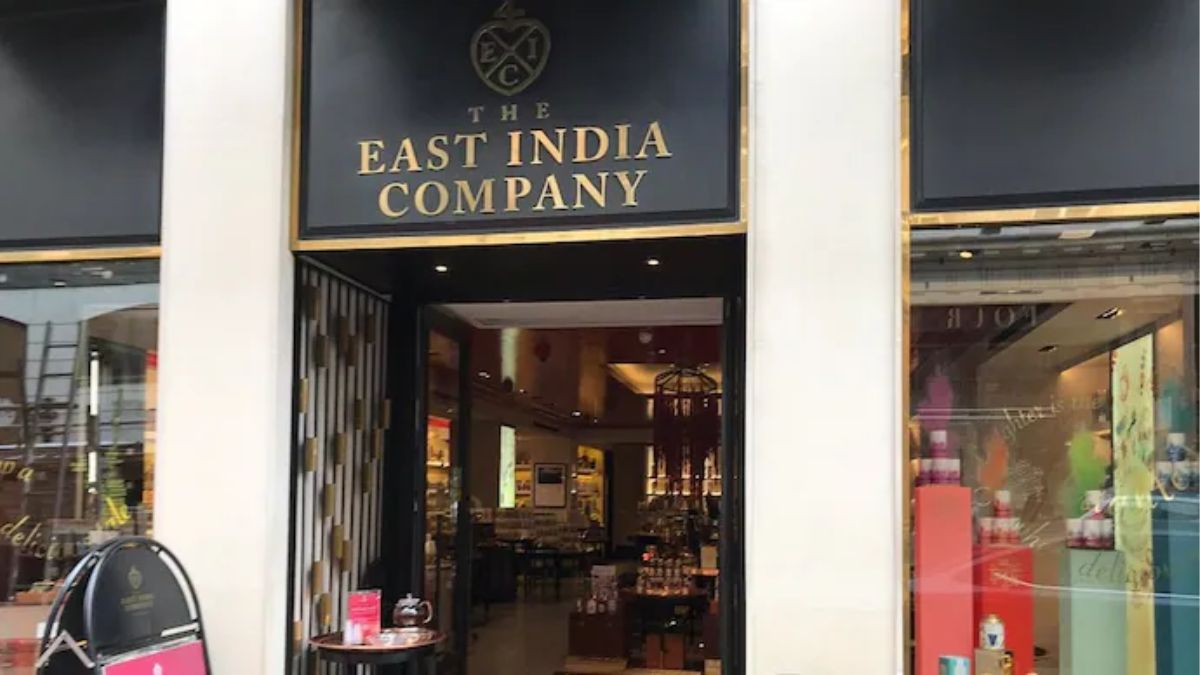
 "The East India Company was founded on December 31, 1600, by a royal charter granted by Queen Elizabeth I. Image courtesy: X")
Once the world’s most powerful trading empire, the East India Company, has closed its chapter for the second time in London. This time, as a luxury retailer.
The original East India Company ruled vast Indian territories in 1757, revolutionised global trade, but left behind a controversial legacy of violence and exploitation. It shut down more than 150 years ago. However, in 2010, British-Indian businessman Sanjiv Mehta secured the rights to the name and opened a retail store. Now this firm has gone bankrupt.
The company has been shut down after being reportedly liquidated in its modern form. The store and website have been closed, and over £ 600,000 (Rs 7.39 crore) in debt has been reported.
What happened?
The latest shutdown of the East India Company has brought a subdued ending to a brand that once shaped the course of Indian and British history.
Last October, the East India Company Limited appointed liquidators, Companies House filings revealed. The firm owned over £600,000 (Rs 7.39 crore) to its parent company, the East India Company Group, which is registered in the British Virgin Islands.
In addition, liabilities also covered £193,789 (around Rs 2.386 crore) in taxes and £163,105 (Rs 1.999 crore) owed to employees. A raft of other associated firms using the East India name have also been dissolved, underlining the full scale of collapse.
The brand’s physical and digital presence is no longer available. Its store at 97 New Bond Street in London stands empty and is being marketed online by a property agency. Its website is also no longer functional.
The Times reported that the East India Company Collections Limited was hit with a winding-up petition last week, a last-resort legal action used by creditors. At one point recently, just a single tea gift box remained listed on Selfridges’ website, signalling how much the revival effort had tumbled.
Who revived the East India Company?
The entrepreneur behind the East India Company’s second life was Sanjiv Mehta. In the early 2000s, Mehta began the process of acquiring the name from shareholders. He bought the original EIC, including its coat of arms, from a group of shareholders in 2005, Times of India (TOI) reported.
In 2010, Mehta opened a 2,000 sq ft luxury store in Mayfair, London. The store sold high-end teas, chocolates, confectionery, spices, and other items, similar to those sold by famous shops like Fortnum & Mason.
As the revision progressed, Mehta viewed it as a turning point in the transition from colonialism to something positive. The entrepreneur said that he felt that he had reclaimed for India what had long been considered a symbol of colonialism and oppression.
In 2010, Mehta told Hindustan Times (HT), “Put yourself in my shoes for a moment: On a rational plane, when I bought the company, I saw gold at the end of the rainbow. But, at an emotional level as an Indian, when you think with your heart as I do, I had this huge feeling of redemption-this indescribable feeling of owning a company that once owned us.”
While speaking to the Guardian in 2017, he said, “The fact that an Indian now owns the East India Company means that the negative has become a positive. The historic East India Company built itself on aggression, but today’s East India Company is about compassion,” India Today reported.
Mehta was born into a Gujarati Jain family in Mumbai. He is now a British citizen and comes from a lineage of diamond traders. Mehta was an alumnus of Sydenham College, Mumbai and IIM Ahmedabad. He moved to the Uk in 1989, according to media reports.
What’s the history of the original East India Company?
The East India Company was founded on December 31, 1600, by a royal charter granted by Queen Elizabeth I. It started as a joint-stock trading company, created to compete for spices and other goods from the East Indies, including India and Southeast Asia.
Its first trading post was opened in Surat, India, between 1612 and 1613. Gradually, it gained rights over British trade east of the Cape of Good Hope. In the 1700s, it had transformed into a major power, constructing forts, forging alliances with local rulers, and waging wars against rivals, including the French and local kingdoms, reported India Today.
After the Battle of Plassey in 1757, it collected taxes, administered courts, and ruled territories like Bengal.
At its peak in the early 1800s, the company maintained a private army of roughly 250,000 men, twice the size of Britain’s own army. It then controlled vast regions of India. It also dominated global trade in commodities like spices, cotton, silk, tea, and indigo, but often at a heavy human toll.
The legacy of the East India Company was marked by territorial expansion, exploitation, and a deep structural impact on the Indian subcontinent. After the 1857 Indian Rebellion, the company was formally dissolved. The British Crown took over the company, dismantled its army, and ended its direct governance.
Scholars have associated the company with systemic exploitation, its participation in global trade networks, including the slave trade, and policies that worsened famines impacting millions. Even today, the debate around its legacy persists.
Now, it is a closed chapter. A third coming of the East India Company seems unlikely.
With inputs from agencies