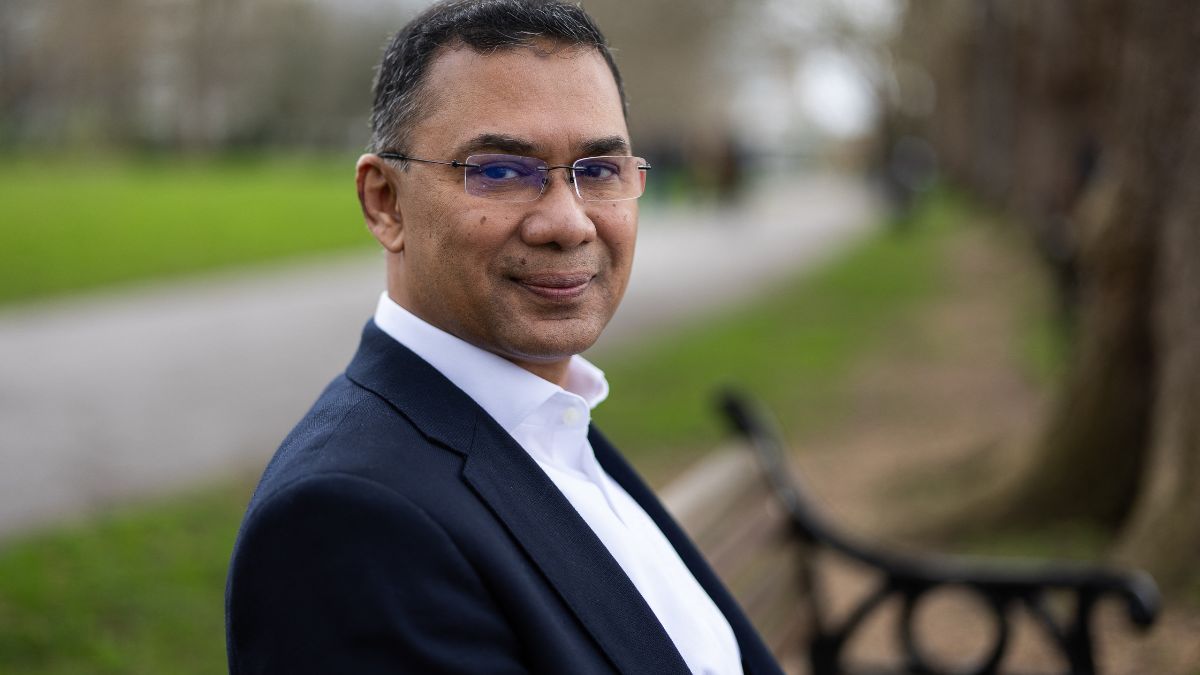
 "Acting chairman of Bangladesh Nationalist Party (BNP), Tarique Rahman, poses for a portrait in a park in south-west London on December 30, 2023. File Photo/AFP")
Tarique Rahman, the son of former Bangladesh Prime Minister Khaleda Zia, is set to return to the South Asian country after more than a decade. The 60-year-old, once seen as the “dark prince” of Bangladesh politics, will be back in his home country after 17 years of self-imposed exile in the United Kingdom.
Rahman, the acting chairperson of the Bangladesh Nationalist Party (BNP), has said he will arrive in Bangladesh on Thursday (December 25). His party is planning a massive welcome for the leader’s homecoming, aiming to attract nearly five million (50 lakh) people for a gathering in Dhaka.
Let’s take a closer look.
Who is Tarique Rahman?
Tarique Rahman is the eldest son of Khaleda Zia and former Bangladesh President General Ziaur Rahman. Rahman has been living in the UK for 17 years in a self-imposed exile.
In October 2018, Rahman and 18 others were sentenced to life imprisonment in the 2004 grenade attack case.
On August 21, 2004, a grenade attack left 24 people dead at an Awami League rally in Dhaka. More than 100 party leaders and activists were injured, with even Sheikh Hasina having a narrow escape.
Khaleda Zia, Rahman’s mother, was the Bangladesh PM at the time. During the sentencing, the Dhaka Speedy Trial Tribunal-1 called the attack a “well-orchestrated plan, executed through abuse of state power”.
The BNP had alleged the case was politically motivated and was aimed at damaging the image of party leaders.
Rahman was arrested during an anti-corruption drive in 2007 when the military-supported interim government was in power. He fell ill after allegedly being tortured in custody. In 2008, he secured bail and permission to fly to London for medical treatment.
Rahman has remained in the UK since then, leading the BNP from exile.
On 24 May 2023, the Dhaka Tribune published a three-part series “on patronisation of bribery and financial irregularities during the 2001-06 period (BNP tenure) based on documentary evidence”, where it described Rahman as the “dark prince”.
Quick Reads
View AllThe reports levelled allegations of corruption and media intimidation against him.
It quoted US embassy cables to allege that Rahman had amassed hundreds of millions of dollars in illicit wealth.
Rahman was sentenced to nine years in prison in absentia in 2023 for accumulating illegal wealth.
The fall of the Sheikh Hasina government in August 2024 following a student-led movement changed Rahman’s legal fortunes. He has since been acquitted in all 84 pending cases, including charges related to the 2004 Dhaka grenade attack, money laundering, sedition, and the Zia Charitable Trust.
Tarique Rahman to return home
Last week, Tarique Rahman announced he is returning to Bangladesh.
Addressing his event in London to celebrate the liberation of Bangladesh in 1971, he said, “I am returning to our country and I seek your blessings for that. On December 25, Insha Allah, with your blessings and with the blessings of Allah, I will return to Bangladesh.”
He urged his supporters not to go to Heathrow airport on the day of his departure to avoid any situation of disorder that could harm the BNP’s image.
In an interview with BBC Bangla earlier this month, Rahman said he had not returned to his homeland yet due to personal reasons. “But I think the time has come. This is an election for which people had been waiting. I cannot keep myself away during this time,” he said.
Bangladeshi actor and journalist Deepanwita Roy Martin told ThePrint on a call that Rahman was delaying his return due to fear for his life.
Why Tarique Rahman’s return to Bangladesh matters
Rahman’s return to Bangladesh comes just months ahead of national elections in the country.
The South Asian country will head to the polls on February 12, 2026.
According to Bangladeshi media, Rahman’s comeback is happening when the BNP is trying hard to rein in its grassroots. Its leaders and activists are facing allegations of several crimes, including extortion.
His move to return home is expected to energise the BNP cadre and voters. However, some are still questioning whether Rehman, who is the frontrunner in the polls, will actually arrive home, given security concerns in Bangladesh.
“We saw this with Sheikh Mujibur Rahman, who was killed along with most of his family. President Zia rose to power in a similarly unstable situation and was assassinated too. State institutions failed to protect both presidents. After 1975, the situation we are seeing in 2024 is one of the most volatile. In such a context, the threat to Tarique’s life cannot simply be brushed aside,” Asif bin Ali, an Atlanta-based geopolitical analyst and doctoral fellow at Georgia State University, told ThePrint.
With the rise of Jamaat-e-Islami and the exile of Bangladesh Awami League leader Sheikh Hasina, undecided voters could sway towards the BNP.
“The real issue is the floating voters—those who do not like the Islamists, those who do not want to vote for an Islamist party, those who are sceptical of the BNP but open to considering it as a liberal democratic option. These floating voters need restored faith if the BNP wants to come to power. If Tarique does not return, the BNP will pay a heavy price, and the void may be filled by Jamaat,” Ali said.
Rahman’s absence has created a vacuum in Bangladesh’s politics that could be filled only upon his return. His mother, Khaleda Zia, has been critically ill since last month and remains hospitalised in Dhaka.
The BNP needs a leader on the ground to helm the party in the upcoming polls.
“Making announcements or speaking live from London is one thing. Showing real faith by coming home, shaking hands with people, talking to ordinary citizens on the streets, praying in mosques, visiting Hindu temples, giving speeches in front of the public, that physical presence creates hope. For many, Tarique has become a symbol of that hope. But that faith is now weakening. So the question of Tarique’s return to his country has moved to the centre of the political debate,” Ali was quoted as saying by the digital news outlet.
While it remains uncertain whether Hasina’s party will be allowed to contest the February elections, Rahman’s return to Bangladesh will offer some credibility to the polls.
Pre-poll surveys by the US-based International Republican Institute project the BNP could bag 33 per cent support, followed by the Jamaat-e-Islami at 29 per cent.
Whether the BNP will return to power and Rahman will become the third head of state from his family remains to be seen. His presence will, however, certainly give hope to a big chunk of voters who have been seeking an elected government for months.
With inputs from agencies