

 "How Yunus regime has allowed Islamists to exploit Hadi’s death to target India")
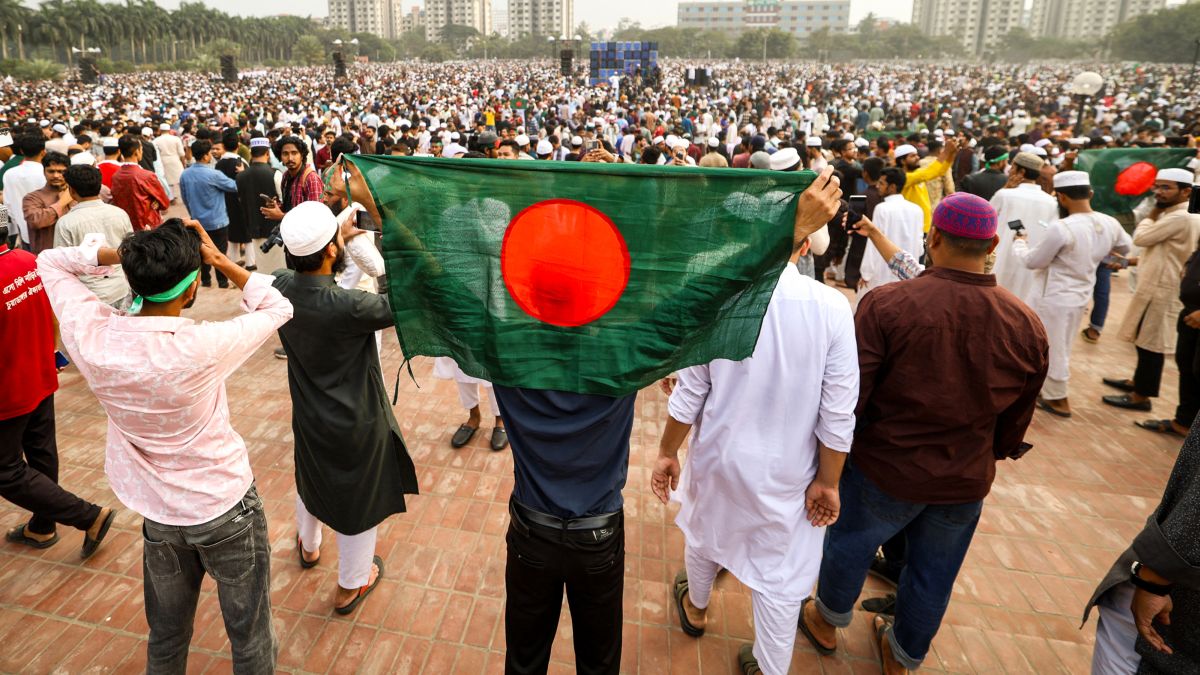
Bangladesh has reached one of those critical and decisive moments where politics has completely slipped out of democratic institutions and manifested itself into a violent political street culture. The killing of Osman Hadi, a controversial youth leader cum agitator who was known less for ideas and more for incendiary rhetoric, has become far more than a single act of violence. His killing has been turned into a political capital that has been harvested most effectively by the Islamist forces that have long waited for an emotive trigger capable of converting street anger into an electoral momentum.
Hadi’s life was defined by outright provocation, not the kind that challenged power through ideas or exposed injustice through argument, but a calculated, performative provocation that was carefully designed to collapse the moral and civic boundaries of Bangladesh society. His speeches routinely weaponised obscenity and sexualised insults, deliberately invoking women’s bodies and genitalia to demean political opponents and shock audiences into submission. His speeches relied heavily on sexualised abuse, misogynistic insults, and deliberately crude metaphors that reduced politics to humiliation rather than persuasion.
This was not an accidental vulgarity, but it was a method aimed at silencing the dissenting democratic voices that stood against the politics of radicalisation and Islamism that have plagued Bangladesh since the fall of Sheikh Hasina’s government last year. By flattening the public discourse into obscenity, Hadi legitimised aggression as authenticity and rage as a political virtue. What followed after his death shows us why that method was always dangerous.
From Rhetoric to Ritualised Violence
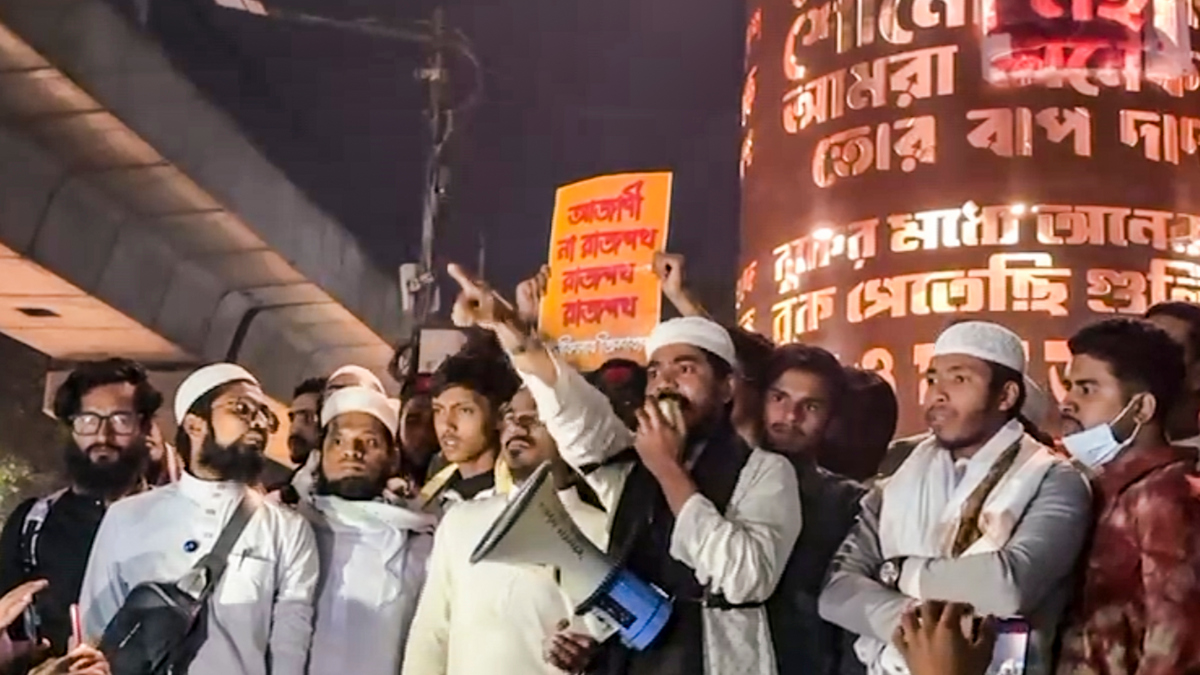
In the days following Hadi’s killing, protests quickly turned into a violent spectre that left many in Bangladesh shocked and the world stunned. As the mobs gathered, they unleashed unprecedented violence on the streets. They retorted to arson by burning down the offices of the prominent media houses of the ‘Prothom Alo’ and ‘The Daily Star’, attacking their journalists, and then proceeded to vandalise the cultural institutions.
Quick Reads
View AllThe very pillars of Bangladesh’s once secular civic space became their focused targets. The violence was not chaotic in nature; as a matter of fact, it was well planned in advance and directed towards the institutions that were symbolic of a secular Bangladesh with the sole aim to completely silence the dissenting or the democratic voices.
This escalation revealed a core truth about Hadi’s ‘idea of Bangladesh’, that movements that are trained in humiliation of the dissenters do not suddenly become disciplined in grief. The language that normalises dehumanisation inevitably prepares the ground for physical violence. Hadi’s followers did not invent this logic after his death; they inherited it.
The Lynching of Dipu Charan Das: A Line Often Crossed
Nothing illustrates Bangladesh’s descent into a radical hellhole more starkly than the mob lynching and the subsequent burning of Bangladeshi Hindu Dipu Charan Das. His gruesome murder was not any isolated criminal act; it was a political signal that was overtly wrapped in communal hatred.
Das, a Hindu, became a proxy victim in a charged environment where Islamism increasingly feeds on anti-Hindu resentment. His killing symbolised how minorities are being pushed outside the protective boundary of citizenship. When mobs feel empowered to lynch and burn with impunity, it indicates not only intolerance but also the ideological confidence the radical masses imbibe, knowing that the violence they unleash will be excused, justified, or quietly ignored.
For Islamist mobilisers, such brutality serves a grim purpose. It radicalises supporters, intimidates minorities into withdrawal, and polarises society along religious lines that can later be translated into votes.
Anti-India Hatred as Political Currency
Running parallel to anti-Hindu violence is a sharp escalation in anti-India rhetoric. India is no longer just a neighbouring state in a political discourse; it is increasingly being portrayed as an existential enemy, a civilisational antagonist, a convenient external villain and a symbol of absolute hate.
The attack on the Indian High Commission was emblematic. Huge crowds descended upon the Indian High Commission compound and resorted to stone pelting. Though the diplomatic premises globally are traditionally protected even during unrest, targeting them sends a message. As the planners and the agitators walked back scot-free after attacking the Indian High Commission, the message towards India was very clear. The violence is not only acceptable, but it is also performative, something to be displayed publicly to prove a radical ideological commitment.
This rhetoric serves multiple purposes for the Islamists that are hell-bent on usurping power in Bangladesh through violent means. It deflects the attention from their own domestic failures, unites disparate Islamist factions under a shared external enemy, and most dangerously collapses the distinction between India and Bangladesh’s Hindu citizens. In this framing, Bangladeshi Hindus become internal stand-ins for India, making them politically expendable.
Islamists as the Primary Beneficiaries
The political beneficiaries of Hadi’s death are unmistakable. Hardline Islamist forces, particularly the Jamaat-e-Islami Bangladesh and the National Citizen Party led by Hasnat Abdullah, have gained a powerful mobilisation tool. Martyrdom narratives are invaluable in Islamist politics, as they shut down the debate, sanctify anger, and frame violence as a moral duty.
With national elections approaching early next year, this emotional capital matters. Street passion often precedes ballot success in Islamist movements. Hadi’s death allows these parties to bypass policy debates altogether and campaign instead on grievance, religious identity, and perceived humiliation.
The Signal from the Interim Leadership
What has intensified fears of radicalisation is the posture adopted by interim head of the government Muhammad Yunus during Hadi’s funeral. His statement that he wished to “carry forward” Hadi’s ideas was read less as a message of reconciliation in the fractured society of Bangladesh and more as an endorsement of his violent ideology through ambiguity.
In transitional moments, words from the top are interpretive cues. By invoking Hadi’s “idea” without confronting the violence and coercion associated with it, the interim leadership intentionally legitimised the violence and excesses. This reiteration of ‘Hadi’s idea’ has now transformed itself into a virtual signalling where Islamist groups interpret such messages of using violence as a genuine political tool, and the mobs associated with them interpret it as permission to unleash it.
BNP’s Strategic Drift into Anti-India Rhetoric
Perhaps the most revealing consequence of this Islamised atmosphere is how it is reshaping even the traditionally mainstream party. The BNP (Bangladesh Nationalist Party), long positioned as a major electoral force, now finds itself struggling for relevance in a street environment that is dominated by religious mobilisation.
To remain politically audible, BNP leaders have begun echoing anti-India rhetoric that stems not necessarily from an ideological conviction but from survival instinct. In a polarised climate, silence on India is treated as weakness and collusion, while moderation is viewed as betrayal. This drift underscores how far the political centre has shifted, so that now even the secular or nationalist parties like the BNP feel compelled to borrow Islamist language to compete in this radically charged atmosphere.
Elections in the Shadow of Radicalisation
As Bangladesh heads toward elections early next year, the landscape looks increasingly distorted. Islamists have gained momentum without winning any debates, and the minorities are being made to retreat from public and political life. Media institutions now operate under constant threat with a solemn message of falling in line with the Islamists. And like an icing on the cake, the anti-India hostility has become a campaign currency rather than a foreign-policy position.
Hadi’s death has added fuel to accelerate the pace of the Islamist takeover of Bangladesh. It has provided them with a violent emotion that remains unchecked without any accountability, it has added symbolism without any scrutiny, and it has fuelled violent mobilisation without restraint. The danger is not merely an Islamist electoral takeover, but it is turning into an election that is being conducted after pluralism has already been hollowed out from within the Bangladesh societal milieu.
Bangladesh’s crisis, then, is not about one man’s life or death. It is about how violence is being normalised, how hatred is being monetised, and how striking fear into the minorities is quietly replacing citizenship. If this trajectory continues, the Bangladeshis risk discovering too late that the real casualty of Osman Hadi’s violent legacy is Bangladesh’s very own democratic soul.
(Raja Muneeb is an independent journalist and columnist. He tweets @rajamuneeb. The views expressed in this article are personal and solely those of the author. They do not necessarily reflect the views of Firstpost.)


 "‘Bangladesh’s Yunus govt failed to control ‘mobocracy’’: BNP leader on attack on Indian mission")
 "Tarique Rahman to return to Bangladesh after 17 years: Can Khaleda Zia’s son influence February elections?")
 "US Congressmen raise alarm over anti-Hindu violence in Bangladesh")
 "‘Time to Kash out’: Why Kash Patel’s choice of new wheels has sparked a row")
 "‘Bangladesh’s Yunus govt failed to control ‘mobocracy’’: BNP leader on attack on Indian mission")
 "Tarique Rahman to return to Bangladesh after 17 years: Can Khaleda Zia’s son influence February elections?")
 "US Congressmen raise alarm over anti-Hindu violence in Bangladesh")
 "‘Time to Kash out’: Why Kash Patel’s choice of new wheels has sparked a row")



