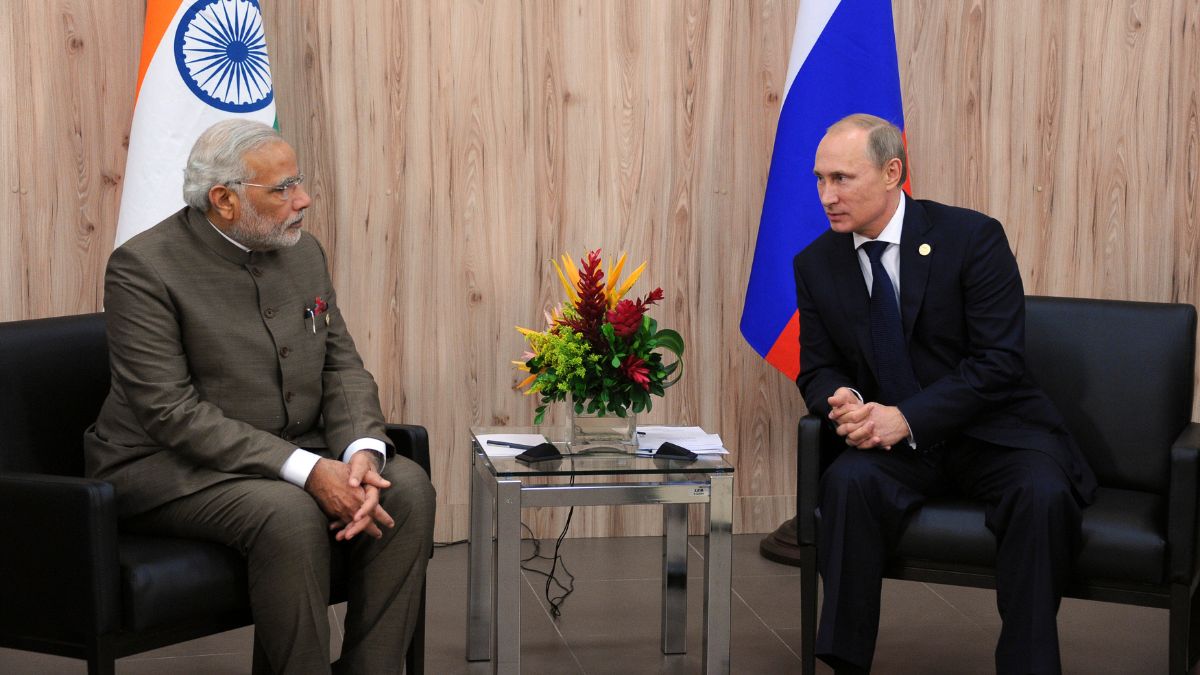
 "Russia's President Vladimir Putin (R) meets with India's Prime Minister Narendra Modi during the sixth Brics Summit in Fortaleza, July 15, 2014. This was the duo's first official meeting after Modi took office. File Image/Reuters via RIA Novosti")
Russian President Vladimir Putin arrived in New Delhi on December 4 on a State visit for the 23rd India-Russia Annual Summit that can only be described as a high-stakes display of partnership in the face of continued Western pressure on New Delhi to diversify and look elsewhere for partners. Well, perhaps that is what it means when two global powers are in a “Special and Privileged Strategic Partnership”.
Since Prime Minister Narendra Modi assumed office in 2014, he and Putin have met numerous times, consistently cementing a relationship defined not by personal fondness alone, but by a deep, strategic interdependence that has been tested time and again.
Modi even broke protocol to personally receive Putin on the tarmac Thursday evening at Palam airport after which they took a car ride together for their dinner.
The foundation of this relationship is India’s doctrine of strategic autonomy, which dictates that New Delhi’s foreign policy and procurement choices are driven solely by national interest, irrespective of pressure from any major power bloc.
Russia, for its part, respects this autonomy, offering consistent support for India’s multilateral ambitions — such as a permanent seat on the UN Security Council — and maintaining a policy of non-interference in India’s domestic affairs.
This foundational trust has enabled the two leaders to maintain strong personal rapport, with Modi describing Russia as India’s “all-weather friend and trusted ally” and Putin referring to Modi as a “dear friend.”
How defence & energy have been indispensable anchors
Since 2014, the India-Russia partnership has systematically upgraded its military-technical cooperation from a simple buyer-seller dynamic to one involving joint development and production under the ‘Make in India’ initiative.
Russia remains India’s largest, though diversifying, supplier of sophisticated military equipment. A key indicator of the partnership’s depth is the $5.43 billion deal for the S-400 Triumf long-range surface-to-air missile system, signed in 2018.
India proceeded with the deal and has been receiving deliveries despite the threat of secondary sanctions under the US Countering America’s Adversaries Through Sanctions Act (CAATSA).
The move highlights the strategic value New Delhi places on Russian technology for its national defence architecture.
Even military-technical cooperation between the two nations has been extended until at least 2031, ensuring the sustained supply of critical spares, maintenance, and joint production components for India’s massive inventory of Russian-origin platforms, including Sukhoi Su-30MKI fighter jets, T-90 tanks, and the BrahMos cruise missile joint venture.
In the energy sector, Russia is a vital partner in India’s civilian nuclear power programme, as witnessed by the ongoing commissioning of units at the Kudankulam Nuclear Power Plant.
This long-term commitment in nuclear energy provides a stable, non-hydrocarbon component to India’s rapidly growing power requirements.
How a post-2022 reality tested Modi-Putin bonhomie
The Russian invasion of Ukraine in February 2022 represented the most lethal stress test for the Modi-Putin partnership, forcing India to perform a delicate diplomatic balancing act.
Factually, India has maintained a neutral stance in multilateral forums, notably abstaining from all UN votes condemning Russia’s actions.
However, the most significant and most visible diplomatic intervention occurred on the sidelines of the Shanghai Cooperation Organisation (SCO) Summit in Samarkand, Uzbekistan, in September 2022.
During the summit, Modi publicly told Putin, “Today’s era is not an era of war.”
This statement was widely viewed as India’s sharpest public critique of the conflict and was acknowledged by Putin.
Despite this public disagreement on the conflict, the leaders have continued their frequent engagements, including a bilateral visit by Modi to Moscow in July 2024 and their most recent meeting on the sidelines of the SCO Summit in Tianjin, China, in September 2025, where Modi reiterated his call for an expedited cessation of the conflict.
The Ukraine war also dramatically deepened the economic relationship of the two countries.
Leveraging steep discounts offered by Russia following Western sanctions, India significantly ramped up its crude oil imports.
Before 2022, Russian crude accounted for less than 1 per cent of India’s total imports; by mid-2025, Russia had become India’s single largest supplier, accounting for approximately 40 per cent of its crude oil imports.
This strategic move ensured energy security and saved India billions of dollars, directly contributing to India’s record bilateral trade volume.
How Modi and Putin need to deal with the rupee-rouble challenge
Bilateral trade reached an unprecedented $68.72 billion in the Financial Year 2024-25.
However, this figure is heavily skewed by Indian imports of Russian crude, gas, and fertilisers ($63.84 billion), resulting in a massive 13:1 imbalance against India’s exports ($4.88 billion).
This has led to a significant accumulation of Indian Rupees in Special Rupee Vostro Accounts (SRVAs) in India — a system established to bypass Western sanctions and the SWIFT exclusion.
The stranded rupee surplus presents a liquidity crisis for Russian entities, who have been unable to effectively repatriate or invest these funds, thus undermining the long-term sustainability of the discounted energy trade.
To address this, the leaders are expected to focus on two major financial solutions.
First, implementing the Reserve Bank of India’s regulatory changes that permit Russian entities to invest their accumulated rupee balances into Indian assets, including Government Securities (G-Secs), equities, and infrastructure projects.
This would convert a short-term liquidity issue into long-term Russian investment in India, potentially helping to achieve the ambitious bilateral investment target of $50 billion set by the two countries.
Second, discussions will focus on activating new financial tools, such as integrating India’s RuPay and Russia’s MIR card payment systems for easier bilateral tourism and trade settlement, as well as finalising a mechanism to facilitate increased Indian exports, particularly in pharmaceuticals, agricultural products, and IT services, to correct the trade deficit.
The full operationalisation of the International North-South Transport Corridor (INSTC) is also viewed as a crucial structural solution to facilitate this trade diversification.
How Putin-Modi have continuously engaged
Since 2014, the consistent pattern of high-level engagement has been a defining characteristic of the Modi-Putin dynamic. The duo has met over 20 times in both bilateral and multilateral settings.
The most notable meetings include:
July 16, 2014: Brics summit sidelines in Fortaleza, Brazil (their first official meeting)
December 10-11, 2014: 15th India-Russia annual summit in New Delhi, India
July 8-10, 2015: Brics and SCO summits sidelines in Ufa, Russia
December 23-24, 2015: 16th India-Russia annual summit in Moscow, Russia
October 15-16, 2016: 17th India-Russia annual summit & the 8th Brics summit in Goa, India
May 31-June 2, 2017: 18th India-Russia annual summit & the St Petersburg International Economic Forum in St Petersburg, Russia
May 21, 2018: Informal summit in Sochi, Russia
October 4-5, 2018: 19th India-Russia annual summit in New Delhi, India
September 4-5, 2019: 20th India-Russia annual summit in Vladivostok, Russia
December 6, 2021: 21st India-Russia annual summit in New Delhi, India
September 16, 2022: SCO summit sidelines in Samarkand, Uzbekistan
July 8-9, 2024: 22nd India-Russia annual summit in Moscow, Russia (Modi’s first visit since invasion of Ukraine)
October 22-23, 2024: 16th BRICS Summit sidelines in Kazan, Russia
September 1, 2025: SCO summit sidelines in Tianjin, China
And now upcoming, December 4-5, 2025: 23rd India-Russia annual summit in New Delhi, India (Putin’s first visit since invasion of Ukraine)
Beyond the annual summits, the leaders have used informal settings to deepen their understanding.
Notable instances include the informal summit in Sochi, Russia, in May 2018, and their frequent and famous “chit-chats” during multilateral gatherings.
Modi’s gesture of visiting Putin in Moscow in July 2024, shortly after being re-elected for a third term, served as a powerful signal of the relationship’s continuing high priority for New Delhi.
The upcoming Putin visit will follow this established pattern as the partnership navigates Western sanctions and India’s growing defence ties with the US and France, to resolving the rupee payment impasse and ensuring the sustained flow of discounted Russian energy.
Also Watch:
Inhaling global affairs on a daily basis, Anmol likes to cover stories that intrigue him, especially around history, climate change and polo. He has far too many disparate interests with a constant itch for travel. You can follow him on X (_anmol_singla), and please feel free to reach out to him at anmol.singla@nw18.com for tips, feedback or travel recommendations