 "Viral videos, sold-out toys… Why the world is going bananas for Punch, the Japanese monkey")
The world is going bananas for Punch, the baby monkey in Japan.
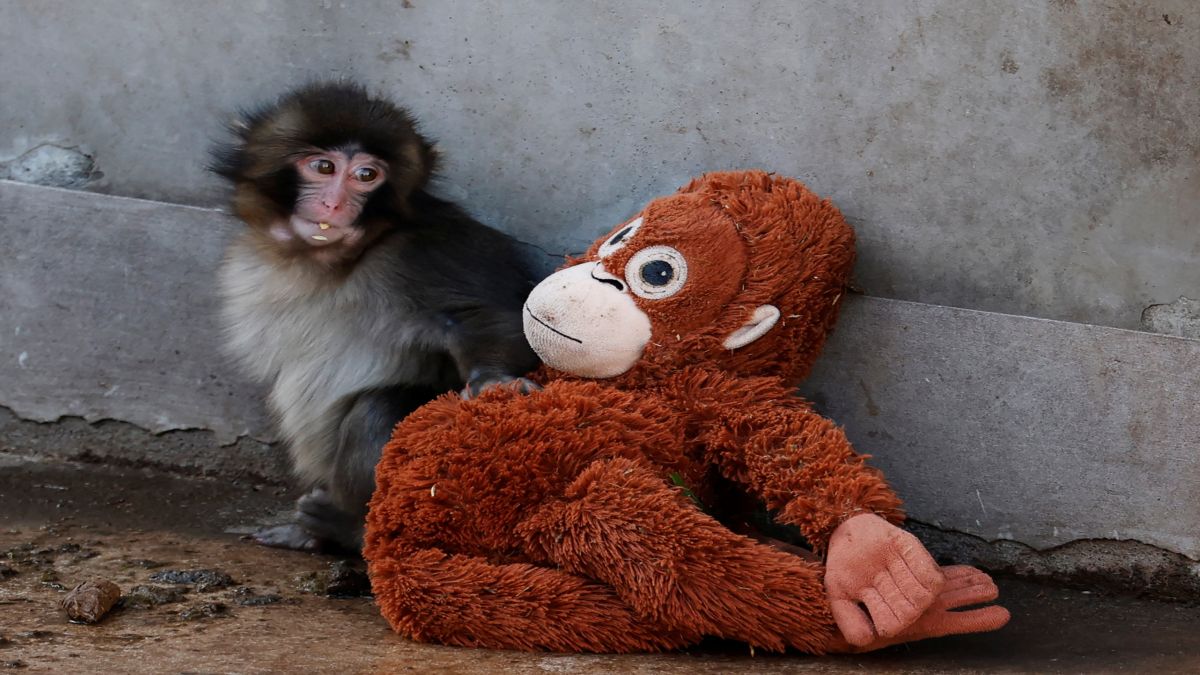
The Japanese macaque born last July at Ichikawa zoo has captured the hearts and minds of people, after videos of him clutching a stuffed orangutan toy after he was abandoned by his mother went viral on social media.
Reels and videos have flooded the internet; google Punch the monkey and heart-shaped photos of the macaque emerge on your screen. People from across the world are thronging the zoo in record numbers to catch a glimpse of the primate. And there are even offers to buy him.
One could say the world has gotten drunk on Punch.
The tale of Punch the Monkey
For those who haven’t been online or are unaware about Punch (we are shocked), the Japanese macaque, named Panchi-kun, was born at the Ichikawa City Zoo on July 26, 2025.
According to the zoo, Punch, as he is named in English, was abandoned by his mother shortly after birth. Without maternal support, he struggled to integrate into the troop, with viral videos showing him being chased and dragged by older macaques.
To help him cope, the caretakers at the zoo gave him an IKEA toy in the shape of an orangutan to help combat his anxiety and assist with his loneliness. He began carrying the plushie named “Ora-mama” everywhere he went, seemingly treating it as a replacement for his mother.
The rest, as they say, is history. He’s become one of the most talked about topics, and hashtags #GanbarePanchi and #HangInTherePunch have gone viral. Major international outlets, including BBC News, The New York Times, and Forbes, have carried reports on the macaque and his heartbreaking story.
Punch becomes star attraction at zoo
Since people became aware of Punch’s story, there’s been a frenzy around the macaque. The primate has become a star attraction at the Ichikawa City Zoo, drawing crowds from across the globe.
Last Thursday, the Japanese zoo recorded more than four times its usual number of visitors, around 900 people, thanks to Punch. According to a New York Times report, about 8,000 people visited the zoo last weekend, more than double the number of visitors on the same Saturday and Sunday of the previous year.
“He’s so cute, so I had to come see him. I studied his pictures in advance so that I could recognise him. It makes me a little sad he’s growing so fast, but I’m relieved to see he’s making friends,” said one visitor to AFP.
Such is the frenzy to catch a glimpse of Punch that the zoo has taken steps to reduce stress for its monkeys. In order to protect its monkeys, the zoo authorities have made the outer perimeter of Monkey Mountain a restricted area. The officials have also urged people to observe the animals in a peaceful manner.
A viral superstar, a commercial boon
The madness over Punch has also spilled over into the online world. He’s become a social media sensation with thousands of videos dedicated to him.
Social media users have gotten emotional over the primate, with tributes pouring in from everywhere. “I would adopt Punch and love him forever,” wrote one user. Another admitted: “3 days in a row crying over Punch.”
Even late-night US television has taken notice of the phenomenon. Stephen Colbert referenced Punch during the opening monologue of his show, as did John Stewart.
Google has also jumped on the bandwagon, celebrating Punch. Every netizen who recently looked up the viral Japanese macaque is in for a surprise as a charming Google search animation on Punch the Monkey fell like graffiti on the screen, capturing the heart of this global sensation.
Punch’s fame has also spilled into the commercial world. IKEA, which is behind the plush orangutan he carries, has leaned into the hype. The Swedish furniture giant posted a picture on social media of two of the plushes hugging each other, along with the title “Sometimes, family is who we find along the way” and the caption, “We’re ALL Punch’s family now.”
IKEA has also reported a surge in sales of the orangutan soft toy in recent days. The toy, part of IKEA’s Djungelskog children’s line, quickly cleared itself from the shelves. As of February 25, the stuffed animal was sold out on the IKEA website.
And as the toy, which is priced at $20, sells out across the world, it is now being resold online for significantly higher amounts. According to a report in the New York Post, listings on eBay show the toy being offered for as much as $350 — roughly Rs 29,000 — more than 10 times its original retail price.
Andrew Tate’s brother offers to buy Punch
And if all of this wasn’t enough, social media influencer Andrew Tate’s brother, Tristan Tate, has put forward a bid of $250,000 (approximately Rs 2 crore) to purchase Punch from the Japanese zoo.
The offer to purchase Punch came after Tristan reshared a widely circulated video of the monkey and wrote on X, “Which zoo owns this monkey. @Cobratate, and I will buy it.”
Later, he added, “I am not joking.” Within hours, the post drew massive engagement, crossing 5.5 million views in just two days.
Which Zoo owns this monkey.@Cobratate and I will buy it.
— Tristan Tate (@TateTheTalisman) February 19, 2026
250,000 dollars.
I am NOT joking. https://t.co/44UXASPwsO
However, not everyone is happy with Tate’s offer. Some social media users are rallying against the Tate brothers’ offer, with one user writing, “So you’re trying to buy him to get him away from bullies… Just to come live with bullies???? Yeah, no.”
Our fascination with Punch
But what is it about Punch that has got people going crazy? Why is it that we are all Punch drunk?
Psychologists note that the world’s fascination with Punch is connected to attachment theory. Behavioural psychologist Jo Hemmings told HELLO!, “There is something profoundly primal about watching a baby animal being rejected. It bypasses intellect and goes straight to instinct.
“We are hard-wired to respond to vulnerability, particularly infant vulnerability, because, evolutionarily, survival depended upon it. When we see a baby monkey isolated and distressed, our mirror neurons fire up; we feel the rejection as if it were our own. It’s not sentimental weakness - it’s attachment psychology in action.”
Even other experts agree that the visceral emotions that humans are displaying towards Punch stem from our natural empathy towards children. “When humans see a young being that looks lost or confused, it hits something emotional very quickly. Most people don’t sit and analyse why they feel moved. They just feel it. In a quiet way, Punch reminded people of moments when they themselves felt left out, unsupported, or emotionally alone. That’s why the reaction became so strong,” Dr Munia Bhattacharya, senior consultant, clinical psychologist at Marengo Asia Hospital, Gurugram, told India Today.
Child psychologist Dr Sasha Hall also echoed similar sentiments. “A baby being separated from its mother is one of the most powerful emotional triggers we have because connection is so fundamental to survival.”
“Stories like this resonate because the emotions behind them are universal. Rejection, loneliness, and the search for comfort are experiences everyone understands,” the expert told HELLO magazine.
For those still having the feels for Punch, there’s good news now. The monkey has grown closer to the others at the zoo, with videos showing macaques grooming him, sitting beside him, and even hugging him.
Here’s hoping Punch makes many friends.
With inputs from agencies

 "Hugs, praise and more… The Modi-Netanyahu friendship looks solid")
 "PM Modi Israel Visit Live Updates: PM Modi to visit Holocaust memorial in Israel; hold meetings with President Herzog, Netanyahu")
 "India vs Zimbabwe: Why Chepauk could boost Samson; Axar in contention for must-win clash")
 "From tadka dal, thepla & dhokla, PM Modi's private dinner in Israel celebrates the best of Indian comfort food")
 "Hugs, praise and more… The Modi-Netanyahu friendship looks solid")
 "PM Modi Israel Visit Live Updates: PM Modi to visit Holocaust memorial in Israel; hold meetings with President Herzog, Netanyahu")
 "India vs Zimbabwe: Why Chepauk could boost Samson; Axar in contention for must-win clash")
 "From tadka dal, thepla & dhokla, PM Modi's private dinner in Israel celebrates the best of Indian comfort food")