

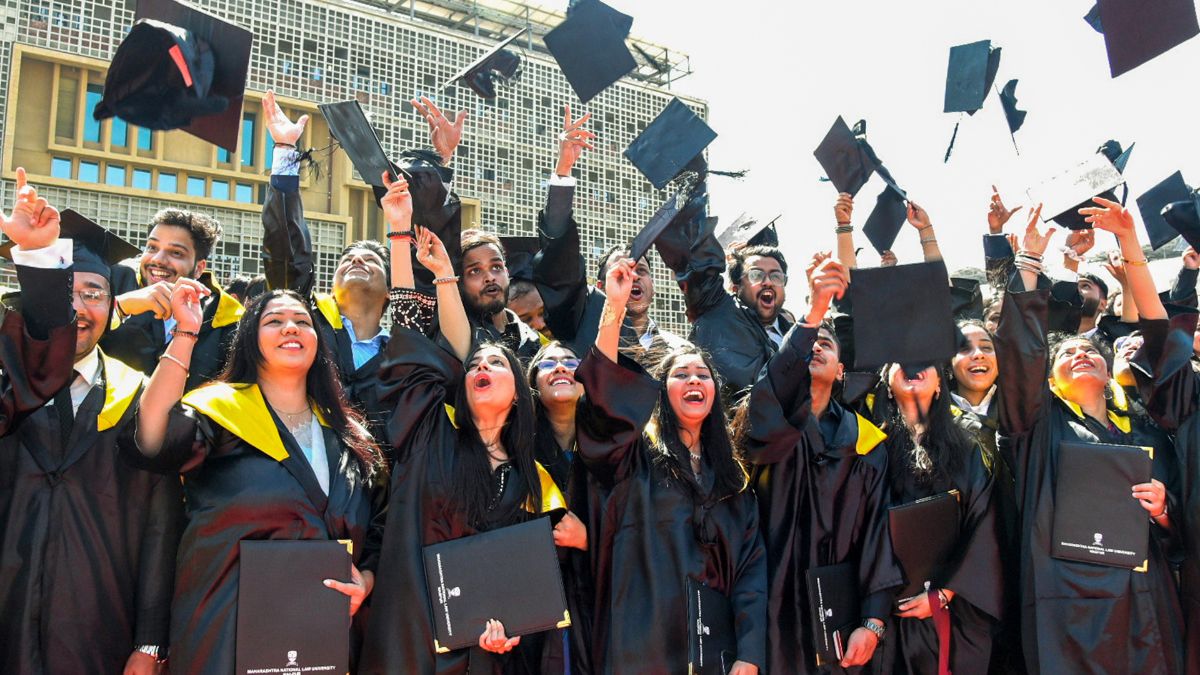
 "The Great Exodus: How many Indian students travelled abroad to study?")
A report released by the government think tank Niti Aayog has found that India is losing a far greater number of students to international universities than it is drawing overseas students. Canada, the United States, the United Kingdom, Australia and Germany are the top five foreign higher education destinations for Indian students, as per the report.
In the Internationalisation of Higher Education in India Report released on Monday (December 22), the Niti Aayog also suggested ways to attract foreign students to India. The report was prepared in collaboration with IIT Madras, the Association of Indian Universities, and global education services firm Acumen.
Let’s take a closer look.
India’s problem of ‘brain drain’
The Niti Aayog found that more than 11.59 lakh Indian students went to study abroad in 2021–22, while just 46,878 international students came to India during the period.
Nepal, Afghanistan, the US, Bangladesh and the United Arab Emirates (UAE) were the largest source countries of overseas students in India in 2021-22, the report said.
The number of students India sent overseas increased to 13.36 lakh by 2024, indicating a constant and rising “imbalance” in student mobility.
Last year, “for every one international student coming to India, nearly 28 Indian students went abroad”, the Niti Aayog said in its report.
“The current trend of internationalisation in Indian higher education is largely skewed towards promoting international exposure through outbound student mobility. This has contributed significantly to brain drain,” the report read.
Where are Indian students heading?
Canada hosted 4,27,000 Indian students in 2024, emerging as the top international higher education destination.
As many as 3,37,630 Indian students visited the US last year, followed by 1,85,000 to the UK, 1,22,202 to Australia and 42,997 to Germany.
According to the Niti Aayog report, India is the world’s largest source country of international students, and has the largest higher education age cohort (18-23 years) globally — 15.5 crore.
Quick Reads
View AllWhy brain drain is bad for India
Niti Aayog emphasised that the internationalisation of higher education is “no longer optional but an imperative” for developing globally competitive human capital. “International students are not merely learners, but long-term ambassadors of India’s knowledge, culture and innovation ecosystem,” it said.
The report also pointed out the huge financial impact on Indians studying abroad.
Canada, the US, UK and Australia together hosted 8.5 lakh Indian students who spent Rs 2.9 lakh crore on higher education in 2023-2024.
Citing the Reserve Bank of India (RBI) data, the think tank underlined that the outward remittances under the ‘studies abroad’ component of the Liberalised Remittance Scheme (LRS) surged more than 2,000 per cent, from Rs 975 crore in 2013-14 to Rs 29,000 crore in 2023-24.
LRS allows residents of India to send money overseas for education and other permitted purposes
“This outflow is equivalent to around 53 per cent of India’s total Union higher education budget of about Rs 55,000 crore for 2023-24,” it stated.
The report warned that a large number of skilled and educated youth in India are settling abroad for better opportunities.
“This reduces the pool of capable individuals available to drive India’s development. If not addressed, the continued outflow of talent will hinder India’s ability to fully leverage its demographic dividend,” the report read.
It further highlighted that the outmigration of skilled students and researchers reduces India’s ability to build a strong indigenous research and development ecosystem, as per ThePrint.
“This not only hampers innovation and knowledge creation within the country but also increases dependency on foreign technologies and limits India’s ability to address its unique socio-economic challenges through homegrown solutions. Hence, there is an urgent need to move towards ‘internationalisation at home’.”
The report stressed that the “scale of outbound student mobility highlights the urgency for systemic and institution-level strategies to strengthen India’s capacity to attract, retain, and support international academic and research collaborations, as well as student and faculty inflows.”
How can India attract more foreign students?
India has intensified efforts to internationalise its higher education system, which aligns with the National Education Policy (NEP) 2020 that promotes enabling foreign universities to set up campuses and facilitating top Indian higher education institutions to go global.
The Niti Aayog has recommended that, besides student mobility, internationalisation should expand to introducing global standards, practices, and perspectives to Indian campuses.
“This includes international faculty engagement, joint research programmes, credit transfer mechanisms, and culturally rooted yet globally aligned pedagogy. By doing so, India can retain its talent, attract foreign students, build knowledge capital, and reduce dependency on external systems, turning its higher education sector into a true engine for national transformation and global influence,” the report stated.
As per Niti Aayog, India could welcome 84,000 to 130,000 foreign students by 2030 and 120,000 to 240,000 by 2035. In more ambitious scenarios, these figures could reach 155,000 by 2030, 360,000 by 2035, and roughly 790,000 by 2047.
The report also focused on structural and systemic barriers limiting India’s ability to draw and retain international students, including infrastructure gaps, insufficient student support services, visa and regulatory obstacles, rigid curricula, vague scholarship processes, poor global visibility, a lack of strategic diplomatic alignment, and underutilised public-private partnerships.
“Hence, critical reform in domains such as infrastructure development, curriculum innovation, industry partnerships and research expansion that are linked to short, medium and long-term implementation strategies is vital to increase Inbound Mobility to higher levels,” it read.
Niti Aayog has proposed launching ‘Vishwa Bandhu Scholarship’ for foreign students pursuing two-year Master’s programmes. This would include stipends, tuition support, research grants, accommodation, travel allowances, health insurance, and internships linked to the study, inspired by global best practices.
It also said the top five IITs, IIMs and central universities should be encouraged to run 6-8 week international summer schools, hosting up to 500 students every year, especially from the Global South. These schools would promote academics, research exposure, field immersion and Indian cultural experiences to lure international students.
Niti Aayog proposed overhauling the ‘Study in India’ initiative into a single digital platform for admissions, visas, scholarships and student support.
It called on universities to adopt global standards for housing, campus safety, academic support and counselling, as well as language assistance, mentorship programmes and multicultural activities. This would result in a smoother integration and improved campus experience for foreign students.
The report also made suggestions to stop India’s brain drain by citing the example of China’s Thousand Talents Programme (TTP) and South Korea’s ‘Brain Return 500 Project’.
It also proposed starting ‘Vishwa Bandhu Fellowship’, an international programme to attract and retain top researchers, faculty and professionals, particularly from the diaspora, through flexible engagement models, seamless onboarding, and tangible incentives to support high-impact research and long-term collaboration.
“Internationalisation at home, aligned with NEP 2020, must go hand in hand with global engagement,” the report said. It further underlined that a welcoming, high-quality academic ecosystem is needed to position India as a global education hub by 2047.
With inputs from agencies


 "At least 8,000 new Epstein-linked documents released by US Justice Dept")
 "From Kolkata to Delhi, how Hindu man’s lynching in Bangladesh has fired up Indians")
 "US may retain or sell seized Venezuelan oil and tankers, Trump says")
 "Is Xi Jinping’s military purge over?")
 "At least 8,000 new Epstein-linked documents released by US Justice Dept")
 "From Kolkata to Delhi, how Hindu man’s lynching in Bangladesh has fired up Indians")
 "US may retain or sell seized Venezuelan oil and tankers, Trump says")
 "Is Xi Jinping’s military purge over?")



