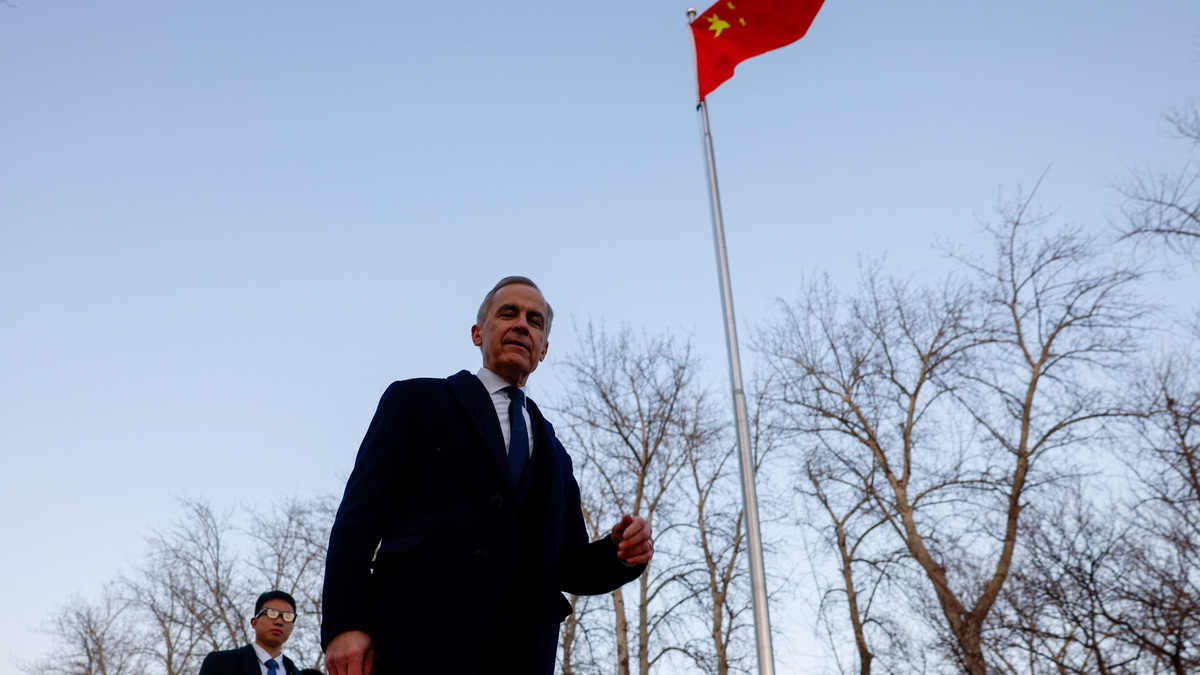
 "Mark Carney is making the first visit to China by a Canadian Prime Minister since 2017. Reuters")
Canada’s Prime Minister Mark Carney on Friday announced that a ‘preliminary trade deal’ had been reached with China. Canada has vowed to import 49 000 electric vehicles (EVs) from China at reduced tariff rates of 6.1 per cent, while Beijing has said it will lower tariffs on its canola seed by 1 March. The two countries also signed a number of memorandums of understanding (MoUs) on energy, green technology, construction and culture.
Canada’s Prime Minister Mark Carney claimed a ‘new era’ is underway when it comes to the relationship between Beijing and Ottawa. Carney, who is currently on a four-day trip to China, is making the first visit to the country by a Canadian Prime Minister since 2017.
Ties between the countries had been at a low under the previous Canadian prime minister Justin Trudeau. Ties hit a nadir in 2018 when Ottawa arrested the daughter of the Huawei founder and Beijing retaliated by holding two Canadians on espionage charges.
The development is in the backdrop of both China and Canada witnessing increased tensions with America under the Donald Trump administration. Carney, prior to the trip, had said he was focused on building an economy that was less dependent on the United States “a time of global trade disruption”.
But what do we know about Carney’s trip? What did he get from China? Let’s take a closer look.
What we know about Carney’s trip
Carney’s four-day trip to Beijing began on Wednesday.Carney and his delegation met Chinese President Xi Jinping, China’s Premier Li Qiang and Zhao Leji, head of China’s legislature.
Carney brought several gifts including a spalted birch wood sculpture from BC, and a carving of a crane made from muskox horn “symbolising renewal, peace, partnership, and resilience,” according to the Prime Minister’s Office.
Carney and Xi previously met in South Korea in October on the sidelines of the Asia-Pacific Economic Cooperation summit in Gyeongju, South Korea. Xi at the time had said he wanted to restart bilateral cooperation and “make up for lost time”.
Carney on Friday praised the “new strategic partnership” between the nations. “Together we can build on the best of what this relationship has been in the past to create a new one adapted to new global realities,” Carney said.
Carney said that engagement and cooperation would be “the foundation of our new strategic partnership”. “Agriculture, energy, finance, that’s where we can make the most immediate progress,” he added.
“It can be said that our meeting last year opened a new chapter in turning China-Canada relations toward improvement,” Xi responded. “The healthy and stable development of China-Canada relations serves the common interests of our two countries.”
“I look forward to continuing to work with you, with a sense of responsibility toward history, our peoples, and the world, to improve China-Canada relations further,” Xi told Carney.
“We’re heartened by the leadership of President Xi Jinping and the speed with which our relationship has progressed,” Carney told Zhao in a meeting in Beijing.
“It sets the stage for these important discussions on a wide range of issues where we can be strategic partners from energy to agriculture, to people-to-people ties, multilateralism, to issues on security.”
“Our teams have worked hard, addressing trade irritants and creating platforms for new opportunities,” Carney told Premier Li Qiang in a separate meeting. “I believe that together, we are bringing this relationship back toward where it should be.”
Carney on Friday evening will attend a gala dinner hosted by the Canada-China Business Council.
But what did Carney actually get from China?
Carney on Friday announced that a ‘preliminary trade deal’ had been reached by both nations. Canada has vowed to import 49 000 electric vehicles (EVs) from China at reduced tariff rates of 6.1 per cent — essentially on most-favoured-nation terms. Canada had previously placed a 100 per cent tariff on Chinese EVs under the Trudeau regime in 2024. Ottawa also put a 25 per cent tariff on Chinese steel and aluminium. China in 2023 had exported 41 678 EVs to Canada.
Trudeau had claimed that Chinese manufacturers had an unfair advantage in the global market because they were being subsidised by the state. This, he contended, threatened domestic EV makers in Canada.
“This is a return to levels prior to recent trade frictions, but under an agreement that promises much more for Canadians,” Carney told reporters in Beijing.
China is Canada’s second-largest trading partner after the United States. In 2024, trade between the two countries touched $84.9 billion (Rs 7.71 lakh crore). However, the US remains by far the biggest market for Canadian goods – buying as much as 75 per cent of them in 2024. China, meanwhile, purchased less than four per cent of Canadian exports in 2024.
Meanwhile, China will lower tariffs on its canola seed by 1 March, to a combined rate of about 15 per cent. Canada said China will also remove tariffs on its canola meal, lobsters, crabs and peas till the end of the year.
Canada is the world’s largest canola exporter. “This change represents a significant drop from current combined tariff levels of 84 per cent,” Carney said. He added that China was a $4 billion (Rs 36,328 crore) canola seed market for Canada. The deals will unlock nearly $3 billion (Rs 27,246 crore)) in export orders for Canadian farmers, fish harvesters and processors, Carney said.
China had imposed a 100 per cent tariff on Canadian canola oil and canola meal and a 25 per cent levy on pork and seafood. In August 2025, it further levied a 75.8 per cent tariff on canola seed. Canadian industry groups have complained that this effectively shut Canada out of China’s market. China’s tariffs resulted in 10.4 per cent fewer Canadian goods being imported.
As per reports, Carney during his meeting with Li signed a number of memorandums of understanding including on energy, crime, construction, culture, food safety, and plant and animal health. One of the MoUs vowed to boost exports of Canadian oil and to increase imports of Chinese green energy technology. In 2024, Canada sent just two per cent of its oil exports to China.
Carney also met several Chinese CEOs including from investment firm Primavera Capital Group, battery maker CATL, state-owned China National Petroleum Corporation, Alibaba Group, and tech company Envision Group.
“We will double non-US trade over the next 10 years. That means we are cognisant of that fact that the global economic environment has fundamentally changed and that Canada must diversify its trading partners,” Canadian Foreign Affairs Minister Anita Anand said in Beijing on Thursday. “The conversation has been productive. Prime Minister Carney is here to recalibrate the Canada-China relationship.”
Carney may already have made a significant start on doing so.
With inputs from agencies